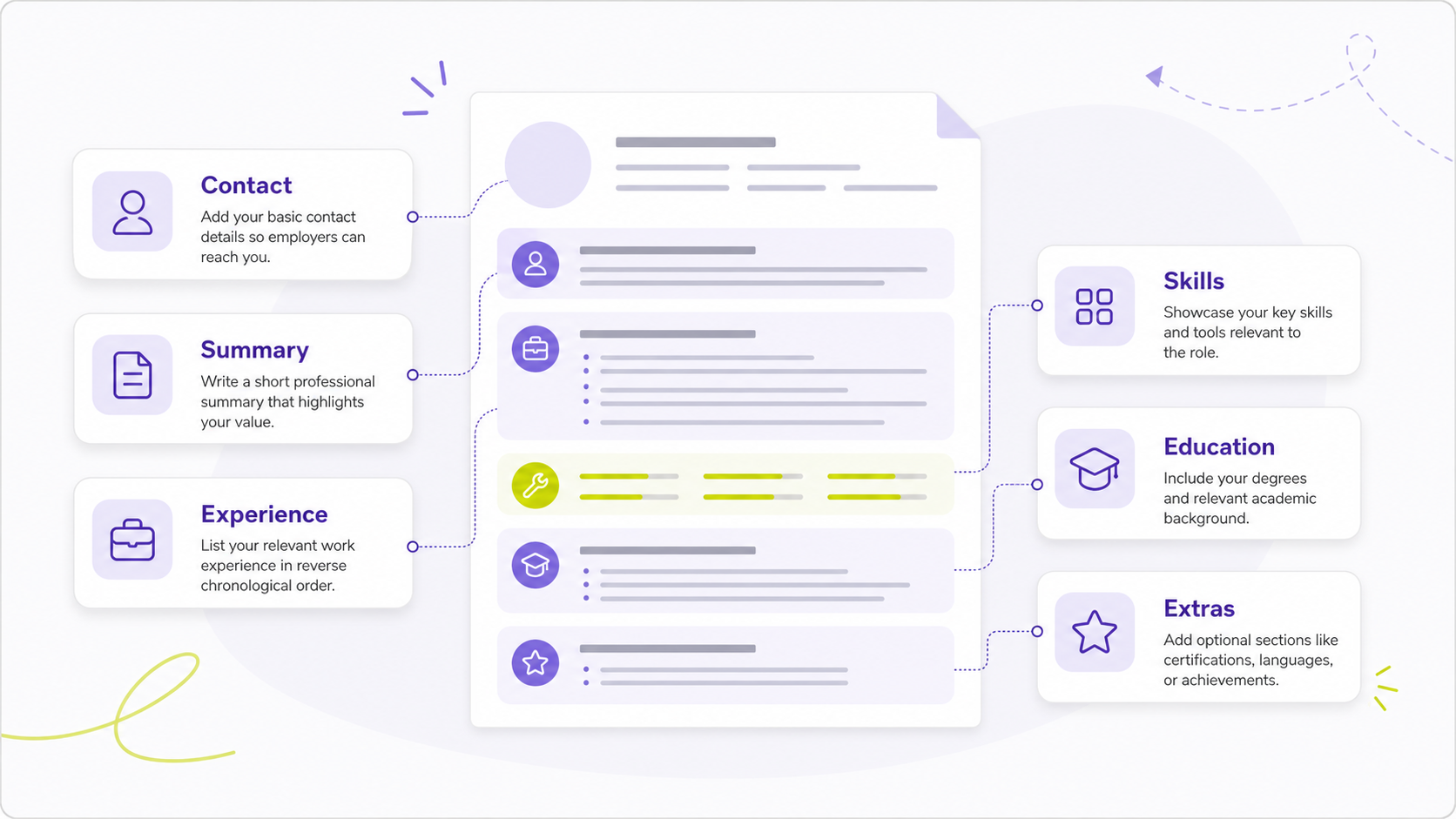
The main resume sections are contact information, a summary or headline, work experience, education, and skills. Depending on your background, you may also add projects, certifications, licenses, awards, languages, volunteer work, publications, or professional memberships.
The rule is simple: every section should earn its spot. Keep a section if it proves you can do the job, reduces risk for the hiring team, or makes your resume easier to scan. Cut it if it adds noise, repeats stronger evidence, or pushes relevant proof lower on the page.
If you are rebuilding your resume from scratch, you can use the Himalayas AI resume builder once you know which sections you need.
Required Resume Sections
Most resumes need these five sections:
| Resume section | What it should do | Common label |
|---|---|---|
| Contact information | Tell employers who you are and how to reach you. | Contact |
| Summary, headline, or objective | Position you for the role in one short scan. | Summary, Headline, Objective |
| Work experience | Prove relevant responsibility, scope, and outcomes. | Experience, Work Experience, Professional Experience |
| Education | Show degrees, credentials, or training that matter for the role. | Education |
| Skills | Surface relevant tools, technical skills, languages, and role-specific capabilities. | Skills, Technical Skills |
Contact information should include your name, email address, phone number, location, and a relevant LinkedIn, portfolio, GitHub, or personal site if it helps. You usually do not need your full street address.
Your top positioning section can be a summary, headline, or objective. Use a resume summary if you have experience to summarize. Use a resume objective if you are changing paths, entering the workforce, or explaining the role you are targeting. Use a resume headline when you want a tight title line under your name.
Your experience section should carry most of the proof. Use bullets that show what you did, how you did it, and what changed. If your bullets feel like duties, use the guide on writing resume bullet points and add scope or outcomes where you can.
Optional Resume Sections and When to Use Them
Optional sections are useful when they add proof that your required sections do not show clearly enough.
| Optional section | Use it when | Skip it when |
|---|---|---|
| Projects | Projects prove relevant skills, especially for technical, creative, analytical, product, student, or career-change resumes. | The projects are old, unrelated, or weaker than your work experience. |
| Certifications and licenses | The role requires or values a credential, license, security clearance, or tool certification. | The credential is expired, basic, or unrelated to the job. |
| Awards and achievements | Awards prove excellence, credibility, or impact in a relevant field. | They are personal, dated, or disconnected from the role. |
| Languages | Language ability matters for the job, customers, market, or team. | You only know a few phrases or the role has no language requirement. |
| Volunteer work | It proves leadership, community work, transferable skills, or fills an experience gap. | It crowds out stronger paid experience. |
| Publications and presentations | They matter in academia, research, policy, science, consulting, writing, or thought-leadership roles. | They are unrelated or too minor for the target role. |
| Professional memberships | Membership signals industry involvement, accreditation, or professional standing. | It is a passive membership that adds no credibility. |
| Hobbies and interests | They show relevant skills, culture fit, or unusual distinction. | They are generic, polarizing, or included only to fill space. |
Projects deserve special attention. If you are applying for software, data, design, product, marketing, research, or early-career roles, a projects section can be stronger than a thin experience section. Put the most relevant projects near the top when they show the skills the employer is actually hiring for.
Resume Sections to Leave Off
Some sections create friction instead of helping. Remove or move these off the resume unless the employer specifically asks for them:
- References or "references available upon request." Employers know they can ask later.
- Salary history or salary expectations. Handle compensation in the application or interview process.
- Full street address. City, state, country, or remote-work location is usually enough.
- Photo, date of birth, marital status, religion, or other personal details that are not job qualifications.
- Generic hobbies such as reading, music, or travel unless they connect to the role.
- High school details once you have stronger college, training, or work experience.
- Old coursework, expired tools, and outdated software that make your resume look stale.
The hardest section to cut is often the one you personally like. Use the employer test: would this help a hiring manager decide you are qualified for this specific role? If not, cut it or move it to LinkedIn.
Best Resume Section Order by Situation
There is no single best order for every resume. The best order puts the strongest job-relevant evidence where a recruiter or hiring manager will see it first.
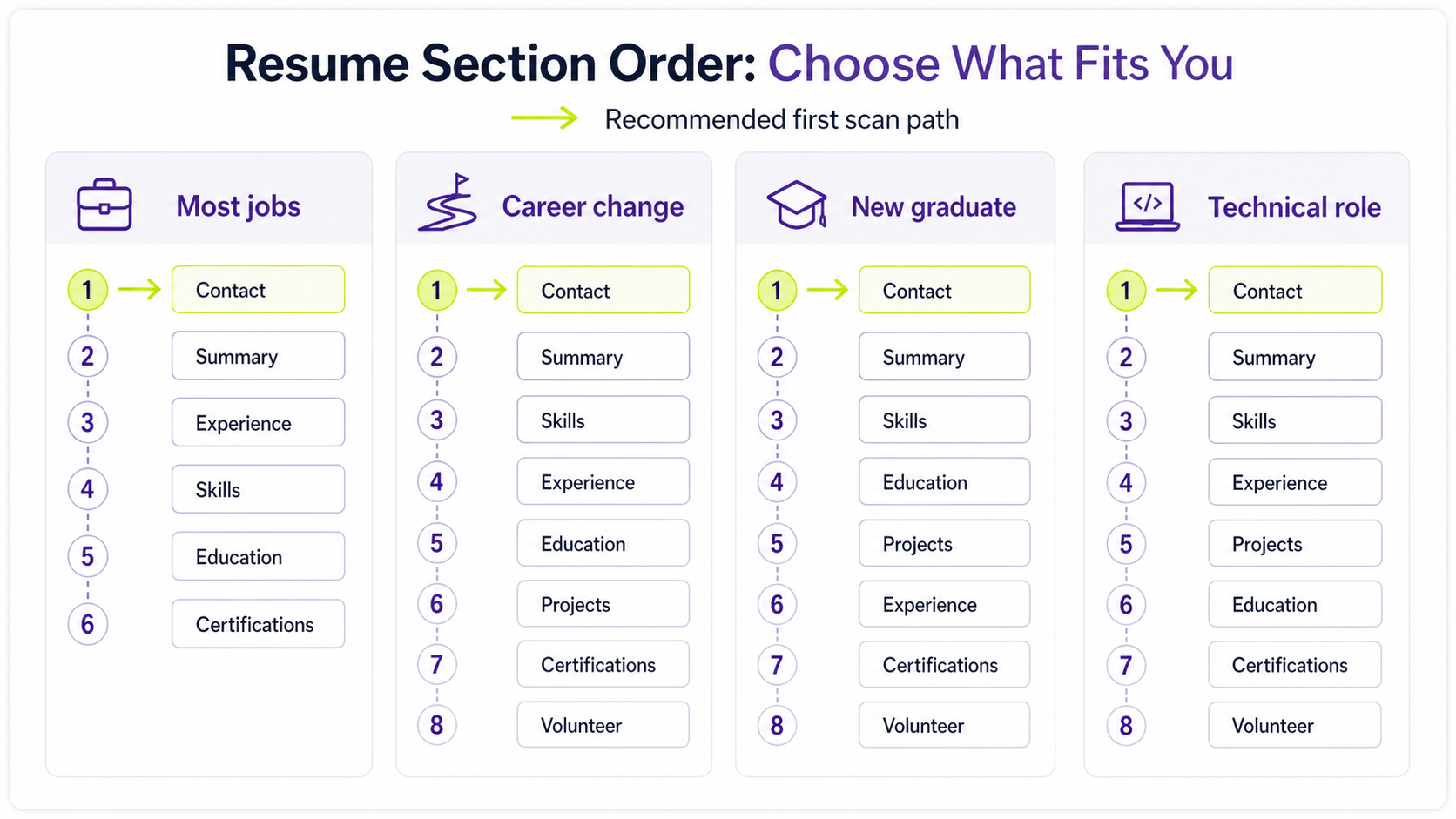
Use the first third of the resume as your proof window. After your name and contact details, a reader should quickly see your target role, the strongest reason you fit, and the section that best proves it. For most experienced candidates, that is work experience. For a new graduate, it may be education and projects. For a technical candidate, it may be skills followed by experience or projects.
| Situation | Recommended section order | Why it works |
|---|---|---|
| Most jobs | Contact, summary or headline, experience, skills, education, optional sections | Recent relevant experience is usually the strongest proof. |
| Career change | Contact, summary/objective, skills, relevant projects, experience, education, certifications | The top must explain the pivot and show transferable evidence quickly. |
| New graduate | Contact, summary/objective, education, projects, skills, experience, volunteer, certifications | Education and projects may be stronger than short work history. |
| Technical role | Contact, headline/summary, technical skills, experience, projects, education, certifications | Tools and technical proof need to be visible early. |
| Limited experience | Contact, objective, education or training, projects, volunteer work, skills, part-time experience | The resume should lead with the strongest available proof, not an empty work-history section. |
Reverse chronological order still works inside most sections. List your most recent role, degree, or project first unless an older item is clearly more relevant and deserves a short "Selected Projects" or "Relevant Experience" section.
What to Put in Each Resume Section
Use clear labels and concise content. A section should help the reader answer a specific question.
Contact
Include:
- Name
- Phone
- City/state/country or remote location
- LinkedIn, portfolio, GitHub, or personal site if relevant
Make sure links work and email addresses look professional.
Summary, Headline, or Objective
Use this section to position yourself, not to repeat buzzwords. A useful summary might include your role, years or depth of experience, domain, strongest skills, and one proof point.
Weak:
Hardworking professional seeking a challenging role where I can grow.
Stronger:
Customer success manager with 6 years of SaaS experience across onboarding, renewal risk, and expansion support for mid-market accounts.
Experience
For each role, include:
- Job title
- Company
- Location or remote status, when relevant
- Dates
- 3-6 bullets focused on responsibility, scope, tools, and outcomes
If possible, quantify resume achievements with volume, scale, time, money, quality, customer, or efficiency metrics. If you do not have exact numbers, add truthful context such as team size, customer type, project scope, or cadence.
Education
Include degrees, institutions, fields of study, graduation dates or expected dates, and honors when relevant. Put education above experience when you are a student, recent graduate, or applying to a role where the credential is the main qualification. Put it below experience when your work history is stronger.
Skills
The skills section should make your resume easier to scan, but it cannot replace proof. Include job-relevant tools, technical skills, methods, languages, and domain skills. Then make sure those skills appear naturally in your experience or projects.
For a deeper pass, use the guide on how to list skills on a resume.
Projects
For each project, include the project name, your role, the tools or methods used, and the outcome. Link to a portfolio, GitHub repository, case study, or live project when it helps the employer inspect the work. Keep projects short unless they are stronger than your formal work history.
Certifications and Licenses
Include the credential name, issuing organization, and date earned or expiration date when relevant. Put licenses higher when they are required for the job. Move older or lower-value certificates below experience or leave them off.
Awards, Languages, Volunteer Work, and Publications
Use these sections when they add proof the employer cares about. Awards should show relevant excellence, languages should include proficiency level, volunteer work should show transferable responsibility, and publications should be relevant to the role or field. If a section does not add evidence, remove it or fold the strongest item into another section.
ATS-Safe Resume Section Labels
Applicant tracking systems and recruiters both rely on familiar headings. Creative section labels can hide your evidence.
Use clear labels such as:
- Contact
- Summary
- Experience
- Work Experience
- Education
- Skills
- Projects
- Certifications
- Volunteer Experience
- Publications
Avoid labels that are clever but unclear:
- Where I have been
- My toolbox
- Wins
- Learning journey
- Things I care about
Those labels may look friendly, but they make scanning harder. If you want personality, put it in your examples and achievements, not in section names that obscure the content.
For formatting and parsing details, read how to make an ATS-friendly resume and the resume format guide.
Common Resume Section Mistakes
The most common section mistake is adding too much. A resume with ten small sections can feel less impressive than a resume with five strong ones.
Watch for these problems:
- Your skills section lists abilities that never appear in experience or projects.
- Your summary says the same thing as your headline.
- Your achievements section repeats bullets already listed under each job.
- Your education section sits above stronger recent experience.
- Your projects section includes work that is less relevant than your professional experience.
- Your optional sections push job-relevant proof onto page two.
- Your section labels are too creative for quick scanning.
If your resume is not getting interviews and you are not sure why, use the AI resume review guide or the diagnostic guide on resume mistakes to avoid.
How to Choose Your Resume Sections
Before you send a resume, ask five questions:
- Does the first half of page one show the role I am targeting?
- Does every section prove fit, reduce risk, or improve scanability?
- Are my strongest examples easy to find in under 10 seconds?
- Are optional sections helping, or are they pushing stronger evidence down?
- Would each section still make sense if a recruiter searched for the job's most important keywords?
If the answer is no, revise the section order before rewriting every bullet. Often the issue is not that your resume lacks content. It is that the right content is buried.
After you choose the right sections, build the resume around the job you want. The Himalayas AI resume builder can help you turn those sections into a clean, structured resume, and the guide on tailoring your resume to a job description shows how to adapt the content for each role.
Resume Sections FAQ
What are the five main sections of a resume?
The five main resume sections are contact information, a summary or headline, work experience, education, and skills. Many resumes also include projects, certifications, awards, languages, volunteer work, or publications when those sections add relevant proof.
What section should come first on a resume?
Contact information comes first. After that, use a summary, headline, or objective. The next section should be your strongest job-relevant evidence, usually experience, but sometimes education, skills, or projects.
Should projects be a separate resume section?
Use a separate projects section when projects prove skills that your work history does not show clearly. This is common for technical roles, new graduates, career changers, freelancers, and portfolio-driven roles.
Should references be on a resume?
No, references usually do not belong on a resume. Prepare a separate reference list and share it when an employer asks.
Is a resume summary required?
A resume summary is not required, but it is useful when it quickly clarifies your role, level, specialty, and strongest proof. If your summary is generic, replace it with a sharper headline or remove it.