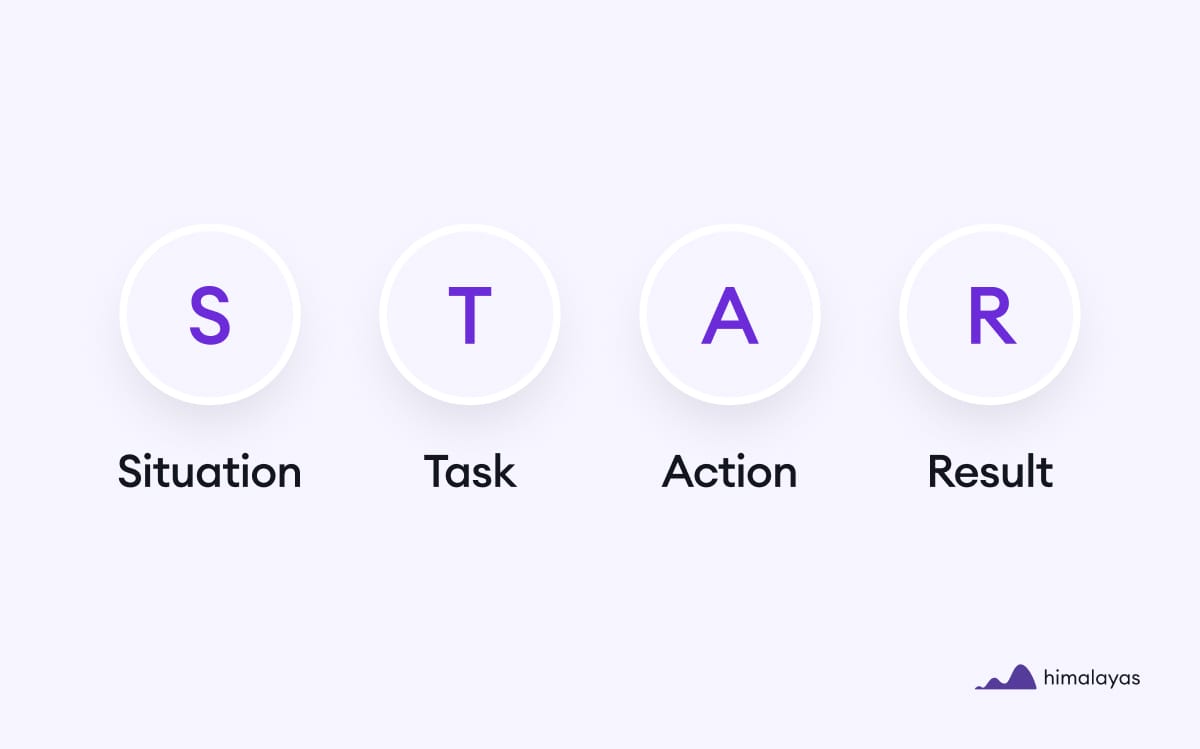
STAR means Situation, Task, Action, and Result. In an interview, the STAR method helps you answer behavioral and situational questions with a clear story: what was happening, what you were responsible for, what you did, and what changed because of your actions.
Use STAR when an interviewer asks for an example, such as "Tell me about a time you handled conflict" or "Describe a time you solved a difficult problem." The goal is not to recite a script. The goal is to give the hiring team specific evidence that you can do the work.

What does STAR mean in an interview?
STAR is an acronym for four parts of an interview answer:
| STAR part | What it means | What the interviewer should learn |
|---|---|---|
| Situation | The context around your example. | What was happening and why it mattered. |
| Task | Your responsibility, goal, or problem to solve. | What you owned or needed to accomplish. |
| Action | The specific steps you personally took. | How you think, communicate, decide, and follow through. |
| Result | The outcome, metric, decision, lesson, or impact. | Whether your actions worked and what you learned. |
The STAR method is most useful for behavioral interview questions, because those questions ask how you acted in a real past situation. It also works for situational questions when you need to explain how you would approach a realistic scenario, but real examples are stronger whenever you have them.
Think of STAR as a structure, not a personality test. A strong answer still needs judgment, honesty, and relevance to the role.
What each part of STAR should do
Most weak STAR answers spend too much time on the setup and not enough time on the candidate's action. Use this balance as a rule of thumb:
| STAR part | Time to spend | What to include | What to avoid |
|---|---|---|---|
| Situation | 10-20% | Enough context to understand the stakes. | Company history, team drama, or every background detail. |
| Task | 10% | Your goal, responsibility, constraint, or target. | Repeating the situation in different words. |
| Action | 50-60% | The steps you took, decisions you made, and people you influenced. | Saying only "we" did something without explaining your role. |
| Result | 20% | Metric, outcome, business impact, customer impact, lesson, or next step. | Ending with "and it went well" without proof. |
For a 90-second answer, that might mean 15 seconds of Situation, 10 seconds of Task, 45 seconds of Action, and 20 seconds of Result.
Interviewers are usually listening for three things: whether your example is relevant, whether your personal contribution is clear, and whether the result proves the skill they asked about.
When to use the STAR method
Use STAR when a question asks for a story or proof. Common question openings include:
- "Tell me about a time when..."
- "Give me an example of..."
- "Describe a situation where..."
- "How have you handled..."
- "What would you do if..."
- "Have you ever..."
Do not force STAR into every interview question. For tell me about yourself, use a concise career summary. For "Why do you want this job?", connect company research, role fit, and motivation. For salary, availability, logistics, and basic yes/no questions, answer directly.
If you are preparing for a full interview, use STAR as one part of your broader job interview preparation checklist.

Build a STAR story bank before the interview
You cannot predict every behavioral question, but you can prepare a small set of flexible stories. Aim for 4 to 6 examples that prove different skills.
Start with the job description. Highlight the responsibilities, tools, outcomes, and traits that appear more than once. Then map each requirement to a story.
| Job requirement or competency | STAR story to prepare | Result proof to include |
|---|---|---|
| Lead cross-functional projects | A launch where you aligned product, sales, and support. | Deadline met, adoption improved, blockers removed, or revenue protected. |
| Handle conflict | A disagreement with a teammate, stakeholder, or customer. | Relationship repaired, decision made, customer retained, or process improved. |
| Work independently | A project you owned with limited direction. | Scope clarified, milestones hit, manager trust increased, or rework reduced. |
| Communicate remotely | An async handoff, documentation habit, or distributed-team process. | Faster decisions, fewer meetings, clearer ownership, or fewer missed details. |
| Learn quickly | A new tool, domain, or responsibility you picked up under pressure. | Ramp time shortened, output shipped, quality improved, or team dependency reduced. |
| Recover from mistakes | A mistake you owned and fixed. | Customer impact contained, prevention added, lesson applied, or trust rebuilt. |
Good STAR stories are reusable. One project can answer questions about leadership, ambiguity, communication, and conflict if you choose the right angle.
Before the interview, write each story as bullets. Do not memorize full paragraphs. Memorized answers often sound stiff, and they are harder to adapt when the interviewer asks a follow-up.
How to answer a question using STAR
Use this process when you hear a behavioral question:
- 1. Identify the skill behind the question.
- 2. Choose the story that best proves that skill.
- 3. Give one sentence of Situation.
- 4. Give one sentence of Task.
- 5. Spend most of the answer on your Action.
- 6. End with a concrete Result.
- 7. Pause so the interviewer can ask a follow-up.
Use this template:
| STAR part | Template |
|---|---|
| Situation | "In my last role, [brief context]." |
| Task | "I was responsible for [goal, problem, or constraint]." |
| Action | "I [specific action 1], [specific action 2], and [specific action 3]." |
| Result | "As a result, [measurable outcome, decision, customer impact, or lesson]." |
Here is the key: the Action section should use "I" more than "we." You can acknowledge the team, but the interviewer needs to understand what you personally did.
Weak: "We worked together and solved the issue."
Stronger: "I mapped the customer complaints, found that most came from one onboarding step, and proposed a new email sequence. I then worked with design to test the copy and shared the results with support."

STAR method examples
Use these examples as models, not scripts. Your answer should match your real experience and the job you want.
Example 1: Leadership
Question: "Tell me about a time you showed leadership."
Situation: "In my last role, our customer onboarding emails were inconsistent across regions, and new users were missing key setup steps."
Task: "I was asked to improve the onboarding flow before a product launch, even though I did not directly manage the regional teams."
Action: "I reviewed support tickets, grouped the most common setup problems, and created a shared onboarding checklist. I asked each regional lead to review the checklist for local requirements, then I ran a weekly launch-readiness meeting to remove blockers. I also created a short dashboard so support and product could see which issues were improving."
Result: "Within the first month, setup-related support tickets dropped by 28%, and the checklist became the default onboarding process for the next launch."
Why it works: the answer shows influence without authority, clear personal action, and a measurable result.
Example 2: Conflict
Question: "Tell me about a time you handled conflict at work."
Situation: "A designer and engineer on my team disagreed about whether to delay a feature because of accessibility concerns."
Task: "I needed to keep the launch moving while making sure we did not ship an experience that excluded users."
Action: "I asked each person to write down the risk they were most worried about and the smallest acceptable fix. I compared those notes with our launch criteria, then proposed a narrower release: ship the core feature on time, hold back the inaccessible interaction, and commit to a follow-up milestone. I documented the decision and owners so it did not become an ongoing argument."
Result: "We launched on schedule, avoided the accessibility issue, and added an accessibility review step to future release planning."
For deeper examples, use our guide to answering conflict interview questions.

Example 3: Mistake
Question: "Tell me about a time you made a mistake."
Situation: "Early in a reporting project, I sent a weekly metrics summary before checking that one dashboard filter had been updated."
Task: "I needed to correct the report quickly and prevent the team from making decisions from the wrong number."
Action: "I messaged the stakeholders, explained which metric was wrong, and sent the corrected report with a short note about the cause. Then I added a pre-send checklist and asked a teammate to review the filter logic for the next two reports."
Result: "The correction went out the same day, no planning decisions were affected, and the checklist caught two similar issues later that quarter."
Why it works: the answer owns the mistake, fixes the immediate problem, and shows prevention.
For more, read how to answer "Tell me about a time you made a mistake".
Example 4: Remote collaboration
Question: "Tell me about a time you worked well with a remote team."
Situation: "I joined a project with teammates in three time zones, and decisions were getting delayed because important context lived in meetings."
Task: "I needed to make the work easier to follow asynchronously without adding more calls."
Action: "I created a weekly written update with decisions, open questions, risks, and owners. I also moved routine approvals into comments and reserved meetings for tradeoffs that needed live discussion."
Result: "The team cut two recurring meetings, decisions were easier to trace, and the project hit the launch date without anyone needing late-night calls."
If you are applying for distributed roles, pair STAR stories with our remote job interview questions.

Common STAR interview questions to practice
Prepare stories for the question types most likely to appear in your interview:
| Competency | Questions to practice | Useful Himalayas guide |
|---|---|---|
| Leadership | "Tell me about a time you led a project." "How do you influence without authority?" | Behavioral interview questions |
| Conflict | "Tell me about a time you disagreed with a coworker." | How do you handle conflict? |
| Resilience | "Tell me about a time you failed." "What did you learn?" | Tell me about a mistake you made |
| Strengths | "What is your greatest strength?" "Give an example." | What is your greatest strength? |
| Weaknesses | "What is your greatest weakness?" "How are you improving?" | What is your greatest weakness? |
| Remote work | "How do you communicate remotely?" "How do you stay accountable?" | Remote job interview questions |
You do not need a different story for every question. You need enough stories to show range: achievement, conflict, mistake, collaboration, ambiguity, and learning.
How to sound natural, not scripted
STAR can sound robotic when candidates label every part out loud or memorize a full answer. You usually do not need to say "My Situation is..." or "The Task was..." unless the interviewer specifically asks for that structure.
Use these rules instead:
- Start with the point: "A good example is a customer onboarding project from last year."
- Keep the context short.
- Use plain language.
- Focus on your actions.
- Include one metric or concrete outcome.
- Stop after the result instead of adding a long explanation.
- Be ready for follow-ups.
If your answer feels too polished, convert it back into bullets. Practice from the bullets until the story sounds conversational.

How to use STAR on your resume
STAR can also help with resumes, but the format changes. Interview answers can use all four parts. Resume bullets usually compress the story into action and result:
Weak resume bullet: "Responsible for onboarding emails."
Stronger resume bullet: "Improved onboarding email sequence by analyzing support tickets and rewriting setup prompts, reducing setup-related support tickets by 28%."
For resume-specific examples, use our guide to creating a STAR method resume.

Common mistakes when using STAR
| Mistake | Why it hurts | Better approach |
|---|---|---|
| Spending too long on Situation | The interviewer waits too long for the proof. | Give only the context needed to understand the example. |
| Combining Situation and Task vaguely | Your responsibility is unclear. | State exactly what you owned or needed to accomplish. |
| Saying "we" for every action | The interviewer cannot evaluate your contribution. | Use "I" for your decisions, actions, and communication. |
| Ending without a result | The story feels unfinished. | Share a metric, decision, customer impact, lesson, or prevention step. |
| Choosing a story unrelated to the role | The answer may be good but not persuasive. | Map stories to the job description before the interview. |
| Memorizing a script | Follow-up questions become harder. | Memorize the story beats, not every sentence. |
| Forcing STAR into direct questions | You may sound evasive. | Answer direct questions directly, then add a brief example if useful. |
The safest test is simple: after your answer, the interviewer should know what happened, what you were responsible for, what you did, and why it mattered.

Practice STAR answers with Himalayas
The fastest way to improve a STAR answer is to practice it out loud against a real job posting.
Use this workflow:
- 1. Choose one job description from Himalayas remote jobs.
- 2. Highlight 5 to 7 competencies the role requires.
- 3. Build a story bank with one example for each major competency.
- 4. Run a timed practice round with Himalayas AI Interview.
- 5. Check whether your answer had a clear Situation, Task, Action, and Result.
- 6. Rewrite only the weakest part and practice again.
You can also run a mock interview with a friend, mentor, or coach. Ask them to score your answer on relevance, personal action, result strength, clarity, and follow-up readiness.

FAQ
What are the four parts of STAR?
The four parts are Situation, Task, Action, and Result. Situation sets context, Task explains your responsibility, Action describes what you did, and Result shows the outcome.
How long should a STAR answer be?
Most STAR answers should be about 60 to 120 seconds. If the answer is much shorter, you may not provide enough proof. If it is much longer, the interviewer may lose the thread.
Should I say "Situation, Task, Action, Result" out loud?
Usually no. Use the structure internally and answer naturally. It is fine to label the parts if an interviewer explicitly asks you to use STAR, but do not make the answer sound like a worksheet.
What if I do not have work experience?
Use examples from school, volunteering, internships, side projects, caregiving, clubs, sports, or community work. The example should still show a real responsibility, action, and result.
Can I use the same STAR story twice?
Yes, if it answers a different competency and you adjust the emphasis. A launch story might show leadership in one answer and conflict resolution in another. Do not repeat the exact same answer without adapting it.
Is STAR only for behavioral interviews?
STAR is best for behavioral interviews, but it can also help with situational and competency questions. Use it when the interviewer wants proof through an example.

Find remote jobs and practice your answers
Himalayas helps you find remote jobs and prepare for interviews with better context. Browse remote jobs, research remote companies, and use Himalayas AI Interview to practice STAR answers before the real conversation.
For best results, practice with a real job description. The closer your story bank is to the role, the easier it is to answer behavioral questions with confidence.