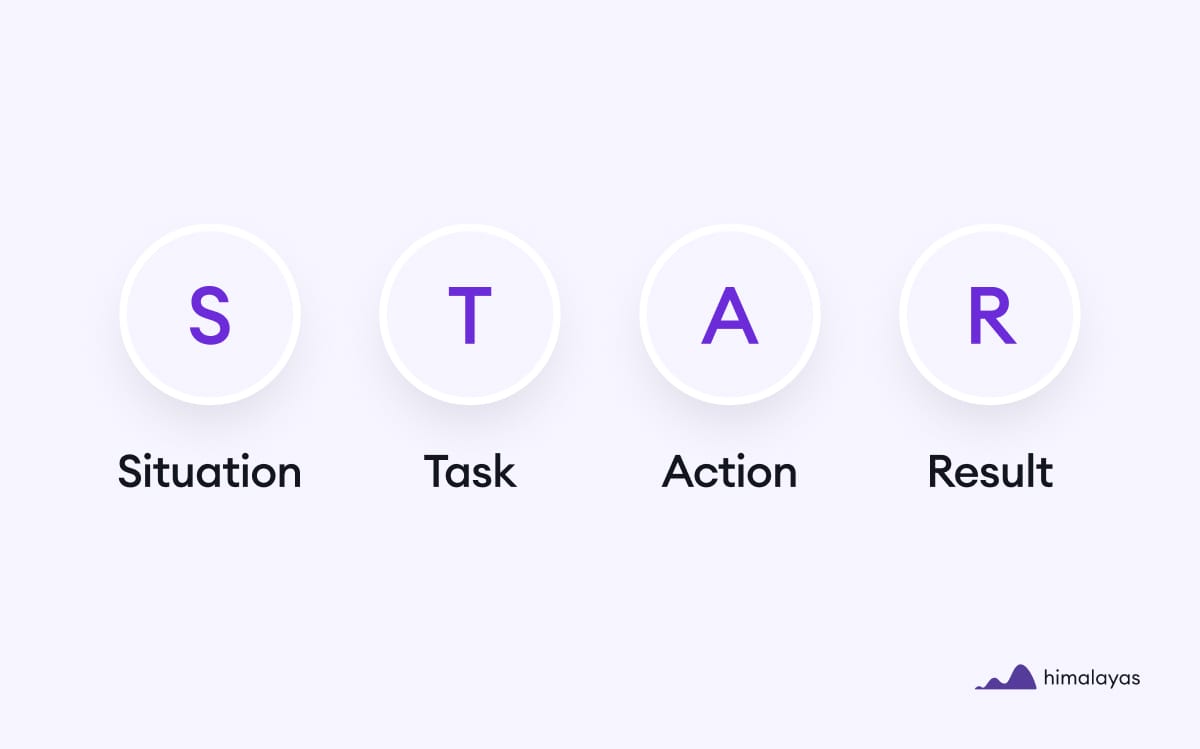
A STAR method resume turns plain job duties into proof of impact. STAR stands for Situation, Task, Action, and Result, but on a resume you usually compress the Situation and Task so the recruiter can see the Action and Result quickly.
Use this formula for most STAR resume bullets:
| Resume bullet formula | What it does |
|---|---|
| Action verb + what you improved + how you did it + measurable result | Shows what changed because of your work. |
For example, instead of writing "Handled customer onboarding," write: "Improved new-customer activation by 18% by rebuilding onboarding emails and training 12 account managers on the new workflow."
That sentence still has STAR: the situation was weak activation, the task was improving onboarding, the action was rebuilding the workflow, and the result was an 18% increase.

What is a STAR method resume?
A STAR method resume is a resume that uses specific accomplishments instead of generic responsibilities. It helps hiring managers understand the context of your work, what you owned, what you did, and what changed afterward.
STAR is most famous as a framework for answering behavioral interview questions, but it works on resumes because hiring teams scan for evidence. A stronger bullet does not just say you were "responsible for reporting." It shows the reporting problem, your contribution, and the business result.
The key difference is length. In an interview, a STAR answer can take a minute or two. On a resume, a STAR bullet should usually fit in one or two lines. You do not need to label each part with "Situation," "Task," "Action," and "Result." You need the reader to see the impact.
What does STAR stand for on a resume?
| STAR element | Interview version | Resume version |
|---|---|---|
| Situation | Explain the background. | Include only the context the recruiter needs. |
| Task | Explain your goal or responsibility. | Combine it with the situation when possible. |
| Action | Describe what you did. | Lead with a strong action verb and your specific contribution. |
| Result | Explain the outcome and what you learned. | End with a number, scope, customer impact, time saved, quality improvement, or other concrete result. |
Resume bullets usually put the action first because recruiters scan quickly. The situation and task are still there, but they are often implied by the role, team, project, or metric.
Weak bullet:
- Responsible for onboarding new customers.
STAR resume bullet:
- Increased new-customer activation by 18% by redesigning onboarding emails, adding product-use checkpoints, and training 12 account managers on the new process.
When should you use STAR on a resume?
Use STAR for the bullets that must prove you can do the job. You do not need every bullet on your resume to be a complete STAR story.
Prioritize STAR for:
- Your top 2-3 achievements under each recent role.
- Projects that prove a required skill from the job description.
- Leadership, process improvement, revenue, cost-saving, customer, operations, engineering, design, research, or cross-functional work.
- Entry-level projects, internships, volunteer work, or coursework where the outcome proves capability.
Use simpler bullets for:
- Tools, systems, certifications, or recurring duties that do not need a story.
- Older roles where space is limited.
- Context bullets that make your strongest achievements easier to understand.
Two-line bullets are fine when the achievement is strong. A recruiter would rather read a clear two-line result than a compressed one-line bullet that hides the point. As a rule, aim for 15-25 words, and let your strongest bullets run a little longer only when the result is worth it.
How to write STAR resume bullet points
Start with the job you want, not the job you had. The best STAR resume bullets connect your past accomplishments to the employer's current needs.
- 1. Read the job description and underline the outcomes the employer cares about.
- 2. Pick accomplishments that prove those outcomes.
- 3. Write the long STAR version in notes.
- 4. Compress the situation and task into context.
- 5. Lead the resume bullet with the action and result.
If you need help finding the right language, use the Himalayas AI resume builder to draft role-specific bullets, then edit each one until the claim is accurate and defensible. Pair that with resume action verbs and a quick pass on how to quantify resume achievements so the final bullet is specific without sounding inflated.

Step 1: Choose the right accomplishment
Good STAR bullets usually come from moments when something changed:
- Revenue increased.
- Costs decreased.
- A process became faster.
- A customer problem was solved.
- A team shipped something difficult.
- Quality, reliability, retention, engagement, or adoption improved.
- You handled a hard situation with judgment.
If nothing changed, it may still be a useful resume bullet, but it may not need the full STAR treatment.
Step 2: Write the long STAR version first
Draft the full story before compressing it:
| STAR element | Notes |
|---|---|
| Situation | Customer onboarding completion had dropped after a product redesign. |
| Task | Improve activation without adding headcount. |
| Action | Rebuilt onboarding emails, added product-use checkpoints, and trained account managers. |
| Result | Activation improved 18% in one quarter. |
Step 3: Compress it into a resume bullet
Now turn the notes into one recruiter-readable line:
- Improved new-customer activation by 18% in one quarter by rebuilding onboarding emails, adding product-use checkpoints, and training 12 account managers.
The bullet does not spell out every STAR label. It does not need to. It shows context, action, and result.
STAR resume examples
Use these examples as patterns, not scripts. The best version uses your real scope, tools, and outcomes.

| Situation | Weak bullet | STAR resume bullet |
|---|---|---|
| Customer success | Helped customers adopt the product. | Increased feature adoption from 42% to 61% by creating onboarding playbooks and coaching 9 customer success managers on account-specific rollout plans. |
| Marketing | Managed email campaigns. | Generated 1,800 qualified trial signups by segmenting lifecycle emails, testing 6 subject-line variants, and aligning offers to product-use milestones. |
| Operations | Improved internal processes. | Cut invoice processing time by 35% by mapping approval delays, automating reminders, and standardizing vendor intake forms across 4 departments. |
| Engineering | Worked on site performance. | Reduced checkout page load time by 48% by lazy-loading noncritical scripts and removing unused dependencies from the payment flow. |
| Entry level | Helped with a research project. | Analyzed 240 survey responses and summarized 5 customer pain points that shaped the final product-research presentation. |
| Project work | Built a dashboard. | Built a weekly revenue dashboard used by 14 managers, reducing manual reporting time by 6 hours per week. |
| Remote work | Collaborated with a distributed team. | Coordinated release notes across 5 time zones by creating an async review process that cut final approval time from 4 days to 36 hours. |
STAR resume summary example
Use STAR lightly in a resume summary. The summary should not become a paragraph of stories, but it can name your strongest result.
Before:
- Customer success manager with experience onboarding SaaS customers and improving adoption.
After:
- Customer success manager who increased new-customer activation by 18% and reduced onboarding escalations by 22% through lifecycle email improvements, account-manager training, and product-use checkpoints.
STAR project example
Projects can use STAR when they prove skills that your paid work does not yet show.
- Built a portfolio analytics dashboard for 3 student investment teams by cleaning public market data, creating reusable Python notebooks, and reducing weekly reporting prep from 5 hours to 90 minutes.
Full STAR method resume example
Here is a modern example that uses STAR bullets without labeling every part.

Maya Chen Customer Success Manager Sydney, Australia | maya.chen@example.com | linkedin.com/in/mayachen
Summary Customer success manager with 6 years of SaaS experience. Increased customer activation by 18%, reduced onboarding escalations by 22%, and improved renewal forecasting accuracy across a 70-account book of business.
Experience
Senior Customer Success Manager, Atlas Analytics Remote | March 2022-Present
- Increased new-customer activation by 18% in one quarter by rebuilding onboarding emails, adding product-use checkpoints, and training 12 account managers.
- Reduced onboarding escalations by 22% by creating a risk-scoring process for accounts with low setup completion.
- Improved renewal forecast accuracy from 71% to 86% by standardizing account health inputs and reviewing expansion risks with sales leadership every month.
- Coached 4 new CSMs on discovery calls, account planning, and executive business reviews.
Customer Success Associate, Greenstack Melbourne, Australia | July 2019-February 2022
- Retained 94% of assigned small-business accounts by creating quarterly usage reviews and prioritizing outreach for customers with declining login activity.
- Shortened support handoff time by 30% by documenting the 20 most common onboarding issues and partnering with support leads on routing rules.
- Built a customer feedback tracker that grouped 350 product requests into 8 recurring themes for product and marketing teams.
Education
Bachelor of Commerce, University of Melbourne
Skills
Customer onboarding, renewal forecasting, account health scoring, executive business reviews, lifecycle email, Salesforce, Gainsight, HubSpot, SQL basics, async collaboration
Common STAR method resume mistakes
The STAR format is only useful when it makes your experience clearer. Avoid these mistakes.

| Mistake | Why it hurts | Better approach |
|---|---|---|
| Forcing STAR into every bullet | The resume becomes dense and repetitive. | Use STAR for your strongest achievements and simpler bullets for context. |
| Spending too many words on Situation | Recruiters may miss the result. | Keep context short and lead with action or impact. |
| Using inflated ownership verbs | Claims can sound unbelievable in interviews. | Choose verbs that match what you owned: led, built, supported, coordinated, analyzed, improved, contributed. |
| Leaving out the result | The bullet still reads like a responsibility. | Add a metric, scope, quality improvement, customer impact, or business outcome. |
| Making up metrics | False precision is risky. | Use defensible scope if you do not have a hard number, such as team size, user group, ticket volume, project duration, or process frequency. |
| Copying one example too closely | Your resume can sound generic. | Keep the structure, but use your real tools, teams, constraints, and outcomes. |
Before you publish the resume, check each STAR bullet against three questions:
- Can I explain exactly what I did?
- Can I defend the number or scope?
- Does this bullet match a requirement in the job description?
If the answer is no, revise it before applying. For more detail, use these guides on resume bullet points, resume keywords, and how to tailor your resume to the job description.
How to turn STAR resume bullets into interview answers
A strong STAR resume bullet should be easy to expand into an interview answer. That is one of the biggest advantages of writing this way: your resume becomes a shortlist of stories you can tell.

Take this resume bullet:
- Reduced onboarding escalations by 22% by creating a risk-scoring process for accounts with low setup completion.
Expand it for an interview:
| STAR element | Interview notes |
|---|---|
| Situation | Onboarding escalations were rising because some customers missed setup milestones. |
| Task | Identify at-risk accounts earlier and reduce escalations. |
| Action | Created a scoring process based on setup completion, login activity, and open support tickets. |
| Result | Escalations fell 22%, and account managers had a clearer weekly outreach list. |
Practice the expanded version before interviews, especially if the bullet supports questions about problem-solving, ownership, customer communication, leadership, or working under pressure. The Himalayas AI Interview tool can help you turn your resume bullets into realistic practice questions and tighten your spoken STAR answers.
STAR method resume FAQ
Should every bullet point use the STAR method?
No. Use STAR for your strongest achievement bullets. Most recent roles should have 2-3 STAR-style bullets, plus simpler bullets for tools, responsibilities, or context.
How long should a STAR resume bullet be?
Aim for 15-25 words. A strong bullet can run to two lines if the result is important, but avoid long story-like bullets.
What if I do not have numbers?
Use scope instead: number of customers, accounts, tickets, projects, people, markets, reports, workflows, or hours. You can also describe quality, speed, risk reduction, customer satisfaction, or stakeholder adoption.
Can entry-level candidates use STAR?
Yes. Use coursework, internships, volunteer projects, campus leadership, freelance work, or personal projects. Focus on what changed because of your work, even if the result is small.
Can STAR help with ATS?
STAR helps with substance, not formatting. To improve applicant tracking system readability, keep formatting simple and use role-relevant language from the job description. Read more about building an ATS-friendly resume.
Build a stronger resume with Himalayas
Use the Himalayas AI resume builder to turn responsibilities into STAR-style achievements, then edit the draft so every number, tool, and ownership claim is true. When the resume is ready, practice the same stories with Himalayas AI Interview and apply to relevant remote jobs with bullets you can defend.