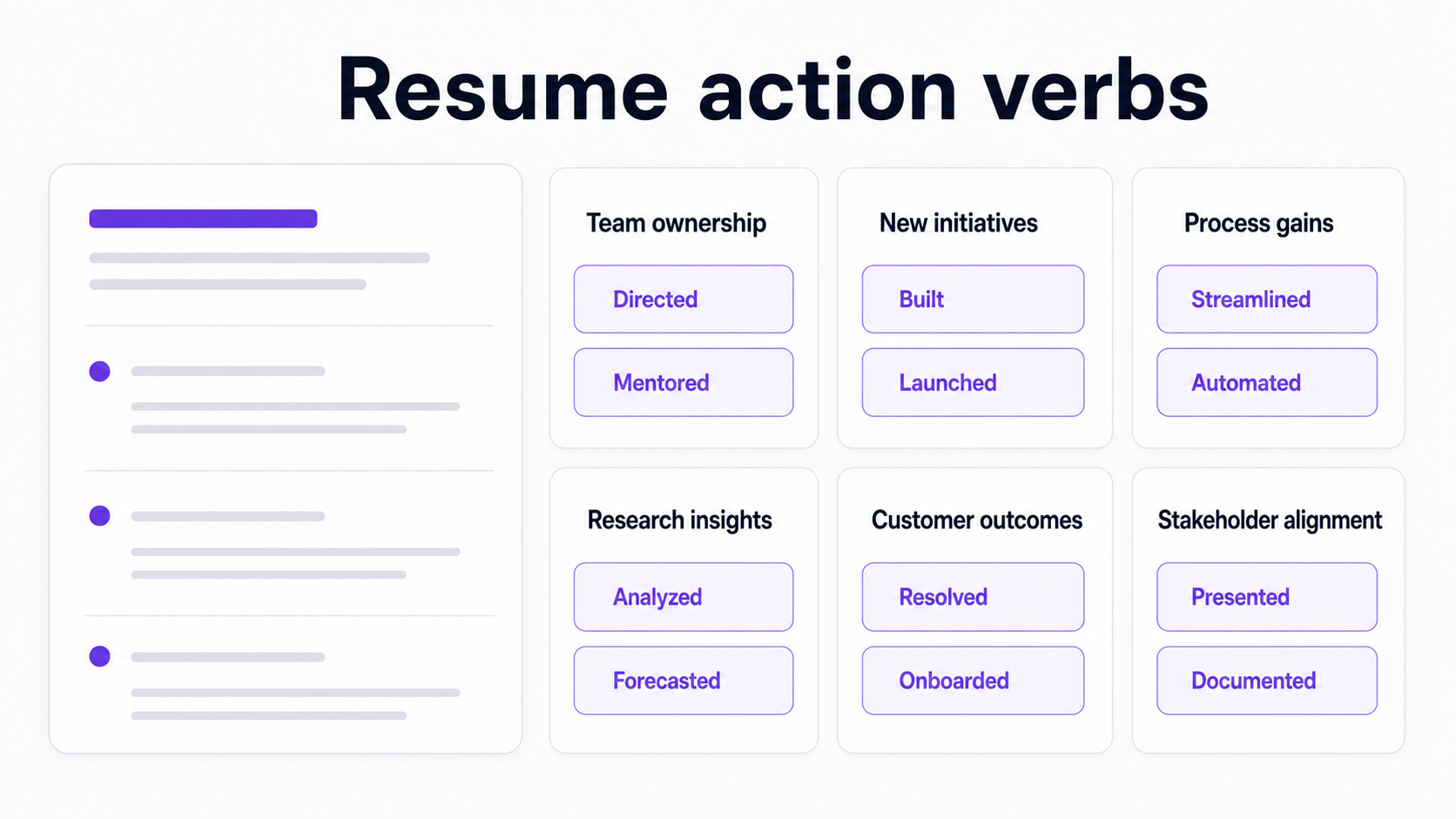
The best resume action verbs are specific verbs that show what you did: led, built, improved, analyzed, launched, streamlined, resolved, negotiated, trained, and delivered. Use them at the start of bullet points, then add the situation, task, action, and result behind the work.
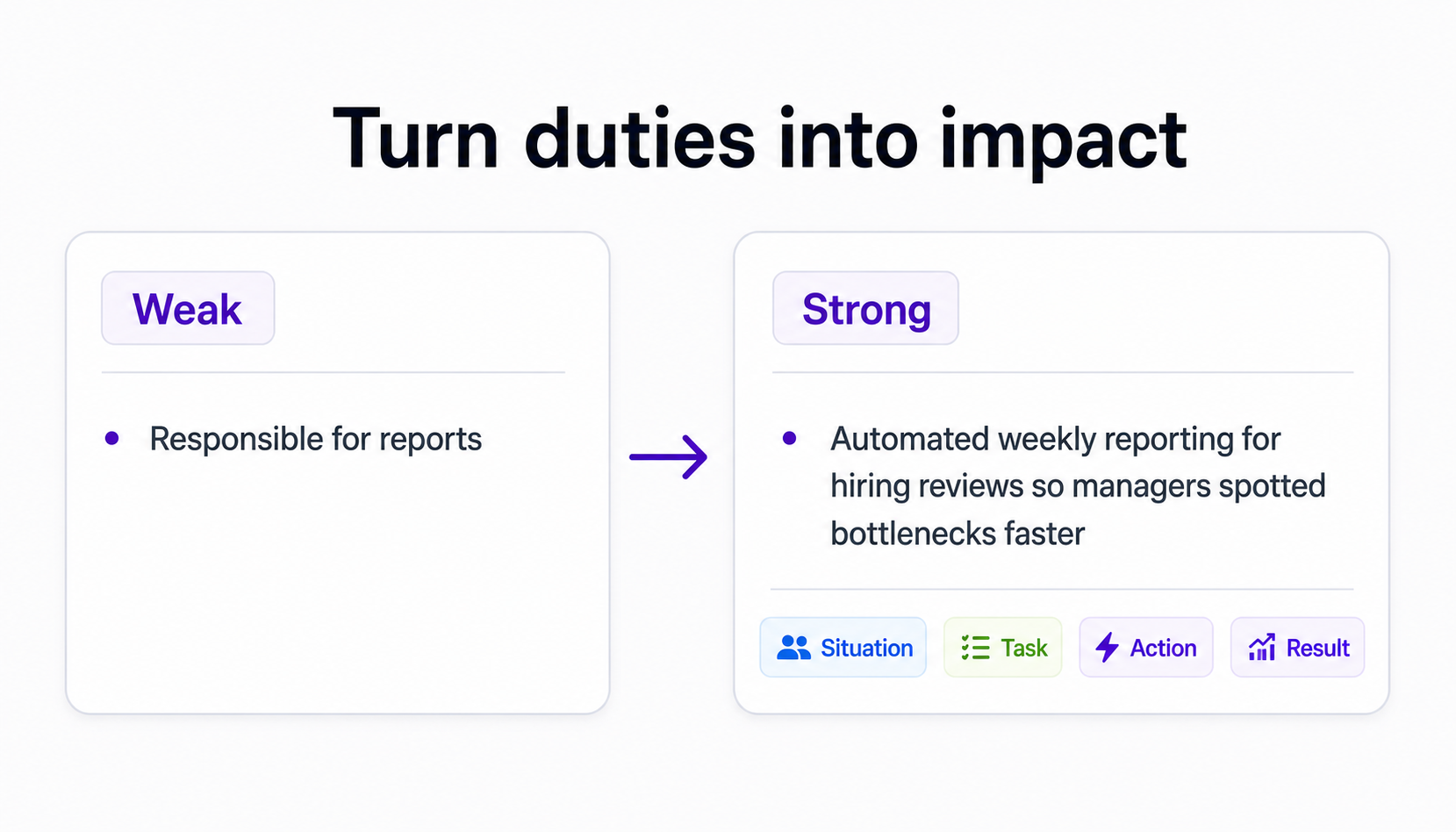
For example, replace "Responsible for reports" with "Automated weekly reporting for hiring reviews so managers spotted bottlenecks faster." The verb matters, but the proof around it matters more.
If you want help turning rough experience into stronger bullets, use the Himalayas AI resume builder after you choose the verbs that best describe your work.
How to use resume action verbs
Action verbs work because they make you the actor in the sentence. They move a bullet point from a passive duty to a clear contribution.
Use a compressed version of the STAR method for resumes:
| Part | What it answers | Example |
|---|---|---|
| Situation | What context was happening? | Remote hiring reviews were slow |
| Task | What work needed to happen? | Managers needed clearer weekly reporting |
| Action | What did you do? | Automated weekly reporting |
| Result | What changed? | Managers spotted bottlenecks faster |
A strong bullet usually compresses those four parts into one sentence: "Automated weekly reporting for remote hiring reviews so managers spotted bottlenecks faster."
Do not choose the most impressive-sounding verb first. Choose the verb that accurately describes the work. "Led" is right if you owned direction. "Coordinated" is better if you aligned people and deadlines. "Analyzed" is better if your value came from interpreting data.
Resume action verbs by category
Use the category closest to the work you actually did. Then tailor the rest of the bullet with details from the role, project, or job description.
| Category | Use when you want to show | Action verbs |
|---|---|---|
| Leadership and ownership | You guided people, decisions, or priorities | Led, directed, owned, chaired, guided, supervised, delegated, mentored, mobilized, aligned, unified, facilitated, shaped, sponsored, governed |
| Building and launching | You created something new | Built, created, designed, developed, launched, founded, initiated, introduced, engineered, established, implemented, deployed, prototyped, formalized, pioneered |
| Improving and optimizing | You made something better | Improved, optimized, streamlined, refined, simplified, modernized, upgraded, strengthened, standardized, accelerated, enhanced, transformed, revamped, automated, reduced |
| Analysis and research | You studied information and made decisions | Analyzed, researched, evaluated, audited, assessed, investigated, measured, forecasted, interpreted, modeled, diagnosed, tested, surveyed, quantified, identified |
| Communication and influence | You explained, persuaded, or documented | Presented, briefed, authored, wrote, documented, translated, clarified, persuaded, negotiated, advised, reported, edited, synthesized, communicated, promoted |
| Customer support and service | You helped users, clients, or customers | Supported, resolved, advised, coached, educated, fielded, triaged, de-escalated, consulted, guided, onboarded, served, responded, assisted, retained |
| Sales, growth, and partnerships | You won business or expanded reach | Sold, closed, acquired, generated, expanded, grew, converted, negotiated, partnered, secured, pitched, renewed, influenced, captured, increased |
| Technical and product work | You shipped technical or product outcomes | Programmed, architected, debugged, configured, integrated, migrated, automated, tested, released, maintained, refactored, monitored, scaled, documented, deployed |
| Operations and project management | You kept work moving | Coordinated, planned, scheduled, organized, executed, tracked, prioritized, administered, managed, delivered, allocated, reconciled, consolidated, controlled, maintained |
| Remote and cross-functional work | You worked across time zones, functions, or async systems | Coordinated, documented, aligned, facilitated, synthesized, unblocked, collaborated, clarified, escalated, standardized, communicated, organized, routed, reviewed, connected |
| Teaching and training | You helped others learn or perform | Trained, coached, taught, instructed, mentored, onboarded, developed, demonstrated, facilitated, educated, guided, prepared, enabled, assessed, supported |
| Creative and content work | You made creative work or improved messaging | Created, designed, produced, edited, scripted, published, illustrated, branded, storyboarded, composed, curated, photographed, filmed, refreshed, shaped |
Leadership action verbs
Use leadership verbs when you owned direction, made decisions, or helped other people do better work.
| Instead of | Try | Example bullet |
|---|---|---|
| Managed | Led, directed, supervised | Led a five-person support team through a new escalation process. |
| Helped | Mentored, coached, guided | Mentored three junior analysts on dashboard QA and stakeholder updates. |
| Was in charge of | Owned, governed, chaired | Owned monthly planning for a cross-functional product launch. |
| Worked with | Aligned, facilitated, mobilized | Aligned sales, product, and support teams around renewal priorities. |
Strong leadership bullets need more than a leadership verb. Add who you led, what changed, and how the work affected the team, customer, or business.
Action verbs for building, launching, and creating
Use these verbs when your work produced something new: a process, feature, campaign, report, playbook, system, partnership, or team.
Good verbs include built, created, designed, developed, launched, implemented, introduced, established, engineered, deployed, prototyped, and formalized.
Examples:
| Weak bullet | Stronger bullet |
|---|---|
| Worked on a new onboarding guide. | Created a new onboarding guide that gave remote hires one place to find setup steps, team norms, and first-week tasks. |
| Helped build dashboards. | Built hiring dashboards that gave recruiters weekly visibility into pipeline volume, response rates, and bottlenecks. |
| Was involved in a product launch. | Coordinated launch tasks across product, marketing, and support to keep release messaging consistent. |
If you are writing about software, product, operations, or remote work, be careful with "built." It is strong when you directly created the thing. If your role was coordination, use coordinated, implemented, documented, or supported instead.
Action verbs for improving results
Use improvement verbs when the point of the bullet is a better outcome: faster work, fewer errors, more revenue, higher retention, lower cost, better quality, or smoother operations.
| Outcome | Strong verbs |
|---|---|
| Faster process | Accelerated, streamlined, expedited, automated, simplified |
| Better quality | Improved, strengthened, refined, standardized, upgraded |
| Lower cost or waste | Reduced, consolidated, conserved, reconciled, optimized |
| More revenue or growth | Increased, expanded, generated, boosted, grew |
| Better customer or team experience | Enhanced, clarified, resolved, modernized, transformed |
Examples:
- Streamlined candidate follow-up templates to reduce manual recruiter updates.
- Reduced duplicate support tickets by clarifying help-center routing and response ownership.
- Improved sales handoff quality by standardizing account notes before implementation.
- Automated weekly reporting so managers could review trends without manual spreadsheet updates.
If you can quantify the result honestly, do it. The Himalayas guide to quantifying resume achievements can help you find numbers without inventing metrics.
Action verbs for analysis and research
Use analysis verbs when your contribution was understanding information, finding patterns, or turning data into a decision.
Strong options include analyzed, evaluated, audited, assessed, researched, investigated, measured, forecasted, modeled, diagnosed, tested, surveyed, quantified, and identified.
Weak bullets often say "looked at data" or "worked on reports." Strong bullets say what you analyzed and what the analysis changed.
| Weak bullet | Stronger bullet |
|---|---|
| Looked at customer data. | Analyzed customer feedback themes to identify onboarding steps that created repeated support questions. |
| Made reports for leadership. | Synthesized weekly pipeline data into leadership updates on hiring velocity and conversion risks. |
| Helped research competitors. | Researched competitor pricing pages to clarify packaging differences before a product messaging refresh. |
Use analyzed when you interpreted information. Use audited when you checked quality or compliance. Use forecasted when you projected future outcomes. Use diagnosed when you found the cause of a problem.
Action verbs for communication and collaboration
Communication verbs are useful when you wrote, presented, translated, persuaded, negotiated, documented, or aligned people around a decision.
Use:
- Presented for formal updates, demos, or recommendations.
- Documented for process notes, technical guides, handbooks, or decisions.
- Clarified when you made confusing requirements or expectations easier to act on.
- Negotiated when you worked through tradeoffs with customers, vendors, or stakeholders.
- Synthesized when you turned scattered information into a clear summary.
- Facilitated when you helped a group make progress.
Examples:
- Documented remote onboarding norms so new team members could find async communication expectations without asking managers.
- Presented quarterly customer insights to product and support leaders.
- Clarified ownership across sales and implementation to reduce handoff confusion.
- Synthesized user research notes into three product recommendations for the roadmap review.
For remote roles, communication verbs are often more important than they look. Remote teams value people who can document, clarify, align, and unblock without constant meetings.
Action verbs for customer support, sales, and service
Customer-facing bullets should show who you helped, what problem you solved, and what changed for the customer or business.
| Work type | Action verbs |
|---|---|
| Support | Resolved, triaged, de-escalated, responded, advised, guided, educated |
| Customer success | Onboarded, retained, consulted, renewed, expanded, trained, supported |
| Sales | Prospected, pitched, negotiated, closed, converted, generated, secured |
| Partnerships | Partnered, acquired, cultivated, coordinated, influenced, introduced, expanded |
Examples:
- Resolved customer billing questions by coordinating support, finance, and account ownership.
- Onboarded new customers through product setup, workflow configuration, and launch check-ins.
- Negotiated renewal terms with accounts at risk of churn.
- Generated qualified leads through targeted outreach and follow-up sequences.
Avoid vague phrases like "handled customers." A recruiter should be able to tell whether you solved problems, grew accounts, improved satisfaction, or simply responded to inbound requests.
Action verbs for technical, product, and operations work
Technical and operations verbs should stay accurate. Do not use "architected" if you configured a small workflow. Do not use "owned" if you supported someone else's project.
| Work | Good verbs |
|---|---|
| Software or systems | Programmed, architected, configured, debugged, integrated, migrated, refactored, monitored |
| Product delivery | Prioritized, scoped, tested, released, documented, launched, validated, iterated |
| Operations | Coordinated, scheduled, tracked, reconciled, maintained, standardized, administered |
| Process improvement | Automated, streamlined, simplified, consolidated, optimized, upgraded |
Examples:
- Integrated support ticket data with weekly product quality reporting.
- Debugged onboarding workflow errors that prevented users from completing setup.
- Prioritized backlog items with customer impact, engineering effort, and release timing in mind.
- Standardized project intake so stakeholders submitted clearer requirements before kickoff.
If you are tailoring a technical resume, pair action verbs with role-specific nouns from the job description. The Himalayas resume keywords guide explains how to do that without stuffing keywords awkwardly.
Weak resume verbs to replace
Some verbs are not wrong, but they are easy to overuse. Replace them when a more precise verb describes the work.
| Weak or overused phrase | Stronger alternatives |
|---|---|
| Responsible for | Owned, led, managed, coordinated, maintained, delivered |
| Helped | Supported, advised, assisted, guided, contributed, enabled |
| Worked on | Built, analyzed, coordinated, implemented, documented, improved |
| Handled | Resolved, processed, managed, triaged, administered, coordinated |
| Did | Created, completed, delivered, executed, produced, launched |
| Used | Applied, operated, configured, analyzed, monitored, implemented |
| Made | Created, designed, produced, developed, drafted, built |
| Learned | Trained in, adopted, applied, practiced, implemented, mastered |
You do not need to eliminate every simple verb. "Managed" and "supported" can be fine when they are accurate. The problem is using them without evidence.
Weak: "Managed social media." Stronger: "Managed the monthly social calendar for three product channels and coordinated creative handoffs with design."
Resume bullet examples using action verbs
Use these examples as patterns, not scripts. Change the nouns, scope, tools, and results so the bullet matches your real experience.
| Situation | Strong bullet example |
|---|---|
| Administrative work | Coordinated executive calendars, vendor paperwork, and meeting logistics across three time zones. |
| Customer support | Triaged inbound support tickets and escalated product bugs with clear reproduction steps. |
| Data analysis | Analyzed weekly conversion trends to identify where applicants dropped out of the hiring funnel. |
| Project management | Organized launch tasks, deadlines, and stakeholder updates for a cross-functional release. |
| Sales | Generated outbound pipeline through targeted research, personalized emails, and follow-up sequences. |
| Marketing | Created campaign briefs that aligned audience, message, channels, and launch timing. |
| Software engineering | Refactored legacy API endpoints to improve maintainability and reduce repeated support requests. |
| Product management | Prioritized roadmap items using customer impact, effort, and business value. |
| Recruiting | Screened inbound candidates and documented structured interview notes for hiring managers. |
| Remote collaboration | Documented async decision logs so teammates in different time zones could stay aligned. |
For a deeper bullet formula, use the Himalayas guide on how to write resume bullet points.
How to choose the right action verb for a job description
The right verb depends on the job you want, not just the job you had.
- Read the job description and highlight repeated responsibilities, tools, skills, and outcomes.
- Pick verbs that describe work you have actually done.
- Use nouns from the role when they are accurate: customers, pipeline, onboarding, APIs, dashboards, audits, campaigns, releases, tickets, or revenue.
- Add evidence: volume, frequency, team size, customer type, time frame, quality improvement, revenue, cost, speed, or risk reduction.
- Remove verbs that sound impressive but exaggerate your role.
If you want to identify the language that matters in a posting, use the Himalayas job description keyword finder, then rewrite your bullets with honest matching language.
Action verbs and ATS keywords
Action verbs can make your resume clearer, but they are not a substitute for relevant keywords. Applicant tracking systems and recruiters still look for the role's skills, tools, titles, certifications, responsibilities, and outcomes.
For example, "optimized" is useful, but it is not enough on its own. A stronger bullet might include what you optimized: "Optimized SQL queries for customer reporting dashboards." That bullet gives both the action and the searchable context.
Use action verbs with:
- Role-specific tools and technologies.
- Skills that appear in the job description.
- Clear section headings.
- Measurable achievements.
- Plain, readable formatting.
For the broader setup, read the Himalayas guide to making an ATS-friendly resume. If you need examples by role, browse the free resume examples and templates and adapt the structure without copying someone else's experience.
Resume action verb checklist
Before you send your resume, check each bullet:
- Does the bullet start with a verb that accurately describes your contribution?
- Does it explain the project, process, customer, team, tool, or system affected?
- Does it include a result, improvement, decision, deliverable, or scope?
- Is the verb varied across nearby bullets?
- Is the wording honest and easy to understand?
- Does the bullet include role-relevant keywords where they naturally fit?
- Would a recruiter understand the accomplishment without knowing your company?
When the answer is yes, the verb is doing its job. When the answer is no, the issue is usually not the verb alone. Add context, proof, or a more precise noun.
FAQ
What are good action verbs for a resume?
Good resume action verbs include led, built, improved, analyzed, created, launched, coordinated, resolved, streamlined, documented, negotiated, trained, delivered, and optimized. The best verb is the one that accurately describes your contribution.
What words should I avoid on a resume?
Avoid vague phrases such as responsible for, helped with, worked on, handled, and did. Replace them with specific verbs when possible, then add the situation, task, action, and result context that makes the bullet believable.
Should every resume bullet start with an action verb?
Most experience bullets should start with an action verb because it makes the sentence direct and scannable. Some summary lines or role descriptions may use a different structure, but bullets usually work best with active verbs.
Are action verbs the same as resume keywords?
No. Action verbs describe what you did. Resume keywords include the skills, tools, responsibilities, titles, and qualifications that match a job description. A strong resume uses both.
How many action verbs should I use on a resume?
Use one strong action verb per bullet. Vary the verbs across your resume so every bullet does not start with the same word, but do not use unusual synonyms that make the writing sound unnatural.
Can I use the same action verb more than once?
Yes, if it is accurate and not repetitive. It is better to repeat a clear verb than to choose a dramatic synonym that misrepresents your work. If several bullets start the same way, revise the weaker ones for variety and specificity.
Next step
Once your verbs are stronger, make sure the rest of the resume supports them. Review your resume skills, tighten your resume format, and use the guide on how to tailor your resume to a job description before applying.