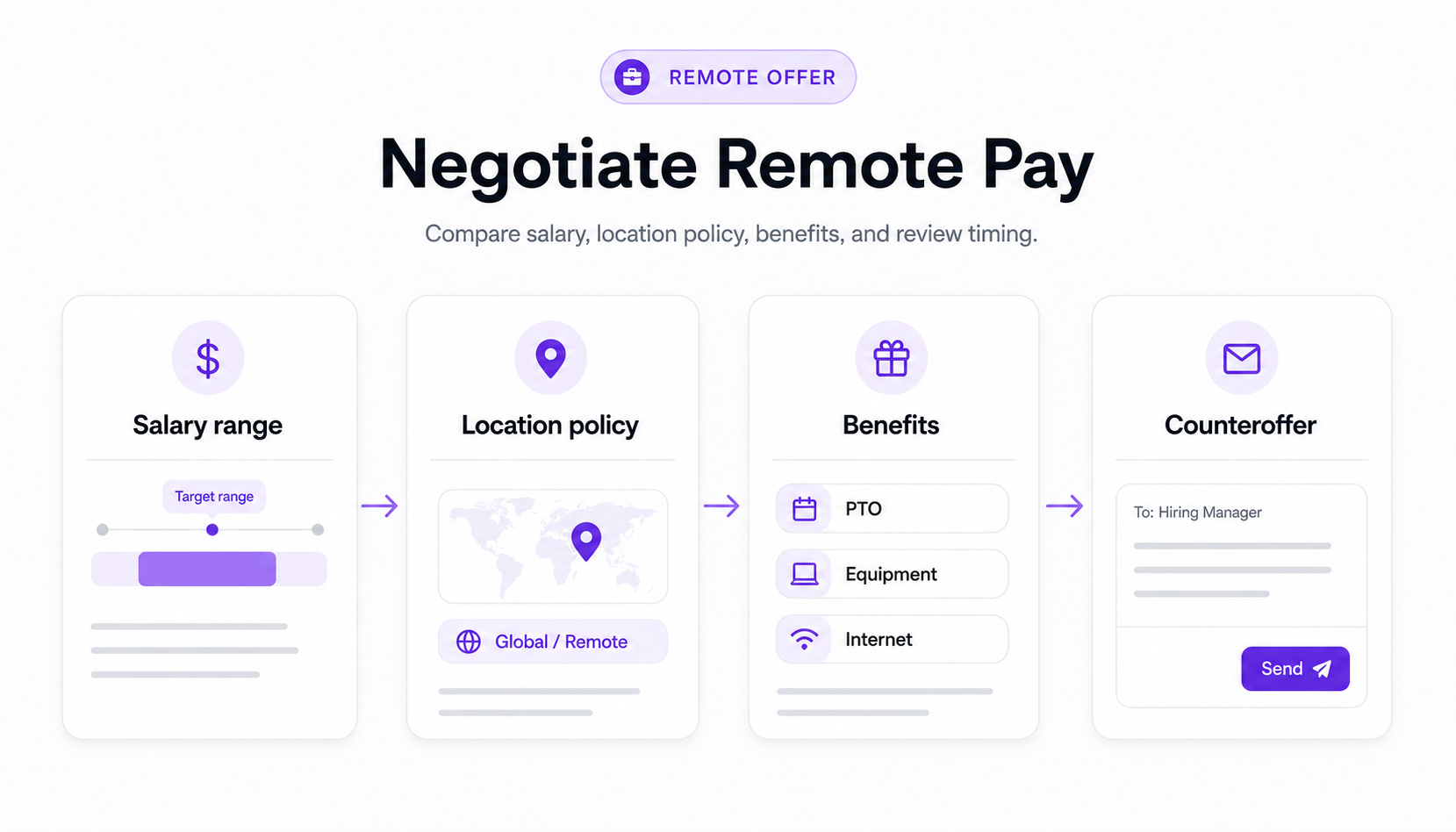
The best way to negotiate salary for a remote job is to compare the offer against similar remote roles, decide your target and walk-away number, map the full compensation package, and send a concise counteroffer tied to market data and the value of the role.
Remote salary negotiation has a few extra moving parts. A remote offer can include location-based pay, work-from-anywhere limits, timezone requirements, contractor terms, currency differences, travel costs, equipment needs, and home-office expenses. Salary matters most, but the full remote package can change what the offer is actually worth.
What makes remote salary negotiation different
Remote work changes the compensation conversation because the job is no longer tied neatly to one office market.
Some companies pay based on the employee's location. Others pay based on the company's headquarters, a national market, a regional band, or a location-agnostic policy. That tension has become a recurring remote-work compensation issue, with WIRED reporting on workers comparing the same remote role across different pay markets.
Some roles are "remote" but only within a country, state, province, or timezone. Some offers are full-time employee roles with benefits, while others are contractor offers where you absorb taxes, insurance, equipment, and unpaid time off yourself.
That means you should not negotiate only the base salary number. You should understand:
- How the company benchmarks pay.
- Whether the offer is adjusted for your location.
- Whether the role is employee, contractor, freelance, or temporary.
- Which benefits are included.
- Whether the company pays for equipment, internet, coworking, travel, and onsite meetings.
- Which timezone or schedule expectations affect your day-to-day life.
- When compensation can be reviewed again.
Remote flexibility is valuable. It can save commuting time, widen your job options, and give you more control over where you live. But flexibility should not automatically replace fair compensation for the work you are doing.
Prepare before you counter
The negotiation starts before you write the counteroffer.
1. Confirm what the offer includes
Ask for the full offer in writing. You need more than a base salary number.
Confirm:
- Base salary or hourly rate.
- Bonus, commission, or equity.
- Benefits.
- Paid time off and holidays.
- Employment type.
- Working hours and timezone expectations.
- Location eligibility.
- Equipment, home-office, internet, or coworking support.
- Travel requirements.
- Start date.
- Review timing.
If the offer is missing details, ask clarifying questions before you negotiate. A higher salary may not compensate for weak benefits, unpaid travel, contractor taxes, or a schedule that does not work for your location.
2. Research the range
Use several sources, not one salary tool.
Look at:
- Salary ranges in similar remote job postings.
- Himalayas listings for comparable remote jobs.
- The employer's posted range, if available.
- Salary databases.
- Recruiter conversations.
- Peer conversations.
- Your own active interviews and offers.
- Public compensation discussions, used carefully.
If a job posting includes a range, read it as a clue, not a guarantee. A wide range may include different levels, locations, experience bands, or internal equity constraints. If the offer sits low in the range, ask what would justify a higher point in the band.
For the basics of interpreting ranges, use What Is a Salary Range? before you decide where to anchor.
3. Decide your numbers
Set three numbers before you respond:
| Number | Meaning | Example |
|---|---|---|
| Target | The number you want and can justify | I would be excited to accept at $125,000. |
| Acceptable | The number you could accept if the rest of the package works | I can make $118,000 work with the stipend and review timing. |
| Walk-away | The number below which the offer does not fit | Below $110,000, I need to keep looking. |
Do not invent these numbers during the call. Decide them when you are calm.
4. Build your value case
Your counteroffer should not sound like "I want more money." It should sound like "Given the role scope and market, this number is the right fit."
Use evidence such as:
- Similar remote roles with higher ranges.
- Years of relevant experience.
- Specialized skills.
- Revenue, cost savings, customer, product, or operational impact.
- Leadership scope.
- Hard-to-find timezone or language coverage.
- Strong interview feedback.
- Competing offers.
If your resume does not make this value obvious, strengthen it before you enter late-stage interviews. The Himalayas AI resume builder can help you turn responsibilities into clearer accomplishment bullets.
5. Track offer details
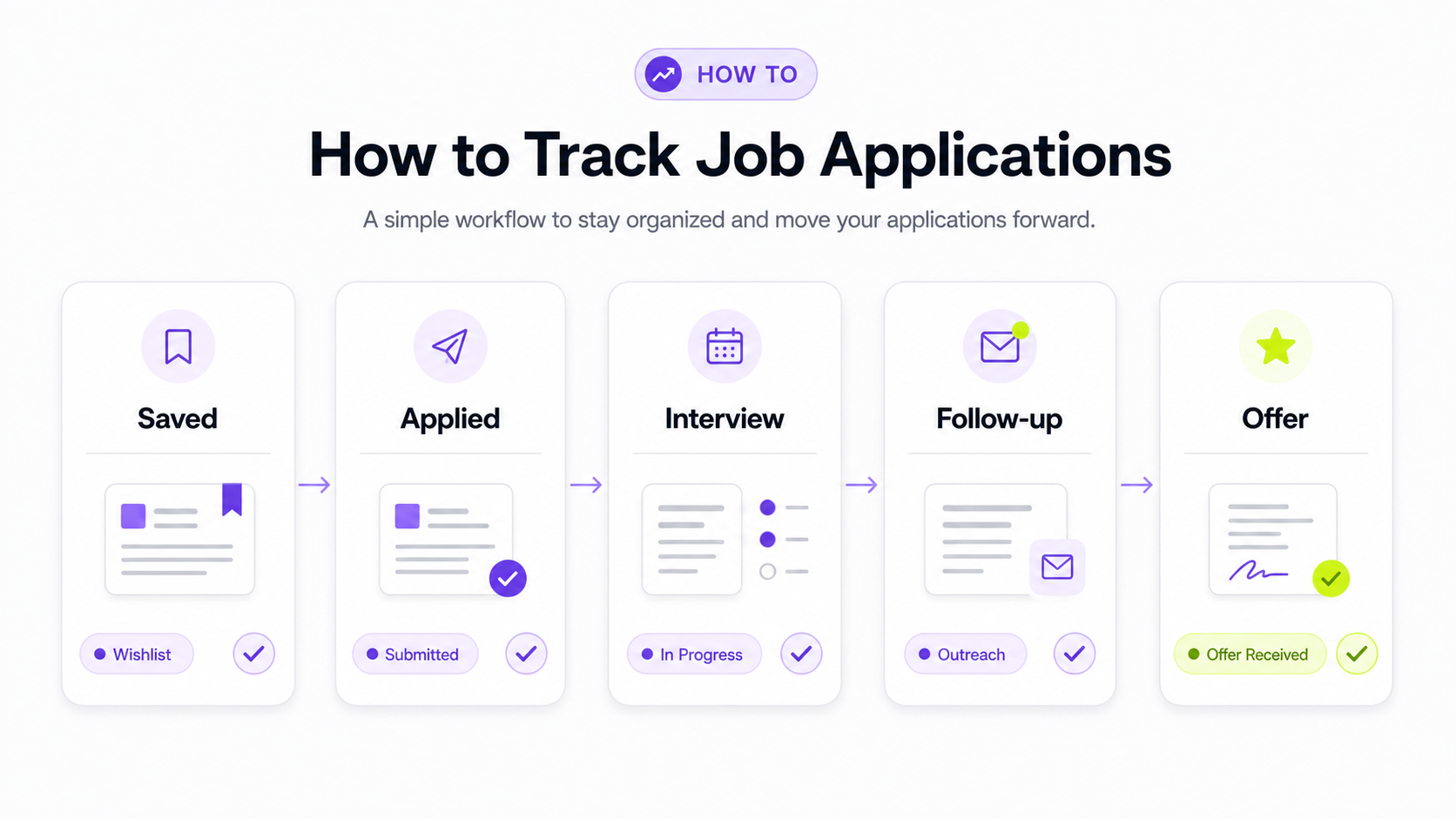
Use a tracker for every role you are seriously considering. Record the salary range, offer number, benefits, remote policy, recruiter notes, counteroffer date, follow-up date, and final outcome.
The Himalayas job application tracker is useful when you want to keep applications, salary ranges, interviews, offers, and next actions in one place.
Remote compensation checklist
Before you decide whether the offer is strong, check the whole package.
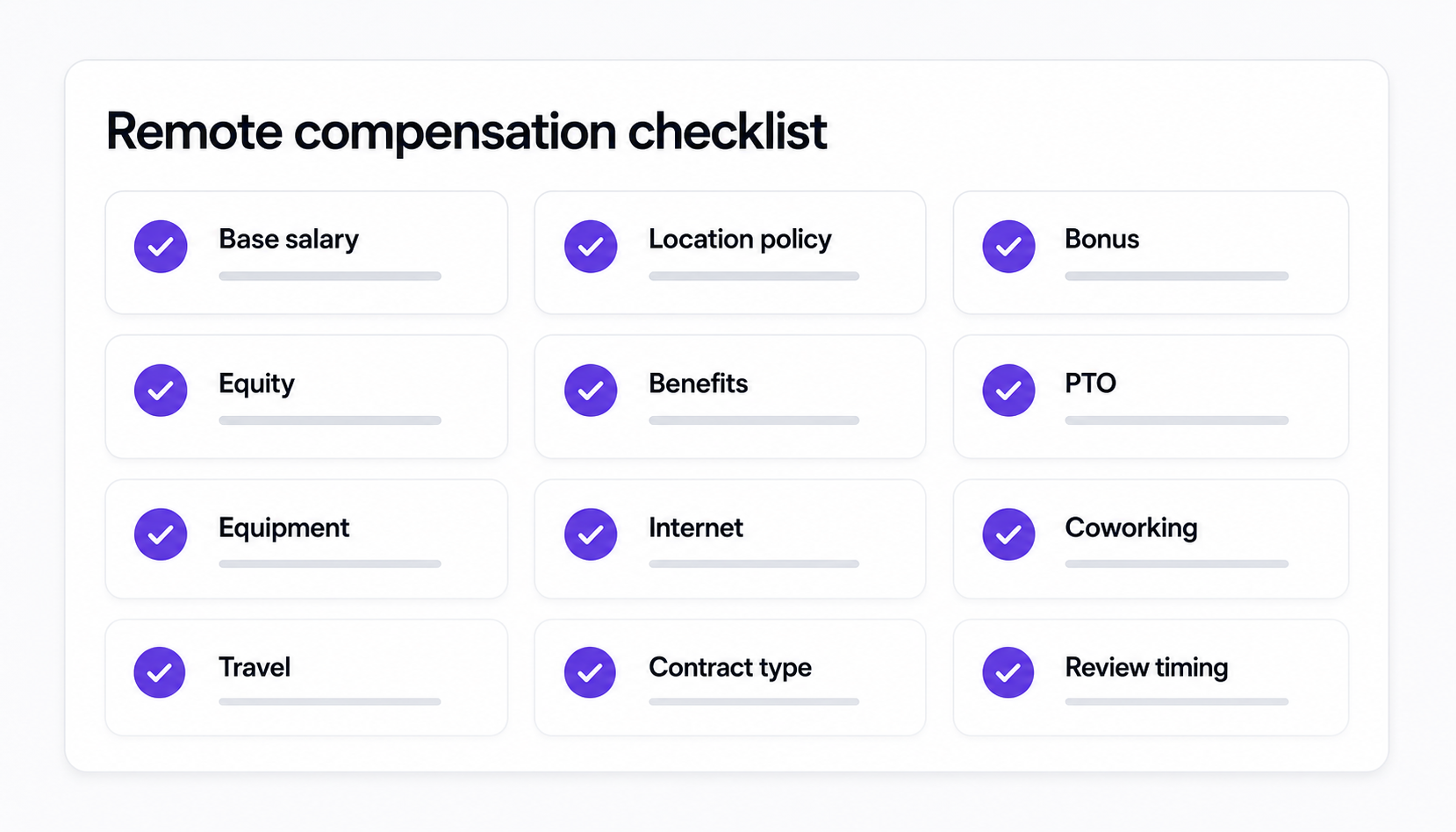
| Compensation factor | What to check | Why it matters |
|---|---|---|
| Base salary | Annual salary, hourly rate, or contract rate | The main number you negotiate |
| Location policy | Local, regional, national, HQ-based, or location-agnostic | Explains why two remote workers may receive different ranges |
| Bonus or commission | Target amount, eligibility, payout history | Can be meaningful but less certain than base salary |
| Equity | Type, vesting, strike price, refreshers | Valuable only if you understand the terms |
| Benefits | Healthcare, retirement, insurance, leave | Contractor offers may look higher until benefits are missing |
| PTO and holidays | Paid vacation, sick leave, local holidays | Remote teams may not follow your local calendar |
| Equipment | Laptop, monitor, chair, home-office stipend | Setup costs can be real |
| Internet or coworking | Monthly stipend or reimbursement | Useful if remote work creates recurring costs |
| Schedule | Core hours, async expectations, timezone overlap | A remote job can still be inconvenient if hours are bad |
| Travel | Retreats, customer visits, office trips | Ask who pays and how often travel happens |
| Employment type | Employee, contractor, freelance, temporary | Taxes, benefits, protections, and PTO can change |
| Currency | Payment currency and exchange-rate risk | Critical for international remote roles |
| Review timing | 3-month, 6-month, or annual compensation review | Important if salary cannot move now |
How to respond to location-based pay
Location-based pay is one of the hardest remote salary conversations because the employer may be applying a policy, not judging your individual value.
Start by asking how the company benchmarks compensation.
You can say:
Thanks for walking me through the offer. Can you help me understand how compensation is benchmarked for this role? Is the range based on my location, the company's market, the role level, or another compensation band?
Then compare the answer with the role's scope.
If the work, responsibilities, timezone overlap, and expected outcomes are the same as a higher-paid market, you can make the case for role-based pay:
I understand the company uses location-based bands. At the same time, this role appears to have the same scope, success metrics, and collaboration expectations regardless of location. Based on comparable remote roles and the impact we discussed, I was targeting [$X]. Is there flexibility to move closer to that level?If base salary cannot move, negotiate the surrounding package:
- Signing bonus.
- Earlier salary review.
- Additional PTO.
- Home-office stipend.
- Coworking budget.
- Internet reimbursement.
- Travel budget.
- Flexible hours.
- Work-from-anywhere flexibility.
- Title or level adjustment.
Also consider whether the policy works for you long term. A location-adjusted offer may be acceptable if the number is strong for your market, the benefits are good, and the role advances your career. It may be a poor fit if the company expects global-level output while paying a deeply discounted rate.
For more context on the pay philosophy, see Companies With Location-Agnostic Pay.
What to say when you negotiate
Keep your counteroffer short, specific, and positive. You do not need a long speech.
Standard remote salary counteroffer
Hi [Name],
Thank you again for the offer. I am excited about the role, especially [specific reason tied to team, product, mission, or work].
After reviewing the responsibilities, remote expectations, and market ranges for similar roles, I was hoping we could discuss a base salary of [$X].
That number feels aligned with [brief value case: experience, scope, skills, impact, competing market data]. If we can get closer to that range, I would feel comfortable moving forward.
Thanks,
[Your Name]
If the offer is below the posted range
Hi [Name],
Thank you for the offer. I noticed the base salary is below the posted range of [$A-$B]. Can you help me understand how the offer was placed within the band?
Based on the role scope and my experience with [relevant skill or responsibility], I was targeting [$X]. Is there flexibility to bring the offer closer to that point in the range?
Thanks,
[Your Name]
If the employer uses location-based pay
Hi [Name],
Thank you for explaining the location-based compensation policy. I understand the company has bands by market.
Given that the role's responsibilities, collaboration expectations, and success metrics are the same regardless of location, I was hoping we could revisit the base salary. Comparable remote roles I am seeing are closer to [$X], and that is the level where I would be ready to accept.
Is there room to move the offer closer to that number?
Thanks,
[Your Name]
If the salary is fixed
Hi [Name],
I appreciate you clarifying that the base salary is fixed. I am still interested in the role and would like to understand whether there is flexibility elsewhere in the package.
Could we discuss [signing bonus / home-office stipend / additional PTO / coworking budget / earlier compensation review / flexible schedule]?
If salary cannot move now, I would also like to agree on what would need to be true for compensation to be reviewed after [3 or 6] months.
Thanks,
[Your Name]
If the offer is contractor instead of employee
Hi [Name],
Thank you for the offer. Since this is structured as a contractor role, I want to account for taxes, benefits, unpaid time off, equipment, and income variability.
Given those differences from a full-time employee package, I was targeting a contract rate of [$X]. Is there flexibility to adjust the rate, or to add support for [equipment / internet / coworking / paid time off / review timing]?
Thanks,
[Your Name]
If you want a six-month review
Hi [Name],
If we are not able to move the base salary further right now, could we include a compensation review after six months?
I would like to align on the outcomes that would trigger that review, such as [specific goals, scope, performance milestones, or expanded responsibilities]. That would make it easier for both sides to revisit compensation based on clear evidence.
Thanks,
[Your Name]
Business Insider's 2026 advice from a Korn Ferry compensation leader makes the same point: if a salary increase is denied, ask how the organization makes compensation decisions and what would need to be true for compensation to be revisited. That turns a flat "no" into a clearer path.
What to negotiate besides salary
If base salary cannot move, do not assume the conversation is over.
Remote roles often have other negotiable pieces:
| Ask | When it helps | Example |
|---|---|---|
| Signing bonus | Salary is fixed but budget exists elsewhere | "Could we add a signing bonus to bridge the gap?" |
| Earlier review | You can prove impact quickly | "Can we schedule a compensation review after six months?" |
| Home-office stipend | You need equipment to work well | "Can the company cover monitor, chair, desk, or setup costs?" |
| Coworking stipend | Your home setup is not ideal | "Is there monthly coworking support?" |
| Internet stipend | Remote work creates recurring costs | "Does the company reimburse internet?" |
| More PTO | Salary is close but time off is weak | "Could we add five PTO days?" |
| Flexible hours | Timezone overlap is difficult | "Can we define core collaboration hours?" |
| Travel budget | Retreats or onsite meetings are required | "Will the company cover travel, lodging, and meals?" |
| Learning budget | Role requires new skills | "Is there an annual professional development budget?" |
| Title or level review | Scope seems higher than the offer level | "Can we confirm whether this is leveled correctly?" |
Negotiate the things you will actually value. A coworking stipend is not useful if you never plan to use coworking. A title change is not enough if the salary misses your minimum.
How to use AI to practice, carefully
AI can help you rehearse a negotiation. It can play the recruiter, push back on your counteroffer, help you tighten an email, and make you more comfortable saying the number out loud. MarketWatch has covered job seekers using AI role-play this way, but the useful part is rehearsal, not outsourcing the decision.
Use a prompt like:
Act as a recruiter for a remote [job title] role. The offer is [$offer]. My target is [$target], my minimum is [$minimum], and my strongest evidence is [evidence]. Push back realistically with objections about budget, location-based pay, internal equity, and experience. After each response, give me feedback on clarity, confidence, and whether I gave too much away.
Use AI for practice, not salary truth.
Do not ask an AI model what salary you deserve and treat the number as reliable. AI-generated salary advice can be inconsistent, outdated, or biased. A 2024 research paper auditing ChatGPT salary negotiation advice found differences in recommended offers when prompt attributes changed, which is a good reason to verify salary targets with real market data instead.
The strongest use of AI is rehearsal:
- Practice your opening ask.
- Practice staying quiet after you make the ask.
- Practice responding to "the salary is fixed."
- Practice asking for compensation review timing.
- Practice asking about location-based pay without sounding defensive.
The Himalayas AI interview practice can help you rehearse high-pressure conversations before you have them with a recruiter or hiring manager.
Should you accept, counter, or walk away?
Use the offer as a decision, not just a number.
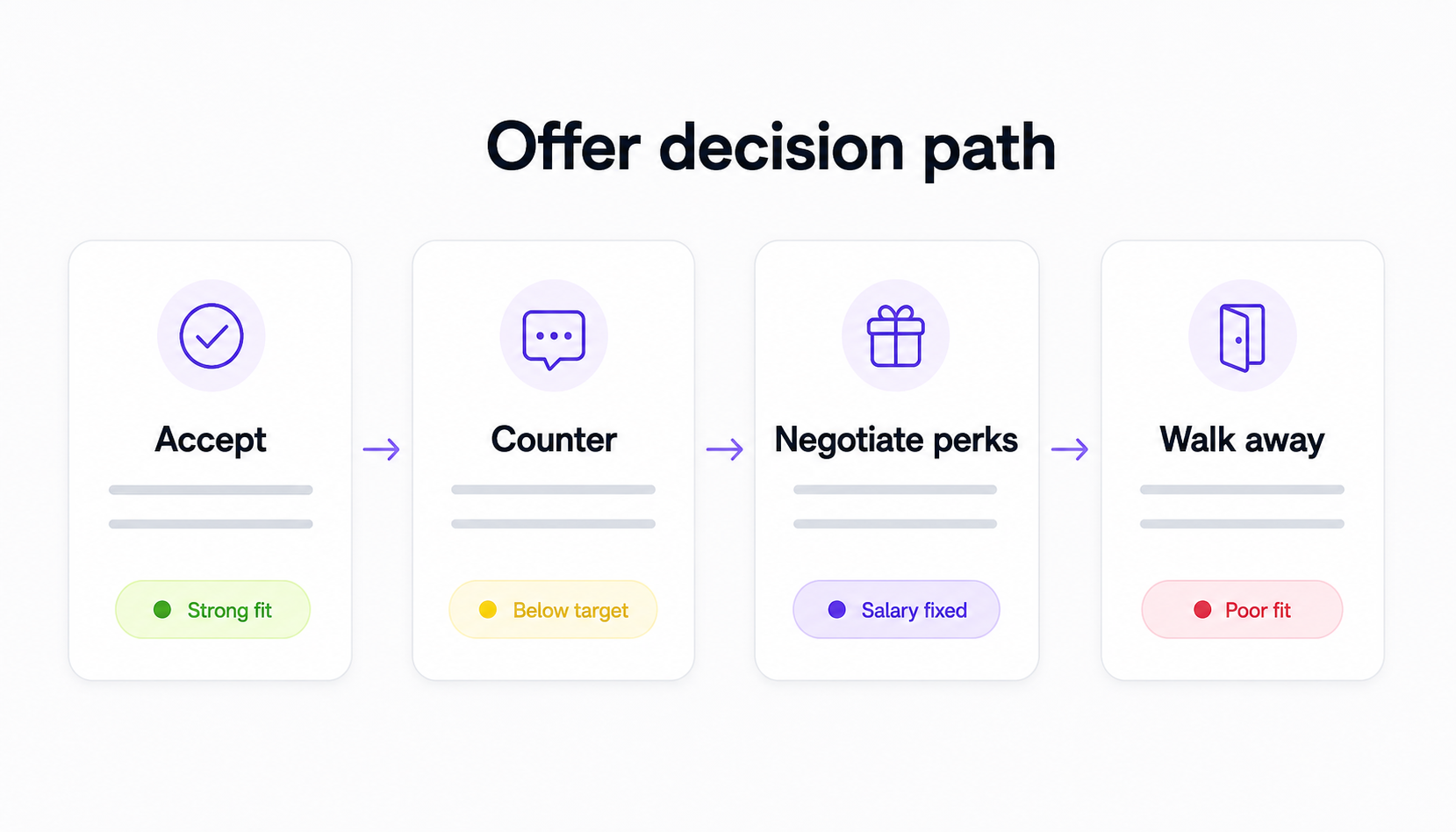
| Situation | Best next step | Why |
|---|---|---|
| Offer meets your target and the remote terms work | Accept or clarify final details | Do not negotiate just to negotiate |
| Offer is close but below target | Counter once with evidence | There may be room to move |
| Offer is low but benefits are strong | Compare total compensation | Strong benefits can change the math |
| Salary is fixed but role is valuable | Negotiate bonus, stipend, PTO, flexibility, or review timing | Other levers may still matter |
| Location-based adjustment feels too steep | Ask how the policy works and make a role-scope case | The employer may have flexibility within bands |
| Contractor rate equals employee salary | Counter or walk away | Contractor work usually needs a premium |
| Currency, taxes, or benefits make the package weak | Recalculate total value | The headline number may be misleading |
| The role requires inconvenient timezone overlap | Negotiate schedule or compensation | Time costs are real |
| Employer pressures you or refuses to answer basic compensation questions | Slow down or walk away | A poor negotiation process can signal future problems |
Negotiation is not about winning every dollar. It is about making the offer match the role, your market, and your life.
Common mistakes when negotiating a remote offer
Negotiating before you understand the package
Do not counter until you know the employment type, benefits, location policy, schedule, equipment support, and review timing.
Using only cost of living
Cost of living matters to you, but employers usually benchmark roles against labor markets, internal bands, and compensation philosophy. Your stronger argument is often role scope, market rate, and impact.
Giving your minimum too early
If you share your true minimum before the employer makes an offer, you may anchor lower than necessary. If asked about compensation early, use a range based on market data and the role scope. For that conversation, see How to Answer "What Are Your Salary Expectations?".
Ignoring contractor math
A contractor rate that matches an employee salary is usually not equivalent. Contractors often need to account for taxes, insurance, unpaid leave, retirement contributions, equipment, and gaps between contracts.
Treating remote flexibility as free compensation
Remote work is valuable, but it does not automatically make a low offer fair. Compare the full package with similar remote roles.
Forgetting to get the final offer in writing
After negotiation, ask for the updated offer in writing. Confirm salary, benefits, remote policy, equipment, start date, and any review timing before you accept.
A simple remote salary negotiation workflow
Use this sequence:
- Get the full offer in writing.
- List salary, benefits, remote policy, schedule, equipment, travel, and employment type.
- Research similar remote roles.
- Decide your target, acceptable number, and walk-away number.
- Write a concise counteroffer.
- Practice the conversation.
- Send the counteroffer.
- Pause and let the employer respond.
- If they say no, ask about compensation philosophy and review timing.
- Accept, counter once more, negotiate another lever, or walk away.
The cleaner your preparation, the calmer the conversation.
Find remote roles with better salary signals
Your leverage improves when you have options. If every role you are considering has vague compensation, unclear location rules, and weak benefits, negotiation gets harder.
Search for remote jobs with clear role requirements, location eligibility, and salary information when available. Track each role's salary range, recruiter notes, interview stage, and offer details so you know what the market is actually showing you.
Then negotiate from evidence, not anxiety.
FAQ
Can you negotiate a remote job offer?
Yes. Remote job offers are often negotiable, especially when you can point to market data, role scope, specialized skills, competing opportunities, or the total value of the package. Even when salary is fixed, benefits, stipends, flexibility, PTO, start date, travel, and review timing may still be negotiable.
Should remote jobs pay based on location?
Companies use different pay philosophies. Some use location-based pay, some use national or regional bands, and some use location-agnostic pay. Instead of arguing philosophy only, ask how the company benchmarks compensation and make your case based on role scope, market data, and impact.
How much more should you ask for?
Ask for a number you can justify with market data and role scope. A practical counteroffer is usually above the initial offer but still defensible against the posted range, comparable roles, and your experience. The right number depends on your evidence, the employer's range, your alternatives, and your walk-away point.
Can negotiating salary cost you the offer?
A professional, evidence-based counteroffer should not be a problem with a reasonable employer, but negotiation is never risk-free. Reduce risk by staying respectful, showing enthusiasm, and making a realistic ask. Avoid ultimatums unless you are truly ready to walk away.
What if the employer says the salary is fixed?
Ask whether other parts of the package are flexible. You can negotiate a signing bonus, stipend, PTO, flexible schedule, coworking support, travel budget, or earlier compensation review. Also ask what would need to be true for compensation to be revisited.
Should you disclose your current salary?
Be careful. Salary-history rules vary by country, state, and city, and your current salary may not reflect the value of the new role. In many cases, it is better to redirect to your expectations for this role based on scope and market data.
What should contractors negotiate?
Contractors should negotiate rate, payment schedule, scope, change requests, termination notice, expenses, equipment, meeting expectations, timezone overlap, intellectual property terms, and whether any time off is paid. A contractor rate should usually account for costs that an employer would cover in a full-time role.
How do you negotiate work-from-anywhere flexibility?
Ask which countries, states, provinces, or timezones are eligible and why. If the company cannot support true work-from-anywhere employment, ask whether temporary travel, defined working locations, or a written flexibility policy is possible.