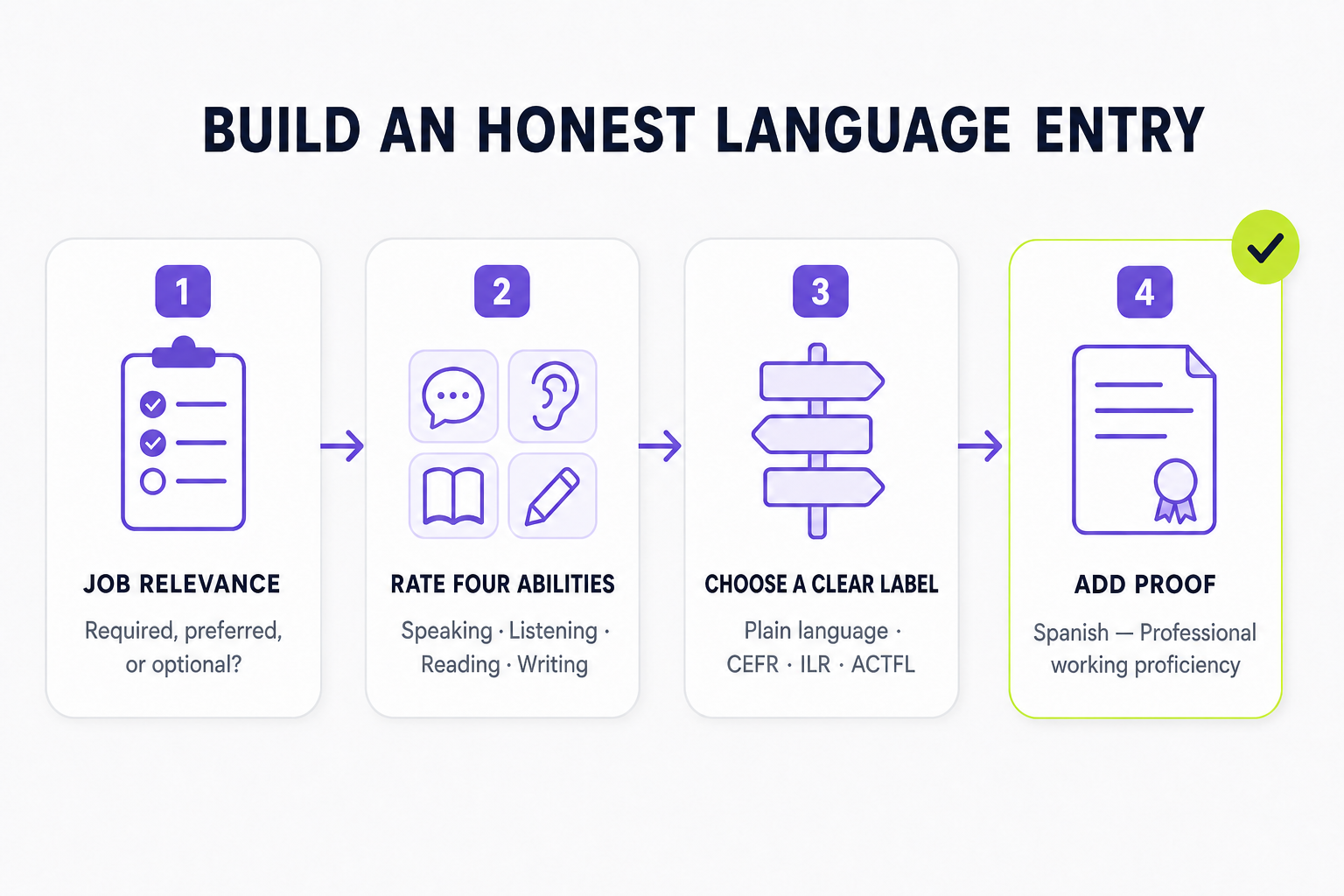
List a language on your resume when it helps you do the target job. Write the language, an honest proficiency level, and—when useful—proof such as a recognized assessment or the kind of work you can perform in that language.
Use this format:
Spanish — Professional working proficiency (speaking, reading, and writing)
Do not claim a level you could not demonstrate if an interviewer switched languages without warning. A conservative, specific description is more credible than an inflated fluent label.
Should you put languages on your resume?
Language ability deserves space when it reduces a hiring risk or helps you serve the employer's customers, team, or market.
| Your situation | What to do | Example placement |
|---|---|---|
| The job requires the language | Feature it and show proof | Headline or summary, dedicated Languages section, and relevant experience |
| The language is preferred or useful | Include it clearly without making it the focus | Skills or Languages section |
| The company operates in a market where you use the language | Include it if you can explain the business value | Skills section plus an experience bullet |
| You can use the language socially but not at work | Include it only if it adds relevant context and space allows | Languages section with a conservative level |
| You know only memorized phrases or took classes years ago | Leave it off unless active learning is relevant and accurately labeled | Usually omit |
| The language has no connection to the role and stronger evidence needs the space | Omit it | Keep the resume focused |
Read the job description before deciding. Look for phrases such as bilingual required, Spanish preferred, support customers in French, or work with teams across Japan. The Himalayas job description keyword finder can surface repeated requirements, but the decision still depends on what you can honestly do.
If the language is a core qualification, do more than place it in a list at the bottom:
Bilingual customer support specialist (English/Spanish) with 4 years of experience resolving billing and account issues across phone, chat, and email.
If it is useful but secondary, a simple entry is enough:
Skills: Salesforce, Zendesk, knowledge base writing; Spanish — conversational
Language skills are one part of your evidence. Use the broader guide to resume skills to decide what else belongs and what your experience should prove.
Choose a proficiency system your employer will understand
A proficiency label should answer a practical question: what can you do in this language at work? Use the system the employer, industry, or region understands. If the posting does not name one, plain-language labels are usually easier to scan than an unexplained code.
| System | Best used when | Resume example | Watch out for |
|---|---|---|---|
| Plain-language labels | A general employer has not requested a formal scale | Spanish — professional working proficiency |
Words such as fluent can be interpreted differently |
| CEFR | The employer, country, school, or certificate uses A1-C2 | French — B2 (DELF) |
Add a plain-language description when the code may be unfamiliar |
| ILR | A US federal, government-adjacent, or explicitly ILR-based role asks for it | Arabic speaking — ILR 3 |
ILR rates skills separately |
| ACTFL | Your formal assessment or employer uses ACTFL levels | Mandarin — ACTFL Advanced Mid (speaking) |
Name the assessed skill and exact level |
Plain-language proficiency labels
Plain language works well when the employer wants a quick description. Keep the terms consistent across languages.
| Label | A useful resume meaning |
|---|---|
| Native or bilingual | You acquired the language early or use it with comparable ease across situations relevant to the job |
| Full professional proficiency | You can work across complex meetings, writing, negotiation, and unfamiliar professional topics |
| Professional working proficiency | You can handle most routine and role-specific work, with occasional limits on nuance or unfamiliar topics |
| Limited working proficiency | You can manage predictable workplace conversations and tasks but need support for complex communication |
| Elementary or basic | You can handle simple, familiar exchanges; the language is not reliable for most job duties |
These are descriptions, not universal certifications. If your ability differs by skill, say so:
Japanese — professional working proficiency in speaking and listening; intermediate reading
CEFR levels
The Common European Framework of Reference for Languages uses six levels from A1 to C2. The Council of Europe’s official global scale groups A1-A2 as basic users, B1-B2 as independent users, and C1-C2 as proficient users.
- A1-A2: basic ability in familiar, routine situations.
- B1: independent use for familiar work, school, travel, and personal topics.
- B2: independent use across more complex topics, including technical discussion in your field.
- C1: flexible, effective use for demanding social, academic, and professional purposes.
- C2: highly precise, spontaneous use across virtually all spoken and written material.
Do not automatically translate B2 as fluent. Write the verified level:
German — B2 CEFR (Goethe-Zertifikat)
ILR levels
The Interagency Language Roundtable uses base levels from 0 to 5, plus intermediate + levels. Its official skill descriptions rate speaking, listening, reading, and writing separately. For speaking, level 2 is limited working proficiency, level 3 is general professional proficiency, and level 5 is functionally native proficiency.
Use an ILR score when it comes from an authorized assessment or the application requests it. Name the skill:
Korean — ILR 3 speaking; ILR 2+ reading
ACTFL levels
ACTFL levels progress through Novice, Intermediate, Advanced, Superior, and Distinguished, with Low, Mid, and High sublevels within several bands. Use the wording when a formal test or employer reports it. The ACTFL Proficiency Guidelines are skill-specific, so include the assessed mode.
Spanish — ACTFL Advanced High, speaking
Do not convert ACTFL, CEFR, and ILR scores yourself. Keep the result in the system that issued it and add a short description if the reader may not recognize the code.
Assess your level before you write it
Do not rate a language by years of study. Assess what you can do now in speaking, listening, reading, and writing.
| Ability | Questions to test yourself |
|---|---|
| Speaking | Could you explain a delay, answer follow-up questions, join a meeting, or handle an upset customer without switching languages? |
| Listening | Could you follow a normal-speed call, understand different accents, and catch dates, prices, and next steps? |
| Reading | Could you understand an email, policy, technical document, or customer request without translating every sentence? |
| Writing | Could you compose an accurate email, case note, report, or instructions that a colleague could use without rewriting? |
Test the situation, not the label
Choose tasks similar to the target job. Hospitality may depend on spontaneous speaking and listening. Research may depend on reading. Localization may require precise writing and cultural judgment.
Conversational can be honest for everyday discussion but misleading for conflict resolution, medical intake, contract negotiation, or technical writing. Describe the ability the employer will use.
Separate uneven abilities
Heritage speakers may speak and understand a language easily but have less formal writing experience. Someone who studied literature may read advanced material but hesitate in live conversation.
Write the difference when it matters:
Vietnamese — native speaking and listening; professional working proficiency in reading; basic writing
Use the no-warning interview test
Imagine an interviewer asks the next question in the language. Could you respond at the level your resume claims?
- If yes, the label is probably defensible.
- If you could respond only on familiar topics, narrow the label or name the modes.
- If you would need to explain that you studied the language years ago, leave it off or use
basiconly when relevant. - If the job requires high-stakes interpretation, translation, safety communication, or regulated terminology, use a verified assessment or credential when requested. General language ability is not the same as professional interpreter or translator qualification.
A verified score can be written as B2 CEFR (DELF). An estimate should not imply certification: write conversational French, not B2, unless a credible assessment supports it.
Where to put languages on a resume
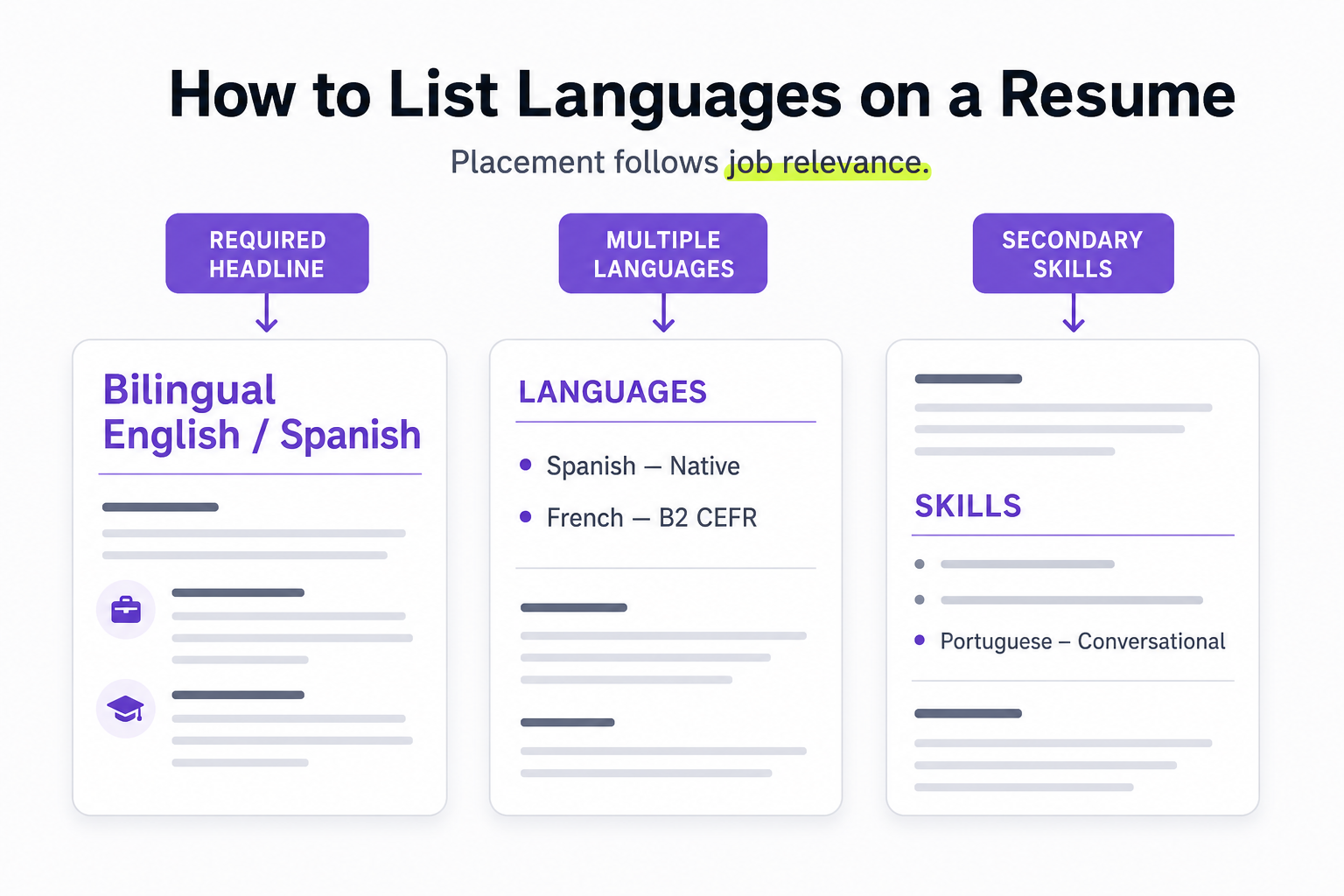
Place languages according to how much they matter. A required language should be impossible to miss. A useful but secondary language should not push stronger qualifications down the page.
| Importance to the job | Best placement | Why |
|---|---|---|
| Required and central | Headline or summary, dedicated Languages section, and experience proof | Recruiters can verify the requirement and see how you used it |
| Required but one of several qualifications | Dedicated Languages section near Skills | Keeps it visible without dominating the resume |
| Preferred or a meaningful advantage | Skills section or short Languages section | Makes the bonus easy to find |
| Relevant because of one project or role | Experience bullet, with a supporting Skills entry if needed | Connects the language to real work |
| Learned through a degree, study abroad, or formal test | Education or Certifications plus Languages | Shows the source without confusing education with current ability |
| Unrelated to the role | Usually omit | Preserves space for stronger evidence |
Headline or summary
Use the top only when bilingual or multilingual ability is a core selling point:
Bilingual English/Spanish Customer Success Manager
Your summary should still lead with job fit. Being bilingual does not replace role experience, tools, or results.
Dedicated Languages section
Create a separate section when the role requires language ability or several languages are relevant:
LANGUAGES
Spanish — native
English — full professional proficiency
French — B2 CEFR (speaking, reading, and writing)
Use Languages or Language Skills. Put it near Skills when languages matter, or lower when supplementary.
Skills section
One useful secondary language can sit inside Skills:
SKILLS
Customer support: Zendesk, Intercom, knowledge base writing
Languages: English — native; Portuguese — conversational
Keep programming languages in technical skills rather than mixing them with human languages.
Experience, education, and certifications
An experience bullet proves value that a label cannot:
Resolved 35-45 weekly account and billing requests in English and Spanish across phone, chat, and email.
List a degree, study-abroad program, or verified assessment in its proper section, then describe current ability separately when it matters. Follow the guide to listing certifications on a resume and use the resume sections guide for overall order.
Keep the format ATS-safe
Use text, a standard heading, and consistent punctuation. Avoid flag icons, star ratings, progress circles, and proficiency bars. A half-filled bar does not explain what you can do and may lose meaning when parsed or read without color.
An ATS-friendly resume should remain readable when copied as plain text.
Language skills resume examples
Use these as patterns, not claims to copy.
Dedicated section
LANGUAGES
English — native
Spanish — professional working proficiency
French — limited working proficiency
Use this when several languages are relevant or the employer explicitly asks for multilingual ability.
Secondary language in Skills
SKILLS
Customer support: Zendesk, Intercom, escalation management
Languages: English — native; Korean — conversational
Use this when the language is a bonus rather than a central qualification.
Bilingual headline and summary
Bilingual English/French Account Manager
Account manager with 5 years of experience supporting B2B software customers across Canada. Conducts onboarding, quarterly reviews, and renewal conversations in English and French.
Use this when the job requires both languages. The summary proves the claim through actual work.
Uneven abilities
LANGUAGES
Vietnamese — native speaking and listening; professional working proficiency in reading; basic writing
English — full professional proficiency
Use this when one label would mislead the employer, especially for heritage speakers.
Verified CEFR entry
LANGUAGES
German — B2 CEFR (Goethe-Zertifikat B2, 2025)
Use this when the employer recognizes CEFR or requests proof.
Skill-specific ILR entry
LANGUAGES
Arabic — ILR 3 speaking; ILR 2+ reading
Use this when the scores come from an authorized assessment and the employer uses ILR.
Language plus professional evidence
LANGUAGES
Portuguese — professional working proficiency
EXPERIENCE
Customer Success Specialist, Acme Software
- Led onboarding calls in English and Portuguese for customers across Brazil and the United States.
- Rewrote 18 setup articles in Portuguese with the localization team, reducing repeated clarification requests from new customers.
The section makes the qualification scannable; the bullets make it credible.
Basic proficiency
LANGUAGES
Japanese — basic speaking and reading; currently completing beginner coursework
Use this only when the learning context is relevant. It does not satisfy a requirement to run meetings or support customers in Japanese.
Native languages, bilingual labels, and regional variants
List your native language when multilingual ability matters, when the employer may not otherwise know which languages you can work in, or when applying across countries. An English-language resume for a general US role does not usually need English — native; a bilingual English/Spanish role benefits from listing both.
Use bilingual when you can function at the level the job requires in both languages. If ability differs substantially, list each level separately.
Name a regional variant when it affects the job. Brazilian Portuguese, European Portuguese, Modern Standard Arabic, or a relevant spoken Arabic variety may clarify fit. Do not add a regional label merely to sound precise.
Show how you used the language
A label tells the employer your level. An experience bullet shows what it allowed you to do.
Customer support
Weak: Used Spanish to help customers.
Stronger:
Resolved account, billing, and product questions in English and Spanish across phone, chat, and email.
Sales or account management
Weak: Fluent in French.
Stronger:
Conducted product demonstrations and renewal conversations in French for accounts across France and Belgium.
Healthcare administration
Weak: Translated for patients.
Stronger:
Scheduled appointments and explained non-clinical intake steps in Vietnamese; coordinated certified interpreters for medical discussions.
This draws a boundary between general language ability and regulated interpretation.
Operations
Weak: Worked with a team in Brazil.
Stronger:
Coordinated weekly inventory handoffs in English and Portuguese with operations teams in the United States and Brazil.
Localization or content
Weak: Helped with German translations.
Stronger:
Reviewed German help-center drafts for terminology, tone, and product accuracy before publication.
Use translated only when you performed translation. Reviewing, proofreading, localizing, and interpreting are different responsibilities.
For more patterns, learn how to write resume bullet points and quantify achievements using real scope or results.
Tailor language skills to each job
The same person may need different emphasis for different applications.
| Job posting | Resume treatment |
|---|---|
Bilingual English/Spanish required |
Put bilingual ability in the headline or summary, add Languages, and prove Spanish use in experience |
Spanish preferred |
Add Spanish to Skills or Languages and one proof point if available |
| No requirement, but the company serves Latin America | Include Spanish if the role interacts with that market |
| No language connection | Keep it low or omit it when space is tight |
Match the employer's wording only when accurate. If the posting says bilingual Spanish/English and you meet that standard, the same recognizable phrase helps recruiters understand the match. If you are conversational, do not copy bilingual just because it appears in the posting.
Use the job description keyword finder to identify required and preferred terms, then tailor your resume with evidence you can support.
The Himalayas AI resume builder can organize the Languages section and incorporate the job's terminology. AI cannot determine your real proficiency. Check every generated claim against your speaking, listening, reading, writing, assessments, and work history.
Common mistakes when listing languages
- Naming the language without a level:
Spanishcould mean native ability or one semester of study. - Using
fluentfor any comfortable conversation: social conversation does not prove you can negotiate, write reports, or explain technical problems. - Mixing systems without explanation: write
French — B2 CEFR, not unexplained codes from several scales. - Listing classes instead of current ability: years of study describe education, not what you can do today.
- Using flags, stars, or skill bars: they are ambiguous and may lose meaning when parsed or read without color.
- Hiding a required language: put it near the top and prove it in experience.
- Listing every language you started learning: resume space is not a learning log.
- Treating multilingual ability as a regulated credential: speaking two languages does not automatically qualify you as a certified interpreter or professional translator.
Language skills checklist
Before submitting, check:
- Relevance: Does the language help with this job, customer group, team, or market?
- Accuracy: Could you demonstrate the claimed level without warning?
- Specificity: Have you included a useful level, framework, or mode detail?
- Audience: Will the employer understand the label or code?
- Placement: Is a required language prominent and a secondary language proportionate?
- Proof: If it matters, does an experience bullet show how you used it?
- Formatting: Does the entry use plain text and a standard heading?
- Consistency: Do your resume, cover letter, application, and professional profile agree?
The best language entry is not the most impressive-sounding one. It is the one that helps the employer understand what you can reliably do.
Frequently asked questions
Should I put a language on my resume if I am not fluent?
Yes, when the level is useful and accurately labeled. Spanish — limited working proficiency can be valuable for predictable workplace conversations. Leave it off when the ability is too basic for the role or stronger qualifications need the space.
Should I list my native language?
List it when multilingual ability matters, when applying internationally, or when the employer needs to verify a language pair. You usually do not need to list the default language of the resume when the role does not ask for it.
Should I list English on an English-language resume?
Usually not for a general English-speaking role. Include it when the job explicitly requires English proficiency, when presenting several languages, or when an international application expects levels.
Is B2 considered fluent?
Do not automatically convert B2 to fluent. Under CEFR, B2 is an independent-user level supporting interaction on complex topics. Write B2 CEFR when that is your verified level.
Can I call myself bilingual?
Use bilingual when you can function in both languages at the level the job requires. If one is much weaker or limited to certain modes, list the levels separately.
Do language certificates belong in Languages or Certifications?
Put the level in Languages and the full verified credential in Certifications when both matter. A compact entry can combine them: German — B2 CEFR (Goethe-Zertifikat B2, 2025).
Should I translate my whole resume for a bilingual job?
Follow the instructions. If the employer requests both languages, provide separate, reviewed versions rather than mixing two languages line by line. Preserve the same facts, dates, titles, and evidence.
Once the entry is accurate, build the rest of the resume around the same standard: relevant, specific, and provable. The Himalayas AI resume builder can help create a tailored version, but you remain the source of truth for every proficiency claim.