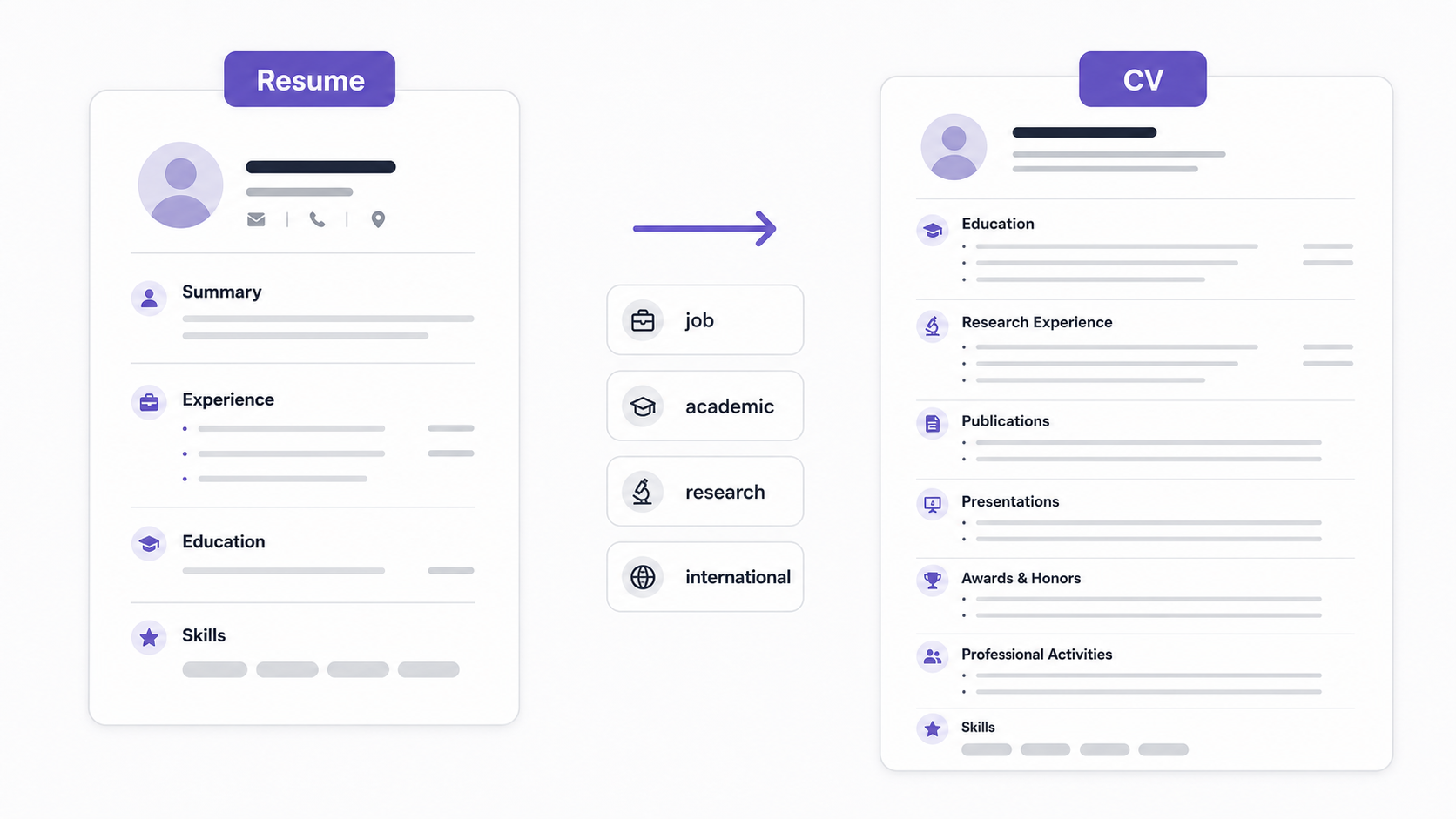
A resume is a short, targeted job-application document. A CV is usually a longer record of your academic, research, teaching, publication, and professional history. For most jobs in the US and Canada, you should submit a resume unless the employer asks for a CV.
The confusing part is that "CV" does not mean the same thing everywhere. In the UK, Ireland, Australia, New Zealand, and parts of Europe, CV often means the standard document you use to apply for jobs. In the US and Canada, CV usually means a longer academic or research document.
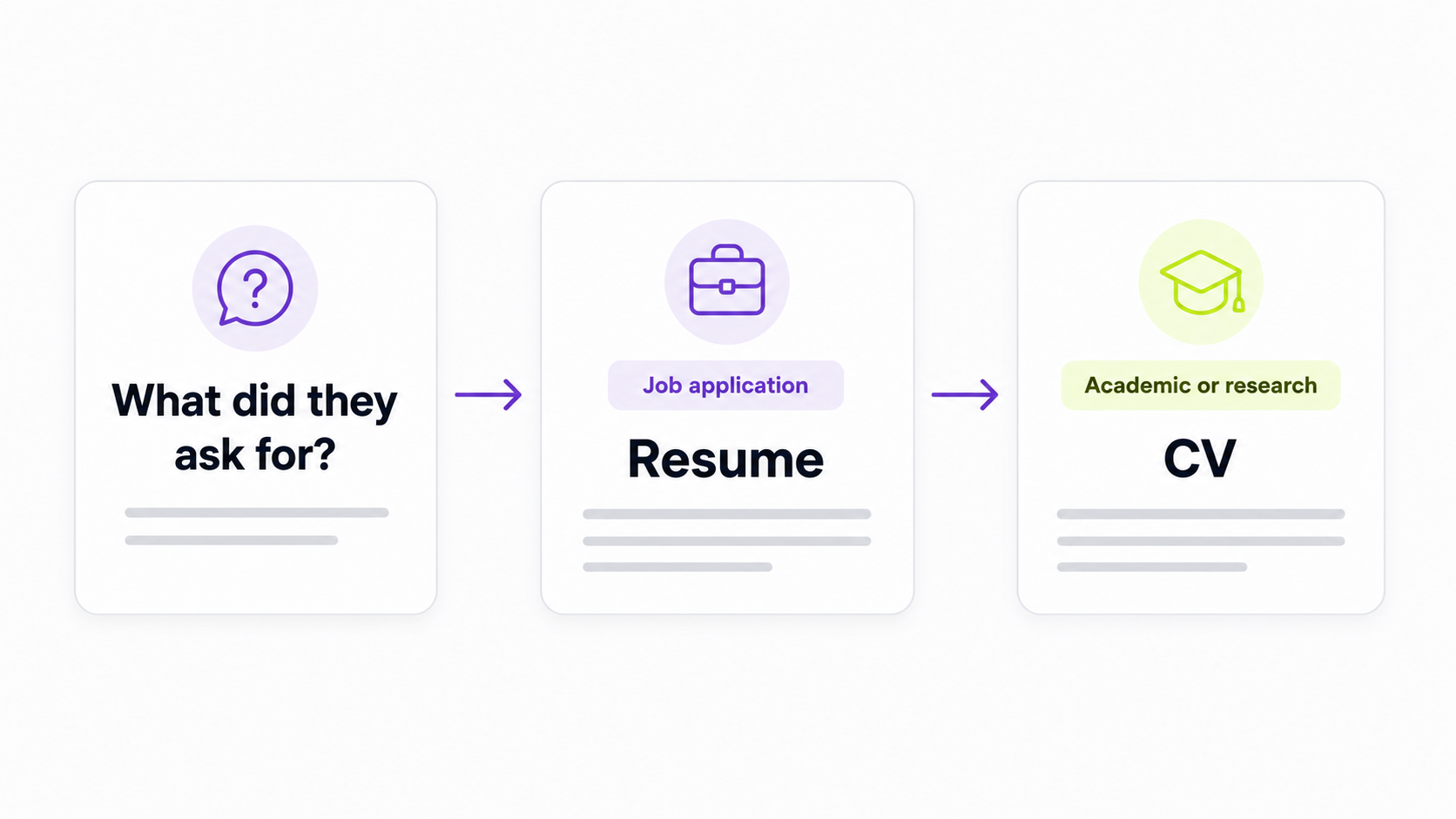
The safest rule is simple: follow the wording in the application. If the employer asks for a resume, submit a resume. If they ask for a CV and the role is academic, research, medical, or grant-related, submit a full CV. If the employer is outside your country and the wording is unclear, use the document style common in that market or ask for clarification.
What is a resume?
A resume is a concise document that shows why you match a specific job. It usually focuses on your most relevant work experience, skills, education, projects, certifications, and results.
Most resumes are one or two pages. They are tailored for each role, which means you choose the details that matter most for that job instead of listing everything you have ever done.
A strong resume should make three things easy to see:
- What role you are targeting.
- What relevant proof you have.
- Why your experience matches the job description.
If you need help structuring one, start with Resume Format: How to Format a Resume. Then use Resume Summary Examples, How to List Skills on a Resume, and How to Use Resume Keywords to make the content more specific.
What is a CV?
CV stands for curriculum vitae, which means "course of life." In the US and Canada, a CV is usually a detailed record of your academic and professional history.
An academic CV may include:
- Education.
- Research experience.
- Teaching experience.
- Publications.
- Presentations.
- Grants, fellowships, and awards.
- Academic service.
- Professional memberships.
- Licenses and certifications.
- Selected projects or clinical experience.
- References or referee details if requested.
A CV can be several pages long because completeness matters more than brevity in academic and research contexts. A professor, researcher, physician, or PhD candidate may need a CV to show publications, conference presentations, grants, and teaching history that would not fit on a normal resume.
For ordinary private-sector job applications, a long academic CV is usually too detailed. Hiring teams want the relevant proof quickly.
CV vs resume: key differences
| Difference | Resume | CV |
|---|---|---|
| Main purpose | Apply for a specific job | Show a fuller academic, research, or professional record |
| Typical length | 1-2 pages | Often longer than 2 pages |
| Level of detail | Selective and tailored | Comprehensive, especially in academic contexts |
| Common US/Canada use | Most non-academic jobs | Academic, research, medical, grant, or fellowship roles |
| Common international use | Sometimes called a resume, depending on country | Often the standard job application document outside the US/Canada |
| Update style | Tailor for each role | Update continuously as credentials grow |
The biggest practical difference is not the name. It is the reader's expectation. A recruiter reviewing a software, sales, operations, support, or marketing application usually expects a focused resume. A faculty search committee may expect a CV that includes publications, teaching, and research history.
Should you use a CV or a resume?
Use a resume when:
- You are applying for most private-sector jobs.
- You are applying for remote jobs, startup roles, or company roles.
- The application asks for a resume.
- You need to show job-specific fit quickly.
- Your academic history is not the main reason you are being evaluated.
Use a CV when:
- The application specifically asks for a CV.
- You are applying for academic, research, teaching, medical, fellowship, or grant roles.
- Publications, presentations, grants, or teaching history are central to the evaluation.
- You are applying for a research-oriented industry role where your publications, methods, or doctoral research are part of the hiring case.
- You are applying in a country where CV is the normal term for a job application document.
If you are applying for remote roles, you will usually need a resume that makes remote-relevant proof visible. Use How to Write Your Remote Job Resume for that workflow.
International usage can change the meaning
This is where many job seekers get stuck. The word "CV" is used differently across markets.
In the US and Canada, "resume" usually means the short job-application document, while "CV" usually means the longer academic document.
In many other countries, "CV" is the normal term for the document you submit for a job. That does not always mean the employer wants a long academic CV. They may simply mean a job-focused resume-style document.
Use this as a starting point:
| Employer location or context | What "resume" usually means | What "CV" usually means | What to submit |
|---|---|---|---|
| US or Canada, private-sector job | Short, targeted job document | Usually an academic or research document | Resume, unless the employer asks for a CV |
| US or Canada, academic/research role | Less common for faculty or research applications | Full academic record | CV |
| UK, Ireland, Australia, or New Zealand | Less commonly used than CV | Often the standard job-application document | Concise job-focused CV |
| Europe, general job application | Depends on country and employer | Often the standard application document | Follow the employer's wording and local norms |
| Fellowship, grant, academic medicine, or PhD application | May be too short | Detailed record of education, research, publications, and credentials | CV |
| Remote company hiring internationally | May use either term | May use either term | Match the application instructions and keep the document job-focused |
When in doubt, look at three signals:
- The country or region of the employer.
- The type of role.
- The application instructions.
For example, a UK software company asking for a CV probably wants a concise job-application CV. A US university asking for a CV from a faculty candidate probably wants a full academic CV.
How to turn a CV into a resume
If you have a long CV but need to apply for a job, do not just rename the file. Convert it into a targeted resume.
1. Choose the target role
Pick one role family before editing. A resume for customer success should not look the same as a resume for research operations, data analysis, or product management.
2. Pull the job requirements
Read the job description and mark repeated skills, tools, responsibilities, and outcomes. Use the Himalayas job description keyword finder if you want a faster way to identify the terms worth reflecting.
3. Keep only relevant sections
A job-search resume usually needs:
- Header.
- Summary or objective.
- Work experience.
- Skills.
- Education.
- Selected projects, certifications, publications, or awards if relevant.
It usually does not need a full publication list, every conference presentation, every academic committee, or every course taught unless those details matter for the role.
4. Rewrite academic proof as job proof
Academic CV entries often list credentials, publications, presentations, or responsibilities. Resume entries should show the work that matters for the target job.
Example CV entry:
Research Associate, Behavioral Science Lab
- Co-authored 2 peer-reviewed papers on user decision-making.
- Presented research at 3 academic and industry conferences.
- Managed survey design, participant recruitment, and data cleaning for 1,200 responses.
- Mentored 4 undergraduate research assistants.
If the target job is user research, research operations, product analytics, or customer insights, keep the parts that prove transferable work:
- Research design.
- Survey methods.
- Data cleaning and analysis.
- Stakeholder communication.
- Mentoring or project coordination.
Resume version:
Research associate with experience designing surveys, cleaning data, and translating behavioral research into practical recommendations. Managed participant recruitment and survey operations for 1,200 responses, presented findings at 3 conferences, and mentored 4 junior researchers.
Resume bullet option:
Managed survey operations for 1,200 participant responses, cleaning data and presenting findings that helped product and research teams understand user decision patterns.
What changed:
- The resume version leads with the target role's useful skills, not the publication count.
- It keeps numbers that show scope.
- It translates academic activity into business-readable work.
- It removes details that matter mainly to an academic committee unless the job asks for them.
For more examples, use How to Write Resume Bullet Points and How to Quantify Resume Achievements.
5. Make it ATS-friendly
Use standard section headings, readable formatting, and a file type the employer accepts. Avoid putting essential information only in tables, images, text boxes, headers, or footers.
Read How to Make an ATS-Friendly Resume before submitting if you are unsure.
Common mistakes
Sending a full academic CV for a normal job
A long CV can bury the proof a recruiter needs. For most jobs, choose the experience and achievements that match the role.
Calling a document a CV but formatting it like a US academic CV
If an international employer asks for a CV, they may still expect a concise job-application document. Match the market and application context.
Using one document for every application
Both resumes and job-focused CVs work best when tailored. Update the summary, skills, and experience emphasis for each serious application.
Removing useful academic proof too aggressively
If your publications, teaching, research, or grants are relevant to the job, keep the strongest examples. The goal is relevance, not deleting your background.
Ignoring the instructions
If the application asks for a PDF, upload a PDF. If it asks for a CV, do not submit a file named resume-final-final.pdf unless you are sure the employer uses those terms interchangeably.
AI prompt to convert a CV into a resume
Use this prompt when you have a long CV and a specific job description:
Turn my CV into a targeted resume for this job.
Use only the information I provide. Do not invent metrics, employers, credentials, publications, or tools.
Target role:
[paste role title]
Job description:
[paste job description]
CV:
[paste CV]
Please:
- Recommend which CV sections to keep, shorten, combine, or remove.
- Draft a 1-2 page resume structure.
- Write a concise summary.
- Rewrite the most relevant experience bullets for the target role.
- Pull real skills and keywords from the job description only where my CV supports them.
- Flag anything that needs human verification before I apply.
You can also use the Himalayas AI resume builder to turn your experience into a cleaner job-targeted resume.
FAQ
Is a CV the same as a resume?
Sometimes, depending on the country. In the US and Canada, a resume is usually a short job-application document and a CV is usually a longer academic or research document. In many other countries, CV is the normal term for a job-application document.
What does CV stand for?
CV stands for curriculum vitae. In academic contexts, it usually means a detailed record of education, research, teaching, publications, presentations, and professional credentials.
Should I submit a CV or a resume?
Submit the document the employer asks for. For most US and Canadian private-sector jobs, use a resume. For academic, research, medical, grant, or fellowship applications, use a CV unless the instructions say otherwise.
Is a CV longer than a resume?
In US and Canadian academic usage, yes. A CV can be several pages because it records a fuller academic and professional history. A resume is usually one or two pages and tailored to a specific job.
Can I use a CV for a remote job?
Usually, you should use a resume for remote job applications unless the employer asks for a CV. Remote employers still need quick evidence of role fit, communication habits, tools, outcomes, and time-zone or async collaboration experience.
What should I name the file?
Use a clear file name with your name and the document type, such as Maya-Chen-Resume.pdf or Maya-Chen-CV.pdf. Match the employer's wording when possible.
Build the right document before you apply
The document name matters less than the reader's expectation. A good resume is focused, relevant, and easy to scan. A good CV is complete enough for the academic or research context where it is being reviewed.
If you are applying for jobs, start with a targeted resume. Use the Himalayas AI resume builder, tailor it with the job description, then search remote jobs on Himalayas when you are ready to apply.