Certifications belong on your resume when they help prove you are qualified for the job you want. The best certification section is not the longest list you can build. It is a short, relevant set of credentials that a recruiter can verify quickly.
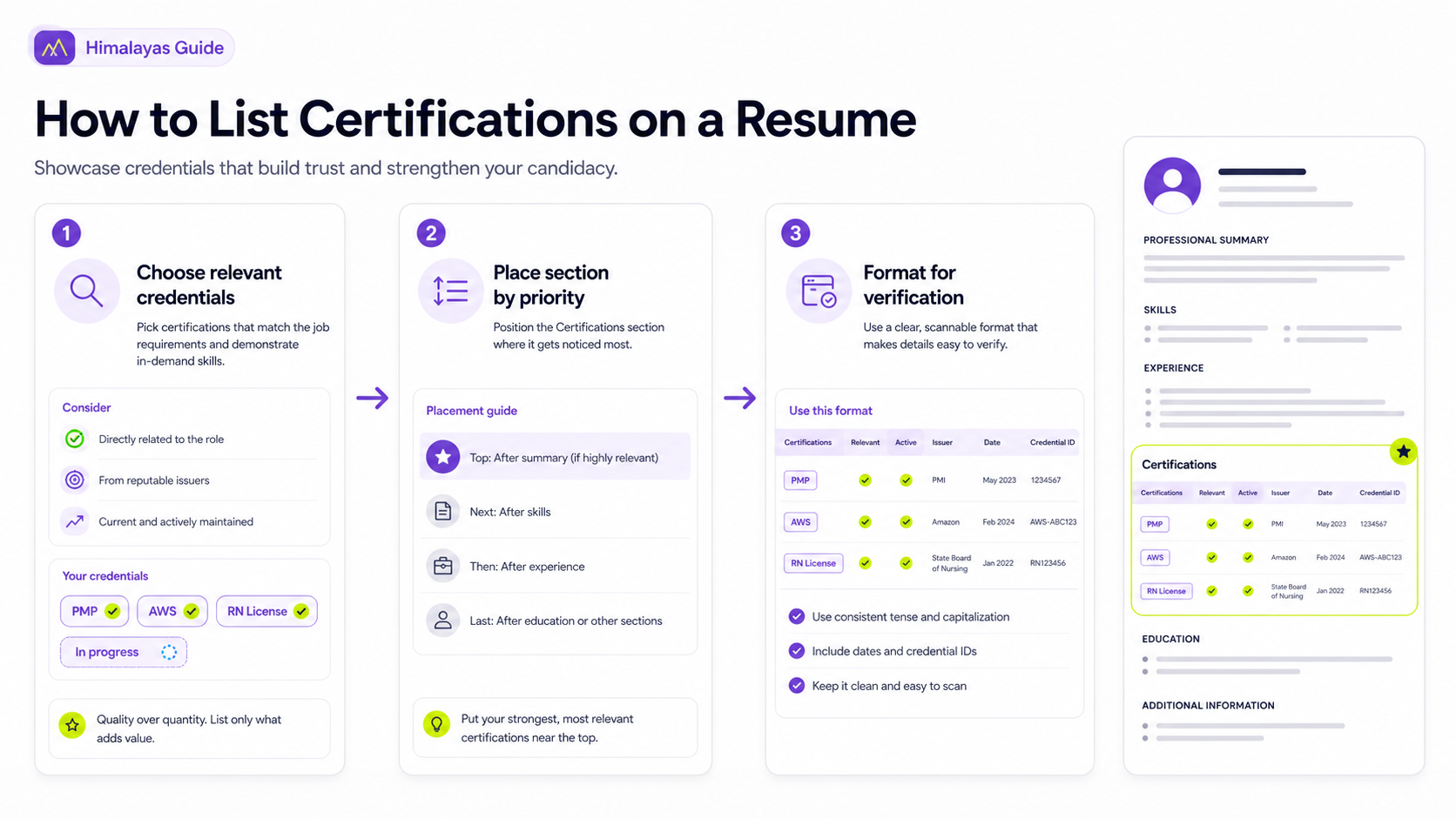
Use a dedicated certifications section when you have several relevant credentials, a required license, or a credential that clearly strengthens your candidacy. If you only have one supporting certificate, you can usually combine it with education, skills, or professional development.
What counts as a certification?
A certification is a credential issued by a professional body, vendor, school, or training provider after you meet a standard. That standard might be an exam, coursework, supervised hours, a portfolio, or renewal requirements.
Common resume credential types include:
- Professional certifications, such as PMP, SHRM-CP, CPA, CFA, or CompTIA Security+.
- Licenses, such as RN, LCSW, PE, real estate license, or state teaching license.
- Vendor certifications, such as AWS Certified Solutions Architect, Salesforce Administrator, or Google Analytics certification.
- Course certificates, such as a Google Career Certificate, Coursera certificate, or university extension certificate.
- Required safety or compliance credentials, such as OSHA, CPR, food safety, or first aid.
Do not treat every course completion badge as equally important. A license or industry-recognized certification usually carries more weight than a short course certificate. The point is not whether you have a certificate file. The point is whether the credential helps the employer trust your skills for the role.
When to include certifications on a resume
Include a certification when it passes at least one of these tests:
| Test | Include it when | Example |
|---|---|---|
| Required | The job posting names it as required or preferred. | CPA for an accounting role. |
| Role-relevant | It proves a tool, method, regulation, or technical skill the role needs. | AWS certification for a cloud role. |
| Credible issuer | The issuer is known or easy to verify. | PMI, CompTIA, state board, AWS, Google. |
| Recent or active | The credential is current or clearly marked in progress. | PMP issued 2025, expires 2028. |
| Experience bridge | It supports a career change or limited work history. | Data analytics certificate for an entry-level analyst role. |
Cut certifications that are outdated, unrelated, too basic for your level, or impossible to explain in an interview. If you are applying for a product manager role, a food safety certificate probably does not help unless the company is in food operations or compliance.
If you are not sure what matters, paste the job description into the Himalayas job description keyword finder and look for required licenses, tools, frameworks, and compliance terms. Then include only the credentials you can connect to those requirements.
Where to put certifications on a resume
Certification placement depends on how important the credential is to the job.
| Situation | Best placement | Why |
|---|---|---|
| Certification is required for the role | Near the top, summary, headline, or dedicated section before experience | Recruiters should see it immediately. |
| Certification strongly supports your target role | Dedicated Certifications section after skills or experience |
It deserves scan-friendly space. |
| You have one or two supporting credentials | Combine with education or professional development | Saves space while still showing proof. |
| Credential is tied to a specific job achievement | Mention it in the relevant experience bullet or role entry | Keeps the credential connected to impact. |
| You are a student or recent graduate | Near education, projects, or skills | The credential may be one of your strongest proof points. |
For most job seekers, a dedicated Certifications section works best after skills or work experience. If a license is mandatory, place it closer to the top. If a credential is minor, combine it with education or leave it off.
For overall section order, use the guide to resume sections and keep the layout consistent with a clean resume format.
What to include for each certification
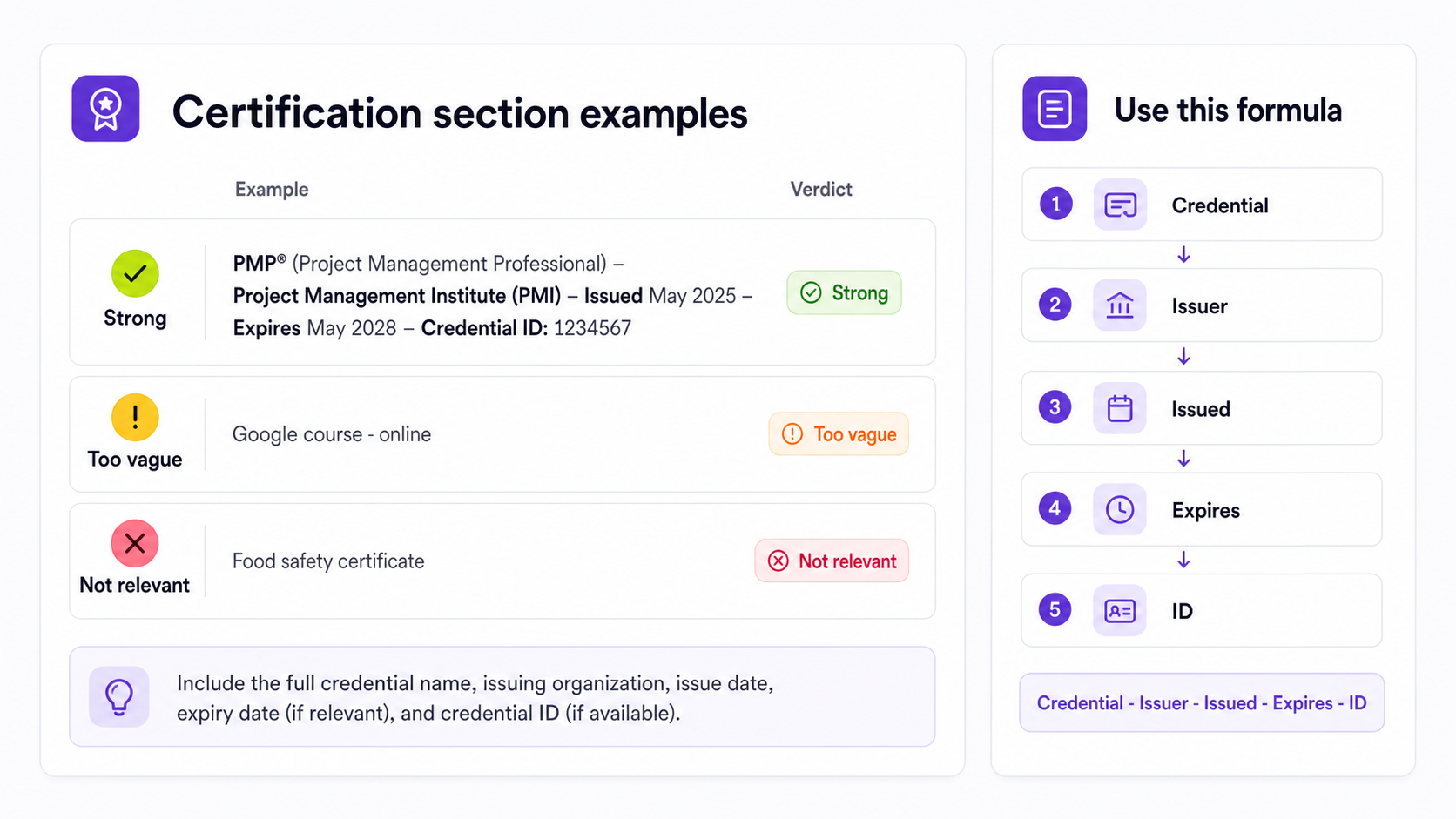
Use this formula:
Credential name - Issuer - Issued date - Expiration date - Credential ID or link
You do not always need every field, but the strongest entries are easy to verify.
| Field | Include it? | Notes |
|---|---|---|
| Full credential name | Yes | Spell out the name before using an acronym if the acronym may be unclear. |
| Issuing organization | Yes | List the professional body, vendor, school, or state board. |
| Date issued | Usually | Month and year is enough. |
| Expiration date | If relevant | Required for licenses and credentials that expire. |
| Credential ID or verification link | Optional | Useful for technical, compliance, or regulated credentials. |
| Status | If not complete | Use In progress or Expected Month Year. |
Examples:
| Strong entry | Why it works |
|---|---|
Project Management Professional (PMP), Project Management Institute, Issued May 2025, Expires May 2028 |
Full name, issuer, issue date, and expiry are clear. |
AWS Certified Solutions Architect - Associate, Amazon Web Services, Issued Feb 2026, Credential ID AWS-12345 |
Includes issuer and verification detail. |
Registered Nurse (RN), California Board of Registered Nursing, License active through Aug 2027 |
License status is clear for a regulated role. |
Google Data Analytics Professional Certificate, Google, Expected Sep 2026 |
In-progress status is honest and dated. |
How to handle special cases
In-progress certifications
You can list an in-progress certification if it is relevant and you are actively working toward it. Be clear that it is not complete.
Use:
Certified ScrumMaster (CSM), Scrum Alliance, In progress, expected Oct 2026
Do not imply you already hold the credential. If the employer requires the certification on day one, an in-progress credential may not satisfy the requirement.
Expired certifications
Usually leave expired certifications off. They can make your resume look stale or careless, especially when the credential is tied to safety, compliance, healthcare, finance, or security.
An expired credential may be worth mentioning only if:
- the role values the knowledge but does not require an active credential
- you are actively renewing it
- the credential explains past experience in a previous role
If you include it, mark it honestly.
Online course certificates
Online course certificates can help when they are relevant, recent, and practical. They are strongest for career changers, entry-level candidates, and people learning a tool required by the job.
They are weaker when they are generic, unrelated, or piled into a long list. A short online course is not the same as a professional certification or license.
Licenses
Licenses deserve extra clarity because employers may need to verify them. Include the state or issuing body, active status, expiration date, and license number when appropriate.
For regulated roles, you can also mention the license in your summary or headline.
Common mistakes to avoid
Avoid these certification-section mistakes:
- Listing every certificate you have ever earned.
- Using vague entries like
Google courseoronline certificate. - Including expired credentials without context.
- Hiding a required license near the bottom of the resume.
- Putting unrelated certificates above stronger work experience.
- Forgetting the issuing organization.
- Using acronyms that recruiters or applicant tracking systems may not recognize.
- Adding credential IDs when they expose private information or are not needed.
- Treating course certificates as equivalent to licenses.
- Adding credentials you cannot explain in an interview.
If your resume is becoming crowded, review these resume mistakes and cut anything that does not support the target role.
Certification section checklist
Before you send your resume, check:
- Is each certification relevant to the job?
- Did you use the full credential name?
- Did you include the issuer?
- Did you add issue or expiration dates where useful?
- Did you mark in-progress credentials honestly?
- Did you remove expired or unrelated certificates?
- Is a required license easy to find?
- Does the section fit the rest of your resume format?
- Did you use keywords naturally instead of stuffing acronyms?
For ATS-safe layout and keyword placement, read the guides to ATS-friendly resumes and resume keywords.
FAQ
Should certifications go before or after education?
Put certifications before education when they are more important to the target role than your degree. Put them near education when they are supporting credentials or when you are a student or recent graduate.
Should certifications go in the skills section?
Usually no. Skills and certifications are different kinds of proof. You can mention the skill in your skills section and list the credential separately. If space is tight, combine them under a heading like Skills and Certifications.
How many certifications should I list?
List the certifications that are relevant to the job. For most resumes, three to six strong credentials are better than a long list of weak or unrelated certificates.
Can I list free online certificates?
Yes, if they are relevant, recent, and useful for the role. Do not include every free course you have completed. Choose the ones that prove a job-related tool, method, or domain.
Should I include certification numbers?
Include a credential ID or license number when it helps the employer verify an important credential. Skip it when the ID is private, unnecessary, or makes the resume harder to scan.
What if my certification expired?
Leave it off unless it still explains relevant past experience, you are actively renewing it, or the job does not require active status. If you include it, be transparent.
Build the resume around the role
Certifications can strengthen your resume, but they should not carry the whole application. Your work experience, skills, achievements, and format still need to match the role.
Use the Himalayas AI resume builder to structure your resume, then use the job description to decide which certifications deserve space. A strong certification section helps recruiters verify your fit quickly; it should never distract from the evidence that you can do the job.