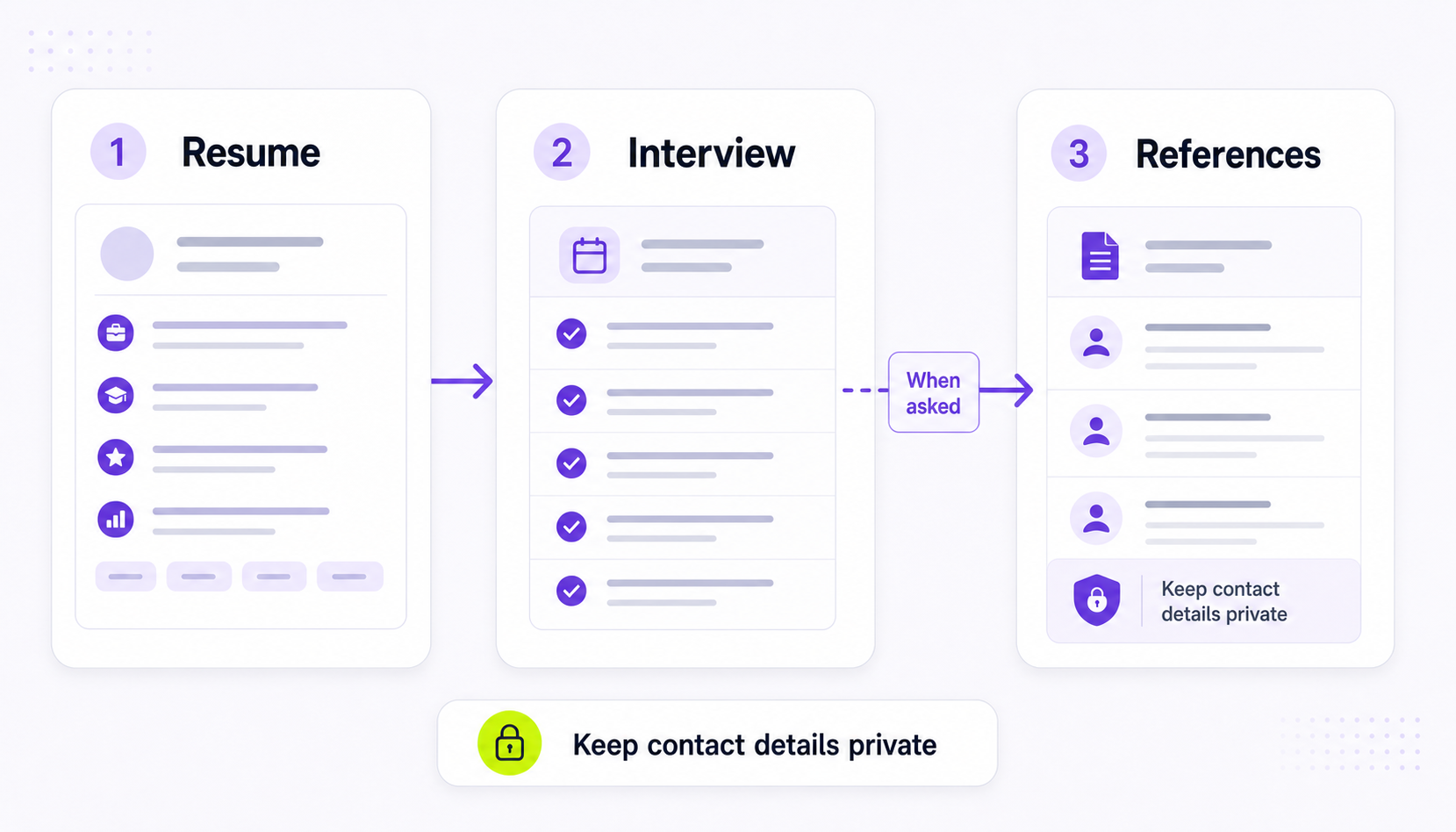
Do not put references on your resume unless the job posting specifically asks for them. In most cases, references should be prepared as a separate document and shared later in the hiring process, usually after an interview or when an employer directly requests them.
That does not mean references are unimportant. It means your resume should use its limited space for your experience, skills, achievements, and proof that you fit the role. Your references are a supporting document, not a standard resume section.
Should you put references on a resume?
Usually, no. Leave references off your resume unless the employer asks for them in the job description, application form, or recruiter instructions.
There are four reasons:
- References take up space that should be used for stronger resume content.
- Employers do not usually check references at the first resume-screening stage.
- Sharing names, phone numbers, and emails too early can expose your references unnecessarily.
- Hiring teams already know they can ask for references if they need them.
The same rule applies to the phrase "references available upon request." It is usually not worth including. Employers assume you can provide references when asked, so the line mostly wastes space.
If you are not sure what to include instead, review the core resume sections and remove outdated filler before adding another section.
What to do instead
Prepare a separate reference list before you need it. Keep it ready as a clean one-page document that matches your resume style.
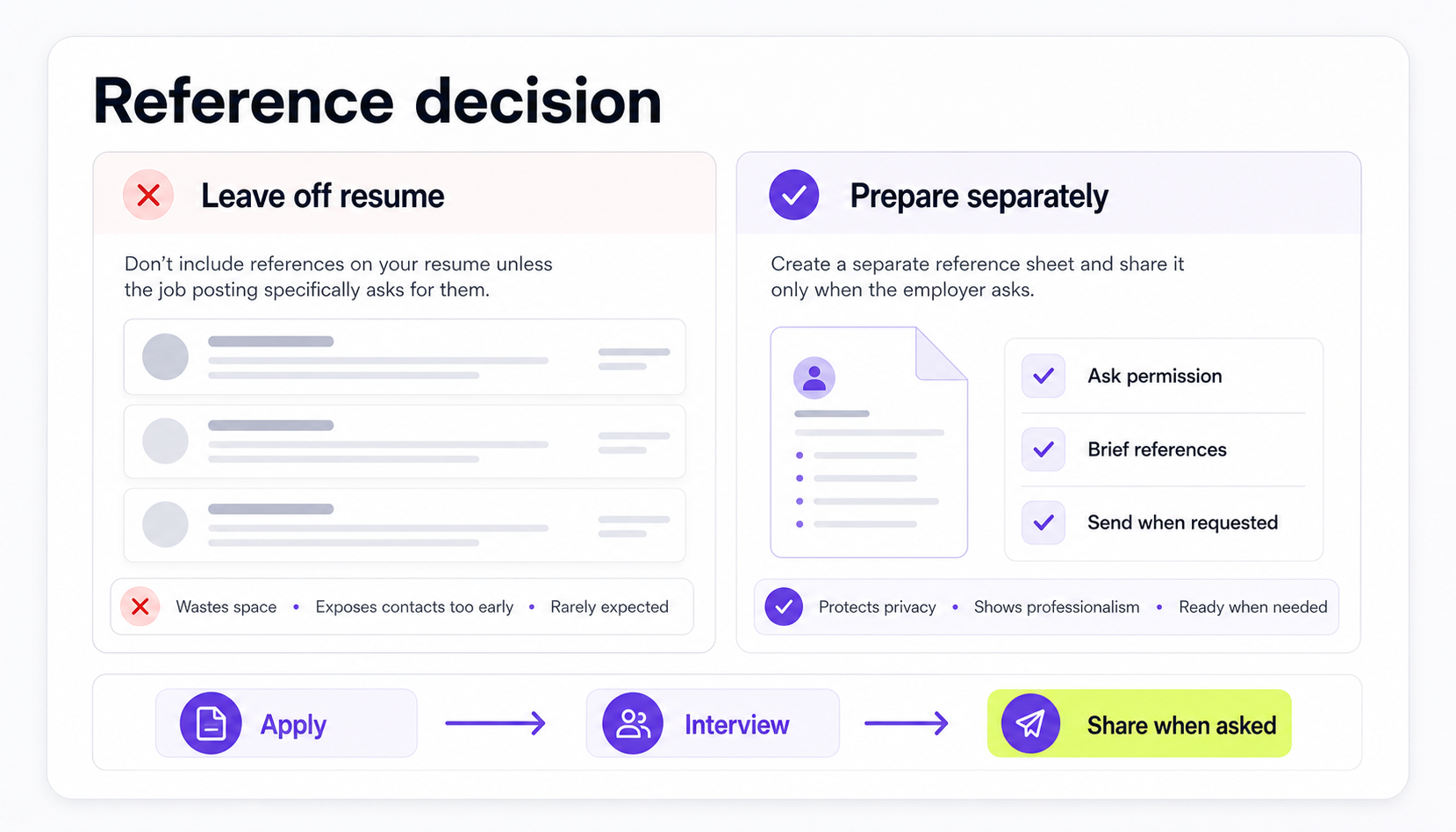
Use this workflow:
- Send your resume and cover letter without reference contact details.
- Interview and confirm the employer wants to move forward.
- Share your reference list when the employer asks.
- Tell your references which role you are being considered for.
- Thank your references after they help.
This keeps your resume focused and protects your references from being contacted before they have agreed, prepared, or seen the role.
When references do belong in the application
Sometimes you should provide references earlier. Follow the employer's instructions when they are explicit.
| Situation | What to do |
|---|---|
| Job posting asks for references with the application | Include a separate reference-list document, not a reference section inside the resume, unless the instructions say otherwise. |
| Online application form has reference fields | Fill out the fields only after you have permission from each reference. |
| Recruiter asks after an interview | Send a separate reference sheet and brief your references that day. |
| Academic, government, fellowship, or grant application asks for referees | Follow the format and number requested by the application. |
| You are asked to bring references to an interview | Bring a printed or PDF reference sheet. |
| No one asks for references | Keep them ready, but do not include them. |
If your resume feels too short without references, that is usually a resume-content problem, not a reason to add reference details. Improve your bullets, achievements, skills, and summary instead. You can use the AI resume builder to structure the resume or run an AI resume review to check whether the space is being used well.
How to format a reference list
Your reference list should be a separate one-page document. Use the same name, email, phone number, font style, and spacing as your resume so the documents feel like a set.
Include this information for each reference:
- Full name.
- Current job title.
- Company or organization.
- Email address.
- Phone number, if they agreed to share it.
- Your relationship to them.
- A short context line, such as "Former manager at Acme from 2022 to 2024."
Do not include private details the employer does not need, such as home addresses, personal notes, or references who have not agreed to be contacted.
Resume reference list example
Use this format:
| Field | Example |
|---|---|
| Your header | Jordan Lee, jordan.lee@email.com, 555-012-3456 |
| Reference name | Priya Shah |
| Title and company | Senior Product Manager, Northstar Labs |
| Contact | priya.shah@email.com, 555-555-0199 |
| Relationship | Former manager |
| Context | Managed me from 2022 to 2024 on a remote product operations team. |
Name the file clearly, for example Jordan-Lee-References.pdf. If you want a consistent naming convention, use the same principles from this resume file name guide.
Who to use as a reference
Choose people who can speak clearly about your work, reliability, communication, and results. The best reference is not always the most senior person you know. It is the person who can give specific, credible examples.
Good references include:
- A recent manager or supervisor.
- A team lead who reviewed your work.
- A coworker who collaborated closely with you.
- A client or stakeholder, if appropriate.
- A direct report, for leadership roles.
- A professor, advisor, or project mentor for students or recent graduates.
- A volunteer coordinator or community leader if your paid work history is limited.
Avoid using family members, close friends, people who barely know your work, or anyone who may be surprised by the employer's call.
For remote roles, prioritize references who can speak to communication, ownership, async collaboration, reliability, and ability to work without close supervision.
How many references should you have?
Prepare three to five references. Many employers ask for three, but having a few backups helps if someone is unavailable or not relevant to a specific role.
For most job seekers, a good mix is:
- One former manager.
- One coworker or cross-functional partner.
- One person who can speak to a specific strength, such as leadership, technical skill, customer work, or project delivery.
If you are early in your career, use academic, internship, volunteer, or project references. The goal is not to prove you have a long work history. The goal is to give the employer someone credible who can confirm how you work.
How to ask someone to be a reference
Always ask before listing someone as a reference. Give them enough context to decide and enough information to speak well about you.
Use a short message like this:
Hi Priya, I am applying for product operations roles and would be grateful if I could list you as a professional reference. The roles are similar to the work we did on the onboarding project at Northstar. If you are comfortable, I would share your email and phone number only when an employer asks for references. I can send the job description and my current resume so you have context.
After they agree, send:
- The job title and company.
- The job description.
- Your current resume.
- A few reminders of projects you worked on together.
- The skills or responsibilities the employer is likely to ask about.
- The expected timing, if you know it.
Track reference requests in your job application tracker so you know which employers received which references and when to thank people.
Common resume reference mistakes
Avoid these mistakes:
- Adding a full reference section to every resume.
- Using "references available upon request" as filler.
- Listing references without permission.
- Sharing personal phone numbers or emails without checking.
- Choosing people who cannot speak to your work.
- Using stale references from many years ago when more recent contacts are available.
- Sending references before the employer asks.
- Forgetting to brief your references before a call.
- Using a reference list with inconsistent formatting.
- Naming the file vaguely, such as
references.docx.
Leaving references off your resume is not a weakness. It is part of keeping your resume focused. If you are tightening your application materials, review these resume mistakes before you apply.
FAQ
Should I write "references available upon request" on my resume?
Usually, no. It is outdated and takes space away from stronger resume content. Employers already know they can ask for references.
Can I put references on a two-page resume?
Still usually no. Even on a two-page resume, references should normally stay on a separate reference sheet. Use resume space for experience, achievements, skills, projects, and credentials.
Should students include references on a resume?
Students should usually keep references separate too. Prepare professors, advisors, internship supervisors, volunteer coordinators, or project mentors as references, then share them when requested.
What if the job application requires references?
Follow the instructions. If the application form asks for references, provide them there after getting permission. If the posting asks for a document, attach a separate reference list unless it specifically says to include references in the resume.
Do employers actually call references?
Some do and some do not. Reference checks are more common later in the hiring process, often after interviews and before an offer. That is why your references should be ready before the employer asks.
Should I include my current manager as a reference?
Only if your current manager knows you are job searching and has agreed to be contacted. If your search is confidential, use a former manager, trusted former coworker, client, mentor, or another professional contact.
Build the resume first, then prepare references
References can support your application, but they rarely help if the resume does not earn an interview. Keep your resume focused on the evidence an employer needs first: relevant experience, clear achievements, strong skills, and a clean format.
Himalayas can help you build and improve that first document. Use the AI resume builder to create a focused resume, then use AI resume review to check whether your content is specific, relevant, and ready to send. Keep your reference sheet ready in the background, and share it when the hiring team asks.