The best free AI interview practice tool to try first is the one that lets you rehearse out loud with questions tied to the role you are actually applying for. Start with Himalayas AI Interview if you have a job description and want job-specific mock interview feedback. Try Google Interview Warmup, ChatGPT, Claude, Gemini Live, FreeMockInterview, Mocklingo, or InterviewCoach.AI if you want free first reps before choosing a paid tool.
The right choice depends on your bottleneck. If your answers are vague, use a tool that reads the job description and asks follow-ups. If you ramble, use a speech coach. If you freeze on camera, use a video interview tool. If you are new to interviewing, use a structured curriculum. If you are tempted by a live answer assistant, pause: preparation tools help you improve before the interview, while live copilots can violate employer expectations and make you dependent on hidden help.
Best free AI interview practice tools to try first
Use a free tool for your first few reps, then upgrade only if the feedback helps you answer more clearly.
| Tool | Best free use | What to test first |
|---|---|---|
| Himalayas AI Interview | Job-specific mock interview from a real role | Paste or import the job description, answer by text or voice, and check whether the feedback improves relevance and structure. |
| Google Interview Warmup | Low-friction spoken practice | See whether the transcript reveals repeated words, missing talking points, or weak answer habits. |
| ChatGPT, Claude, or Gemini | Flexible roleplay and answer critique | Give it a job description, resume, and strict scoring rubric. Ask for one question at a time. |
| FreeMockInterview | No-login role-based practice | Test whether the generated questions match your target role and difficulty level. |
| Mocklingo | AI mock interviews plus communication practice | Check whether feedback helps with both content and spoken delivery. |
| InterviewCoach.AI | Video-style interview practice | Use the free sessions to see whether video pressure, pace, and confidence feedback are useful. |
Best AI interview practice tools compared
| Tool | Best for | AI practice type | Free option | Pricing note |
|---|---|---|---|---|
| Himalayas | Role-specific practice tied to real jobs | Job-description-based mock interviews with text, voice, and conversation modes | First mock interview free | Himalayas Plus unlocks more AI tools |
| Interviews by AI | Fast job-description-based practice | Tailored questions and instant feedback | Limited free start | Public site positions paid access around simple monthly pricing |
| FreeMockInterview | No-login free practice | Role, difficulty, and duration-based mock interview tool | Yes | Public site emphasizes free access |
| ChatGPT | Flexible daily practice | Conversational roleplay and critique | Yes | Free or paid plans |
| Claude | Long-context resume and answer critique | Written mock interviews and structured feedback | Yes | Free or paid plans |
| Google Interview Warmup | Free spoken answer hygiene | Spoken answers, transcripts, and talking-point feedback | Yes | Free |
| Gemini Live | Freeform voice roleplay | Conversational AI practice | Yes | Free or Google AI plans |
| Bossed | Voice-first job-specific pressure practice | CV and job-listing-based voice interview practice | Free start | Check current plan limits |
| Mocklingo | Role/domain practice and communication coaching | AI mock interviews with feedback | Free start | Check current plan limits |
| Big Interview | Structured interview curriculum | Lessons, video practice, answer builder, and AI feedback | Often through institutions | Personal plans vary |
| InterviewCoach.AI | Video interviewer and speech analysis | AI video mock interviews and analytics | Free sessions advertised | Check current plan limits |
| Yoodli | Speech delivery and confidence coaching | AI speaking analysis | Limited | Free and paid plans |
| Huru | One-way video interview practice | AI video feedback and answer scoring | Limited | Paid plans vary |
| Final Round AI | Advanced interview simulation and broader career tooling | Mock interviews plus live-assistance features | Limited | Paid plans vary |
| OphyAI | Behavioral, technical, system design, and case practice | AI mock interviews with scored review | Trial/credits | Check current plan limits |
| Revarta | Voice-based behavioral coaching | AI interviewer and STAR feedback | Limited | Check current plan limits |
| Talentee Nova | Multilingual voice coaching | Voice conversation and adaptive follow-ups | Limited | Check current plan limits |
| Afterview | Real-time company and role-specific mocks | Voice interview simulation and scored feedback | Limited | Check current plan limits |
| Voomer | One-way video interview practice | AI scoring for video answers | Trial | Check current plan limits |
| Rezi | Resume-based interview practice | AI interview questions from resume context | Yes | Resume platform plans vary |
| aiApply | Interview tools inside a job-search suite | Mock interview and interview assistance features | Trial | Product-specific plans vary |
| Interview Prep AI | Quick simulations from CV and JD context | CV and job-description-based practice | Yes | Credit-based plans |
AI practice tools, live copilots, and employer software are different
AI tools for interview preparation are not all solving the same problem.
| Category | Use it for | Be careful when |
|---|---|---|
| AI mock interview tools | Practicing before the real interview, getting feedback, building confidence, and improving answers. | The feedback is generic, too complimentary, or not tied to the job description. |
| General AI assistants | Cheap daily reps, answer rewrites, follow-up drills, and resume-aware critique. | You do not give the model a rubric or it starts writing polished answers you would never say. |
| Speech and video coaches | Pacing, filler words, eye contact, concision, and one-way video pressure. | The tool improves delivery but ignores whether your examples prove the right competencies. |
| Structured prep platforms | Lessons, frameworks, guided practice, and career-center style curriculum. | You already know the fundamentals and only need targeted reps for one job. |
| Live interview copilots | Real-time suggestions during an actual interview. | Employer policies prohibit assistance, the platform detects it, or you become dependent on hidden answers. |
| Employer interview software | Recruiting teams screening, scheduling, recording, or assessing candidates. | You are a candidate looking for practice. These products are usually not built for you. |
Use AI to prepare before the interview. Be cautious using AI to perform during the interview.
How to choose an AI interview practice tool
Start with the interview problem you need to solve, not the longest feature list.
- Choose a job-description-based tool if your answers sound generic.
- Choose voice practice if you think clearly in writing but struggle out loud.
- Choose video practice if you are preparing for one-way interviews, Zoom interviews, or assessment-style prompts.
- Choose a structured curriculum if you need fundamentals, examples, and lessons before you practice.
- Choose ChatGPT, Claude, or Gemini if you want flexible low-cost reps and can bring your own prompt.
- Choose a human mock interview near the end if you need realism, industry-specific judgment, or pressure that AI cannot replicate.
A strong tool should help you improve at least five things: relevance to the job description, specificity, ownership, structure, and follow-up readiness. That is also the core of the STAR method when you are practicing behavioral interview questions.
What to test in your first free AI mock interview
Do not judge a tool from the homepage. Run one short practice session and grade the feedback.
| Test | Good sign | Red flag |
|---|---|---|
| Job relevance | The questions reflect the actual responsibilities, seniority, and language in your job description. | It asks only generic questions you could find in any interview article. |
| Follow-ups | It challenges vague answers with "how," "why," "what did you own," and "what was the result?" | It accepts every answer after one response. |
| Feedback strictness | It names missing metrics, unclear ownership, weak structure, and role mismatch. | It mostly says "great answer" and rewrites your response without explaining why. |
| Spoken realism | You can practice out loud and handle pauses, pressure, and interruptions. | It only helps you polish written scripts. |
| Privacy fit | You understand what happens to your resume, transcript, and job description. | You must upload sensitive documents before seeing clear data terms. |
| Actionability | You leave with one or two specific improvements for the next rep. | You leave with a score but no clear next action. |
If a free session does not make your next answer sharper, do not pay for the tool.
1. Himalayas

Himalayas is the best AI interview practice tool when you want mock interviews connected to jobs you are actually applying for. A generic question bank can help you warm up, but the strongest interview prep starts with the role: responsibilities, seniority, tools, outcomes, and the evidence a hiring manager is likely to probe.
With Himalayas AI Interview, you can generate interview questions from a job description, practice by text, voice, or real-time conversation, and get feedback on how to improve your answer. Your first mock interview is free, which makes it a useful starting point even if you are still comparing tools.
Best for: Job seekers who want role-specific mock interviews tied to real job descriptions.
Where it is strong:
- Job-description-based interview questions.
- Text, voice, and conversation modes.
- Instant feedback on answer quality.
- Strong fit for behavioral, remote-work, and role-specific preparation.
- Natural next step from searching jobs, saving roles, or preparing applications.
Where it falls short: If your only bottleneck is camera presence or filler words, a dedicated video or speech coach may be more focused.
2. Interviews by AI

Interviews by AI is a lightweight option for turning a job description into likely interview questions. The workflow is simple: paste the job description, practice out loud or in writing, then review feedback. That makes it a good fit when you need targeted practice without a large career platform around it.
Best for: Fast job-description-based practice.
Where it is strong:
- Clear job-description input.
- Behavioral and technical question generation.
- Out-loud or written practice.
- STAR-oriented feedback.
- Simple setup for one upcoming interview.
Where it falls short: It is narrower than tools that also manage saved jobs, broader interview plans, video analytics, or resume/application workflows.
3. FreeMockInterview
FreeMockInterview has a strong free-practice angle: no-login access, many job profiles, difficulty choices, and session durations. It is useful when you want quick reps immediately and do not want to create an account before testing whether AI mock interviews help you.
Best for: Free first reps and quick role-based practice.
Where it is strong:
- Low-friction free access.
- Broad job-profile coverage.
- Difficulty and duration controls.
- Useful for candidates who need to start practicing immediately.
Where it falls short: A free tool is only as useful as its feedback quality. Check whether it asks realistic follow-ups and gives specific critique rather than broad encouragement.
4. ChatGPT
ChatGPT is one of the strongest DIY interview practice tools because it can simulate almost any interview scenario if you prompt it well. You can paste a resume, job description, and target-company context, then ask for a recruiter screen, behavioral interview, product interview, technical explanation round, or panel interview.
Use this prompt:
"Act as an interviewer for a [job title] role at a [company type]. Ask me one question at a time. After each answer, score me on specificity, relevance to the job description, STAR structure, clarity, ownership, and impact. Ask realistic follow-up questions when my answer is vague. Be direct, not encouraging."
Best for: Flexible daily practice and low-cost repetitions.
Where it falls short: It will not automatically track your job pipeline, enforce a consistent rubric, or know when feedback is too soft. You have to bring the structure.
5. Claude
Claude is strongest when you want thoughtful written critique across a longer resume, several job descriptions, and multiple answer drafts. It is useful for senior candidates, career changers, or anyone who needs to find the best evidence from a complex work history.
Best for: Resume-aware written critique and answer refinement.
Where it is strong:
- Long-context review.
- Clear feedback on vague claims.
- Good fit for turning resume bullets into likely interview questions.
- Useful for comparing several answer examples against one role.
Where it falls short: Claude is less purpose-built than a dedicated mock interview product. You will need to set up the interview format, rubric, and practice cadence yourself.
6. Google Interview Warmup

Google Interview Warmup is one of the best free ways to start practicing answers out loud. It lets you answer interview questions, see a transcript, and spot patterns in your response.
Best for: Free spoken answer hygiene.
Where it is strong:
- No complicated setup.
- Good first step if you have not interviewed in a while.
- Helps you notice repeated words and weak talking points.
Where it falls short: It is not built around your exact resume, job description, or target company. Use it to warm up, then move to a more role-specific tool.
7. Gemini Live
Gemini Live is useful for freeform voice roleplay inside Google's AI ecosystem. Give it your target role, interview type, and job description, then ask it to act as the interviewer and challenge vague answers.
Best for: Conversational voice practice.
Where it falls short: It is a general AI assistant, not a purpose-built interview prep system. You need to supply the structure and review whether the feedback is strict enough.
8. Bossed
Bossed is a voice-first AI interview practice tool built around a personalized interviewer. Its positioning is useful for candidates who want to import a job listing, upload a CV, choose a difficulty level, and practice under more realistic spoken pressure.
Best for: Voice-based job-specific practice.
Where it is strong:
- CV and job-listing personalization.
- Voice practice.
- Difficulty levels.
- Constructive feedback on interview technique.
Where it falls short: It is most useful when spoken pressure is the problem. If you need structured curriculum or video practice, compare it with Big Interview or InterviewCoach.AI.
9. Mocklingo
Mocklingo combines AI mock interviews with communication practice. It is relevant for candidates who want role/domain practice and also need help sounding clearer, more confident, or more fluent.
Best for: AI mock interviews plus communication practice.
Where it is strong:
- Role and domain coverage.
- Real-time practice.
- Feedback and communication coaching.
- Useful for candidates who want interview and speaking practice together.
Where it falls short: Make sure the tool improves the substance of your answer, not only delivery.
10. Big Interview
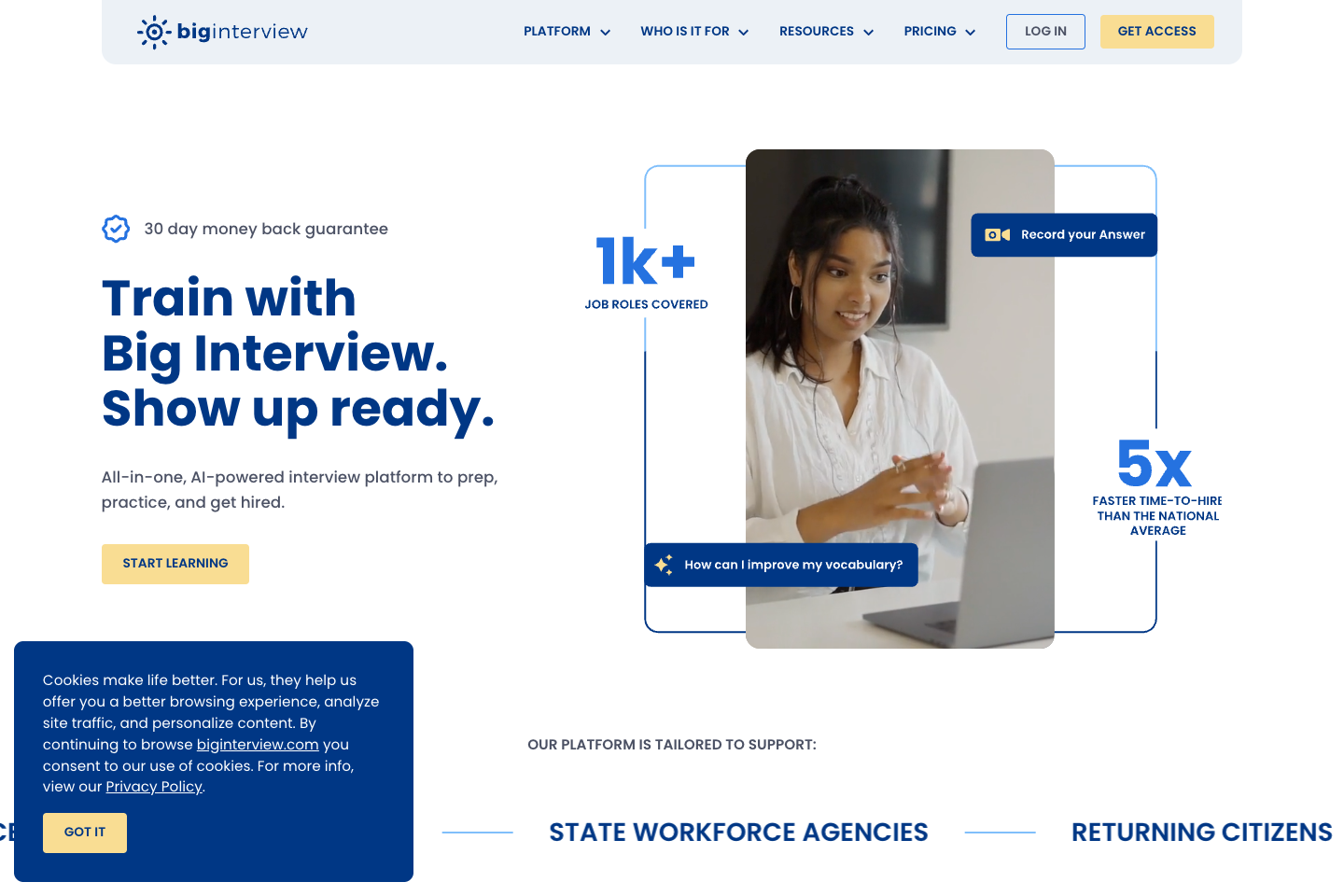
Big Interview is closer to a structured interview training platform than a simple AI mock interview tool. It combines lessons, playbooks, question practice, video practice, answer building, and AI feedback.
Best for: Guided interview curriculum, especially through a university, career center, or workforce program.
Where it is strong:
- Step-by-step learning paths.
- Video practice and AI feedback.
- Career-stage playbooks.
- Strong fit for candidates who need fundamentals before advanced practice.
Where it falls short: It can be more platform-like than quick job-description practice. If you have an interview tomorrow and one job description in hand, start with a faster mock interview tool.
11. InterviewCoach.AI
InterviewCoach.AI focuses on AI video interview practice, speech analysis, STAR coaching, role/company selection, and progress tracking. It is a good fit if your real interview will be on camera or you freeze when speaking to a screen.
Best for: Video-style AI mock interviews and delivery analytics.
Where it is strong:
- AI video interviewer.
- Free sessions advertised.
- Speech, pacing, and confidence feedback.
- STAR story builder and resume review features.
Where it falls short: Video analytics are useful, but they do not replace role-specific evidence. Pair it with job-description practice if your answers lack substance.
12. Yoodli
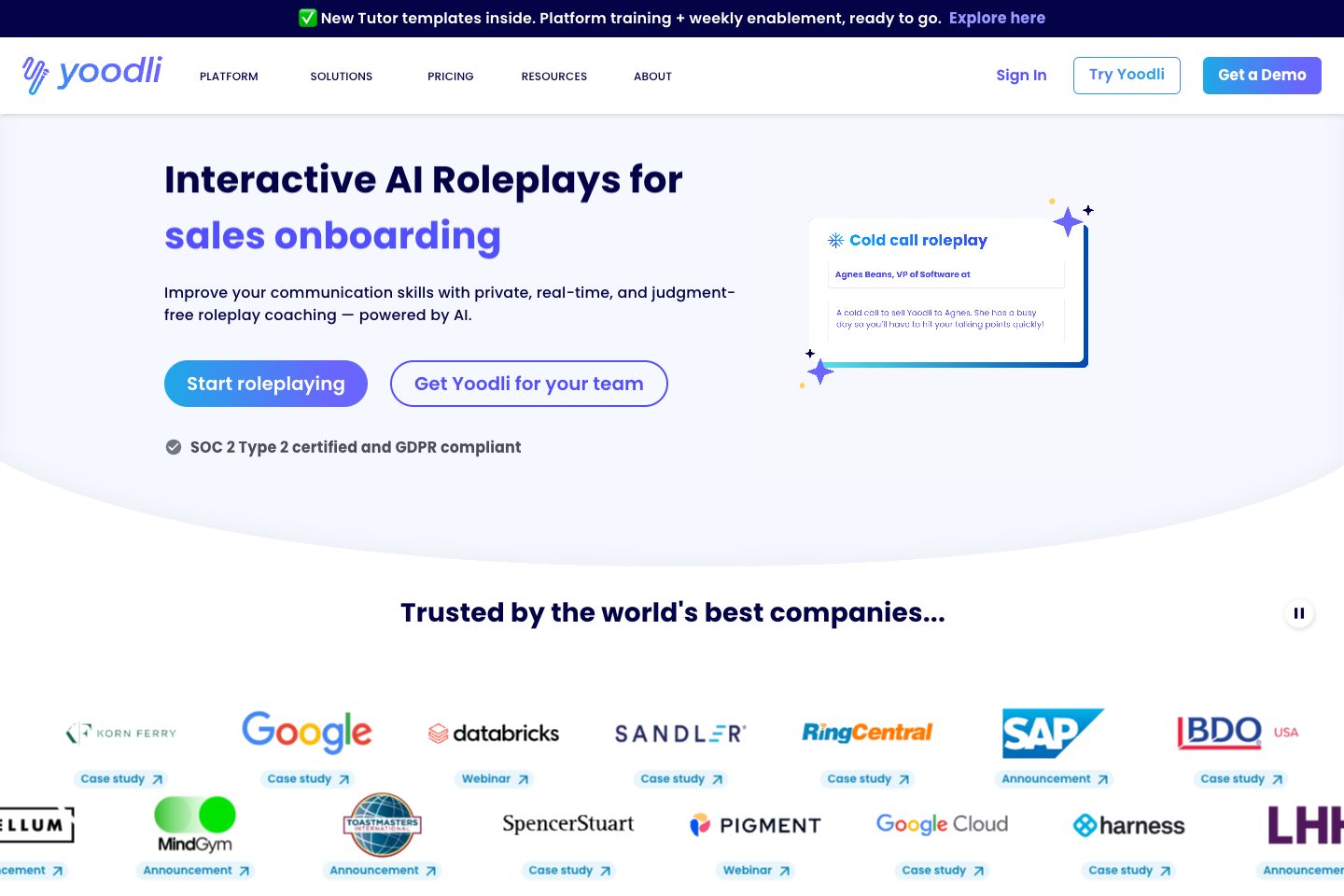
Yoodli is an AI communication coach that helps with pacing, filler words, concision, clarity, and confidence. That is a different problem from question generation, but it is a real interview bottleneck.
Best for: Candidates who ramble, rush, or sound less confident than they feel.
Where it falls short: It is not the best first choice if you need the tool to generate role-specific questions from a job description.
13. Huru
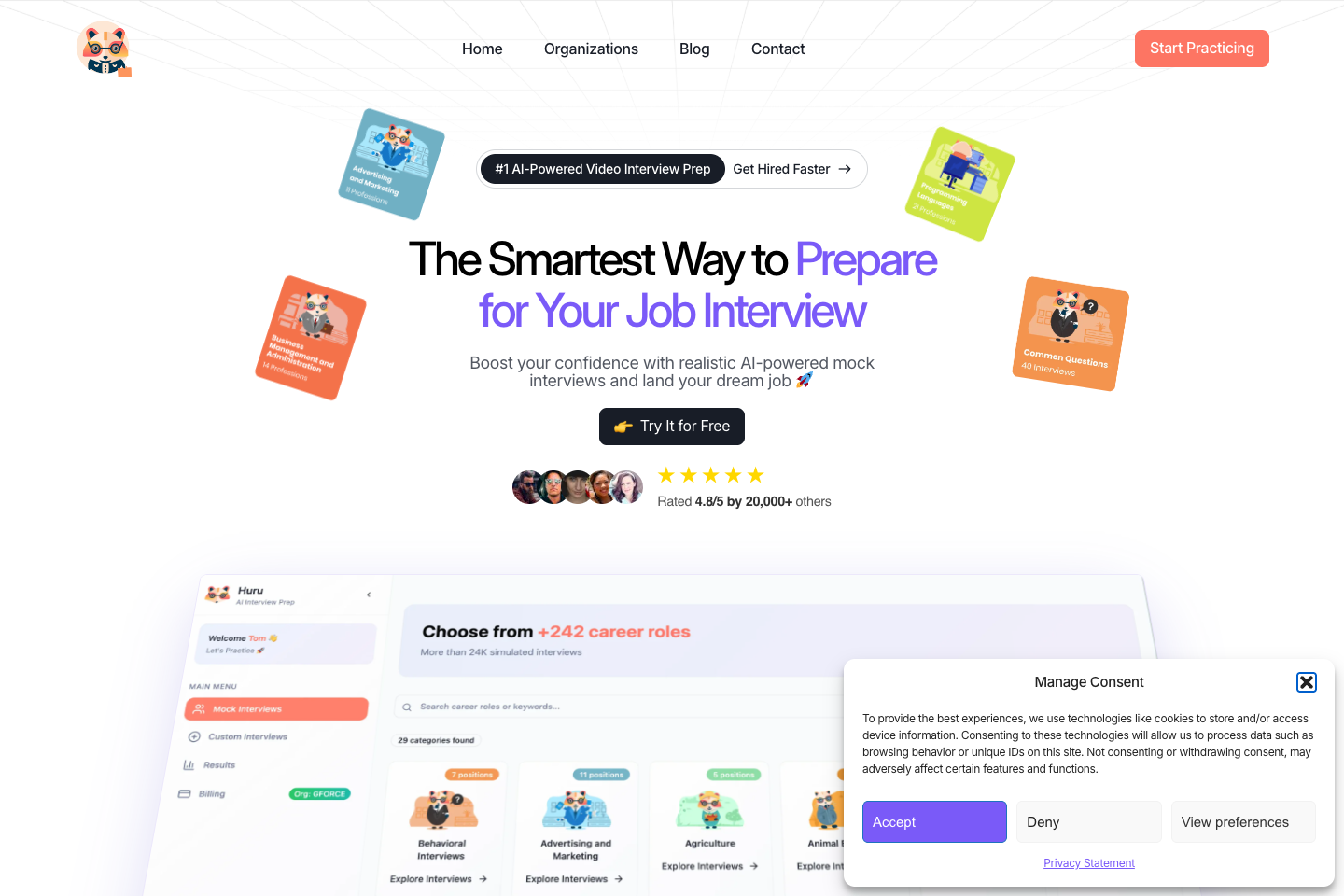
Huru focuses on video interview practice and AI feedback. It is useful for candidates preparing for one-way video interviews, recruiter screens, and situations where on-camera delivery matters.
Best for: Video interview practice and on-camera confidence.
Where it falls short: Delivery feedback is valuable, but your answers still need to prove the right competencies for the role.
14. Final Round AI
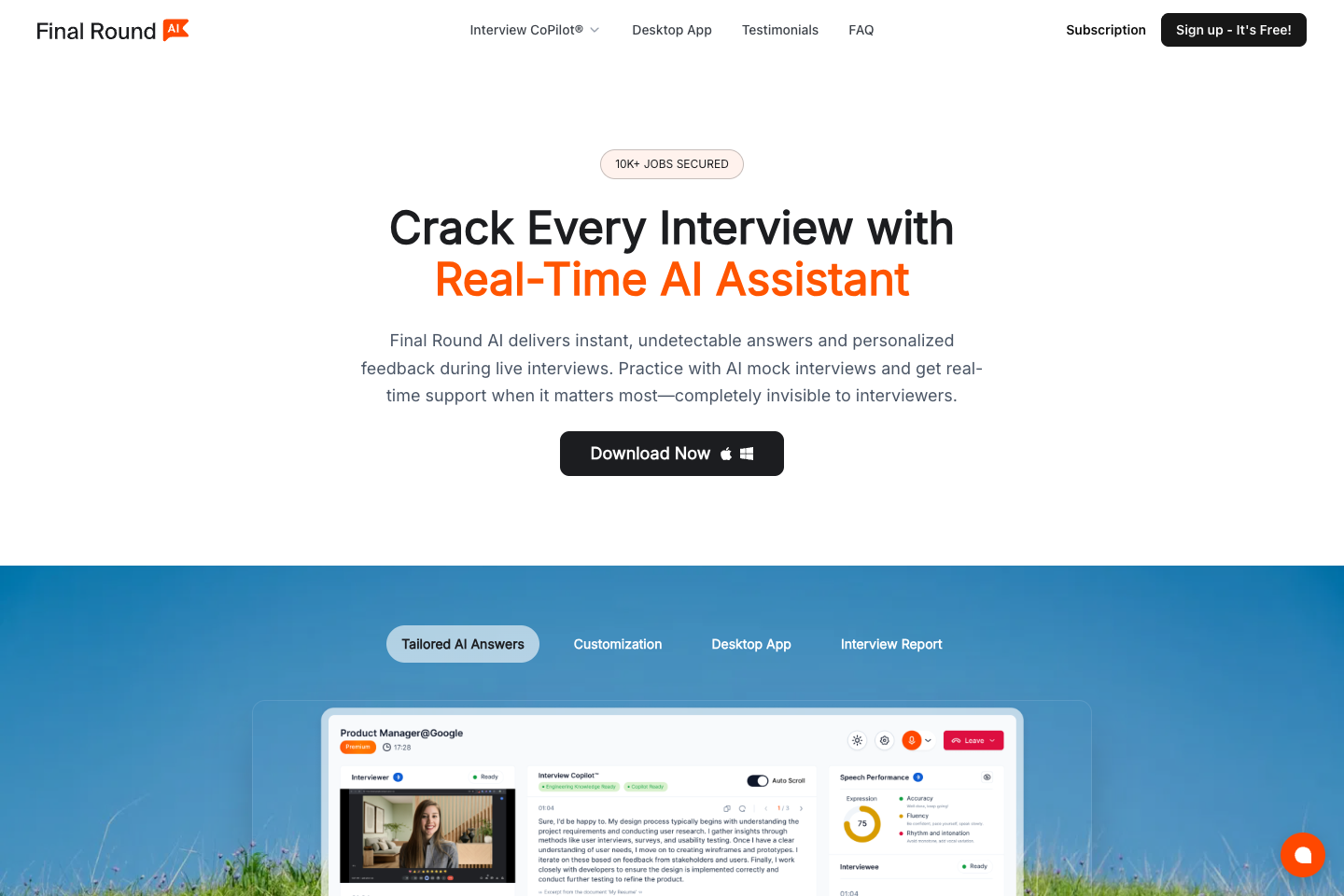
Final Round AI is one of the most visible AI interview platforms in the category. It offers mock interviews, resume support, question banks, and live interview assistance.
Best for: Candidates who want a broad interview suite and understand the boundary between preparation and live assistance.
Where it falls short: The live-assistance positioning can blur the line between legitimate practice and risky interview behavior. Use preparation features before the interview, and be careful with hidden help during real interviews.
15. OphyAI
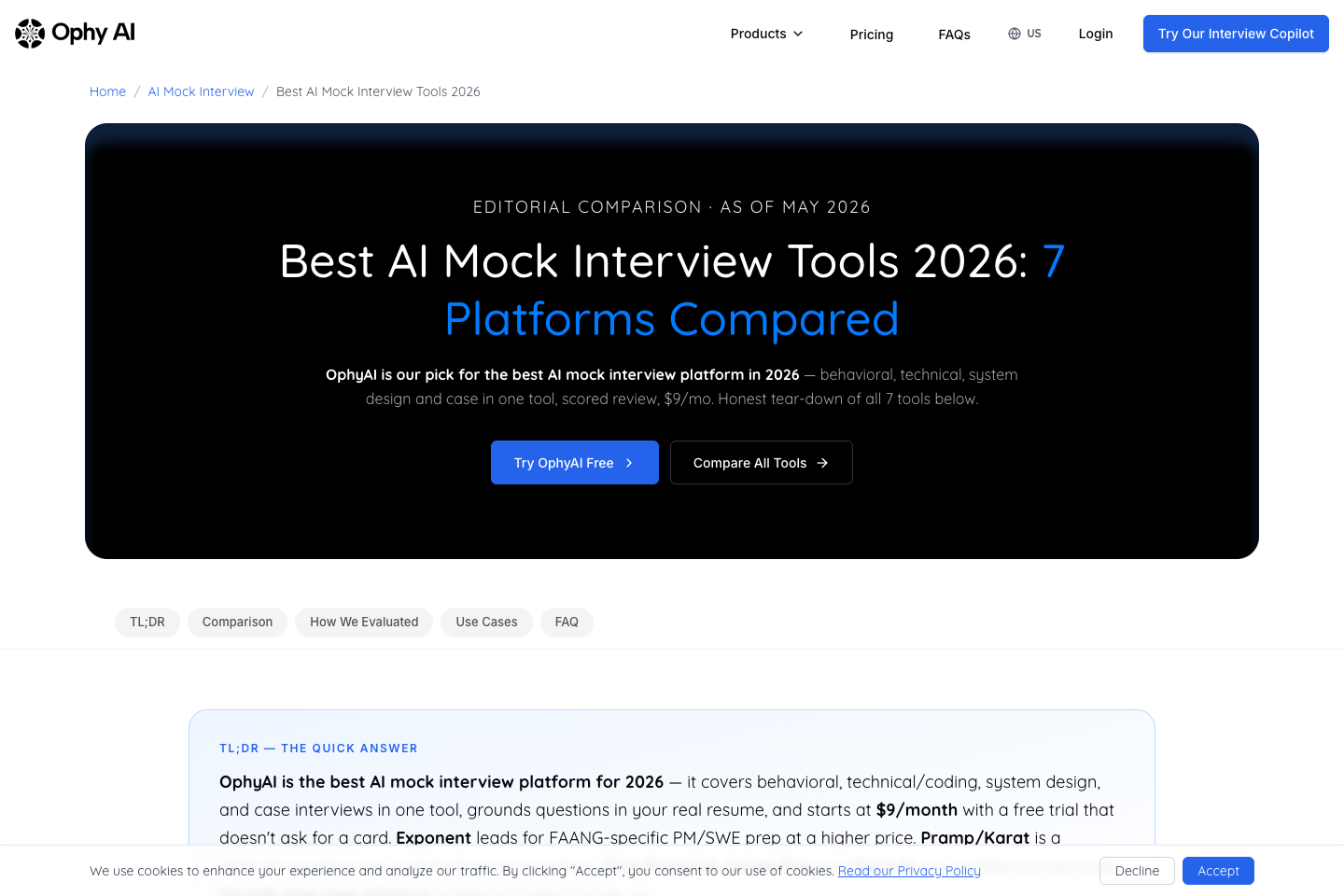
OphyAI positions itself around behavioral, technical, system design, and case interview practice. That breadth is useful if your interview loop includes more than one format.
Best for: Multi-format AI mock interviews.
Where it falls short: Breadth only helps if the feedback is strong for your exact format. Test the tool against the interview round you are most worried about.
16. Revarta
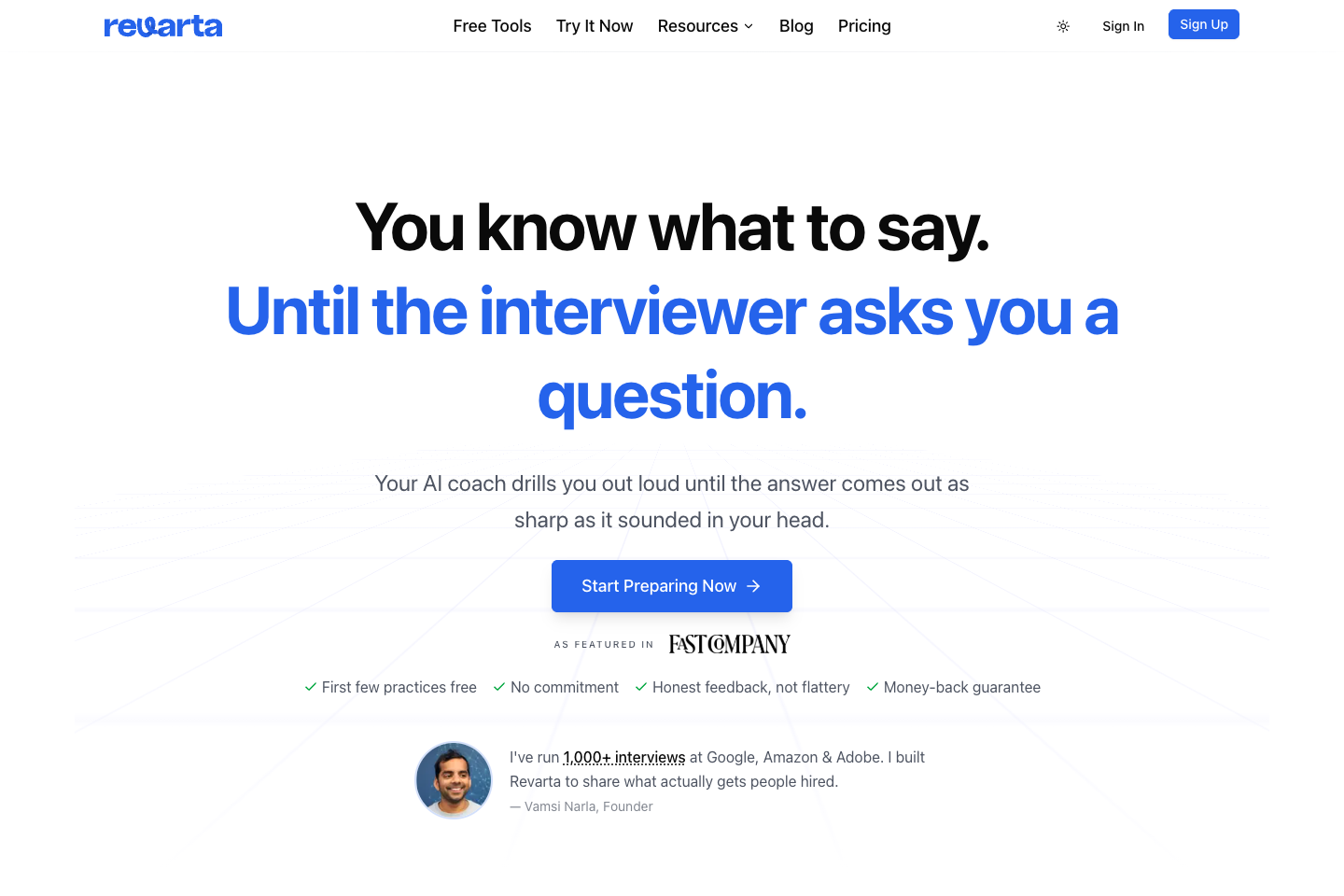
Revarta is a voice-first AI interview coach focused on realistic, job-specific mock interviews and STAR feedback.
Best for: Voice-based behavioral interview coaching.
Where it falls short: Compare its current free limits and pricing before relying on it for a full preparation plan.
17. Talentee Nova
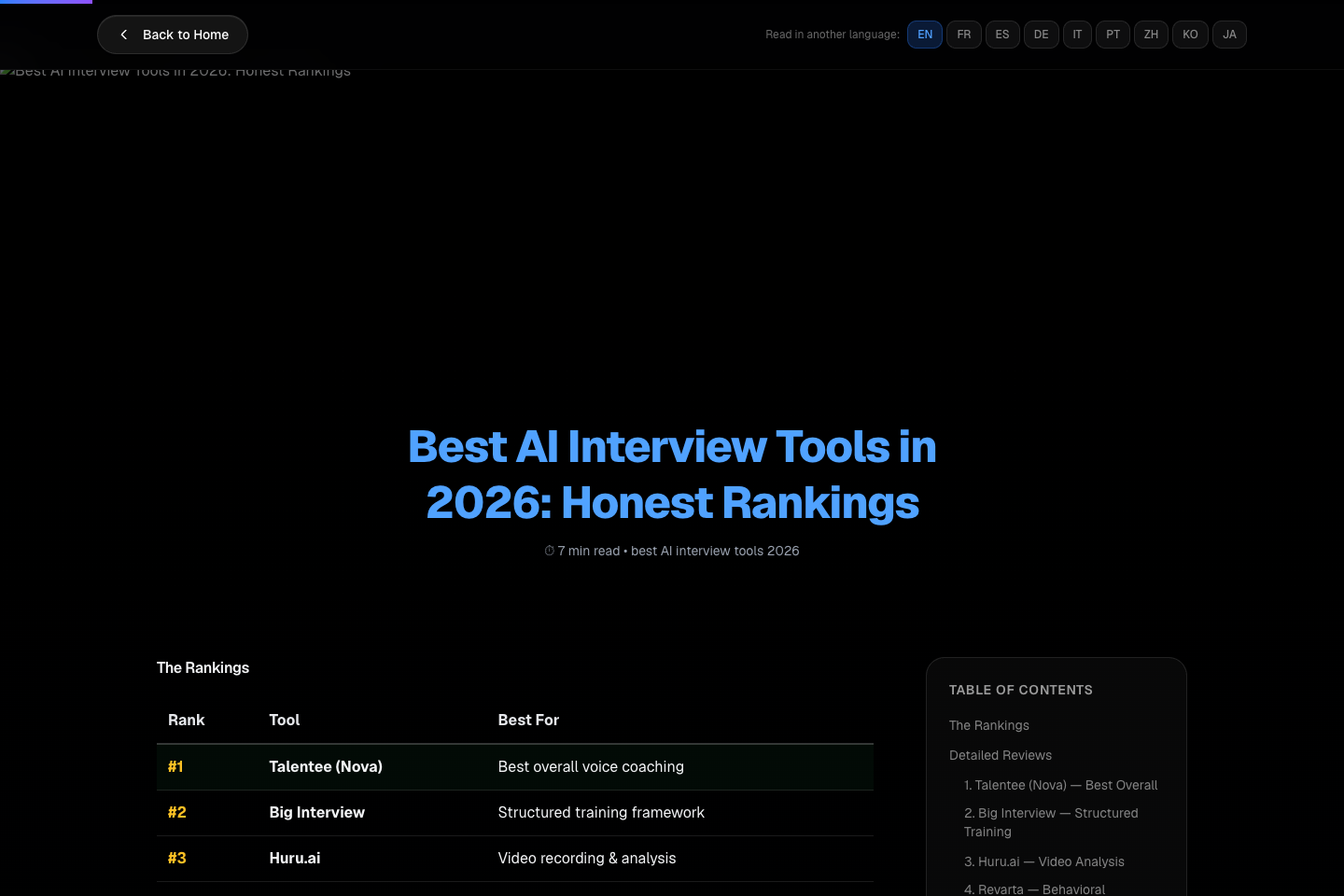
Talentee Nova emphasizes realistic voice conversation, adaptive follow-ups, real-time coaching, and multilingual support.
Best for: Conversational voice coaching across interview types.
Where it falls short: It is most useful when the spoken back-and-forth matters. For written answer critique, ChatGPT or Claude may be enough.
18. Afterview
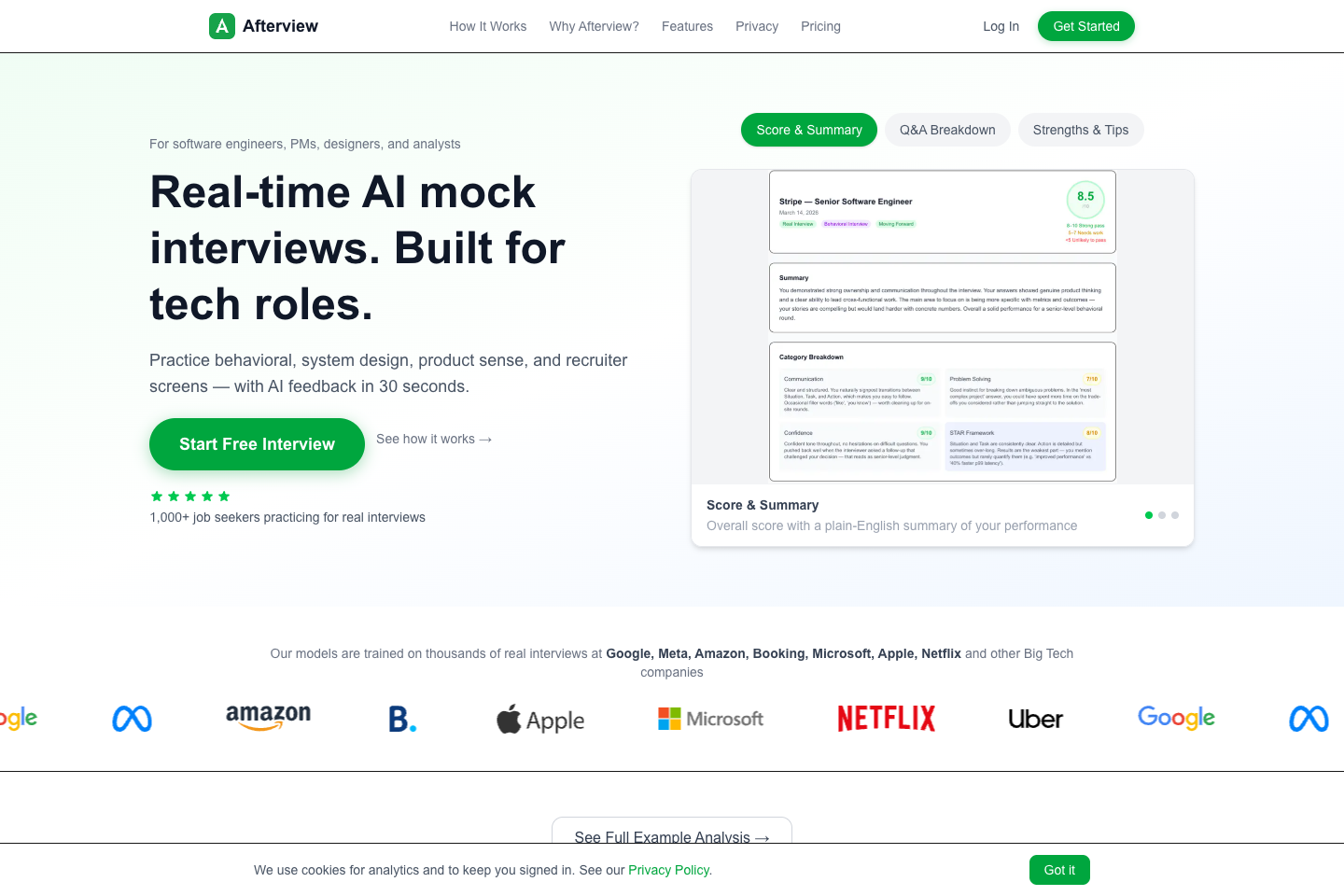
Afterview generates role-specific questions for a target company and position, runs a real-time voice interview, and returns scored feedback.
Best for: Real-time AI mock interviews tailored to a company and role.
Where it falls short: It is newer than some larger platforms. Test one session before committing to it as your main preparation tool.
19. Voomer
Voomer focuses on AI-guided video interview practice, especially for one-way video interviews and assessment-style prompts.
Best for: One-way video interview practice and AI scoring.
Where it falls short: It is less flexible than an all-purpose mock interview tool, but stronger when recorded answer quality is the main problem.
20. Rezi

Rezi is best known for its AI resume builder, but it also includes interview practice. Resume-based practice is useful because interviewers often ask directly about the claims in your work history.
Best for: Resume-based interview practice.
Where it falls short: If you are not already using Rezi for resumes, a dedicated interview tool may be simpler. Compare it with AI resume builders if your preparation starts with your application materials.
21. aiApply

aiApply is a broader AI job-search suite with tools for resumes, cover letters, job applications, and interview preparation.
Best for: Job seekers who want interview practice bundled with application tools.
Where it falls short: Bundled platforms can be convenient, but judge the interview workflow itself. A resume tool with an interview feature is not automatically the best mock interview product. Compare it with AI cover letter generators if the broader application workflow matters more than practice depth.
22. Interview Prep AI

Interview Prep AI helps candidates simulate interviews based on a CV, job description, interview type, and preferred language.
Best for: Simple AI interview simulations with CV and job-description context.
Where it falls short: It is best as a quick simulator. If you need deep delivery coaching, choose a voice or video-focused tool.
Adjacent tools worth knowing about
Some tools are useful for interview preparation but do not cleanly fit the main category.
| Tool type | Examples | Why it is adjacent |
|---|---|---|
| Human mock interview platforms | Pramp, Interviewing.io, InterviewBuddy | Useful for realism and expert judgment, but not AI-first interview practice. |
| Technical prep platforms | Exponent, HackerRank practice, coding mock interview tools | Strong for coding, product, or case rounds, but not always general interview practice. |
| Live interview copilots | LockedIn AI, Interview Copilot, Parakeet AI, Beyz AI, some Final Round AI features | They may assist during real interviews, which creates policy, trust, and dependency risk. |
| Employer interview software | Spark Hire, Greenhouse, HireVue-style assessment platforms | Built for recruiters or assessment workflows, not primarily for candidates practicing on their own. |
| Resume and cover-letter suites | Career.io, Jobright, Hiration, Careerflow | Helpful job-search tools, but interview practice is only one part of a broader workflow. |
Best AI interview practice tools by use case
| If your problem is... | Start with... | Why |
|---|---|---|
| You want practice for a specific job you are applying for | Himalayas or Interviews by AI | Both start from the job description. Himalayas also fits naturally into the job-search workflow. |
| You need many free or low-cost reps | ChatGPT, Claude, Gemini, Google Interview Warmup, FreeMockInterview | They lower the barrier to daily practice. |
| You ramble or sound nervous | Yoodli, Mocklingo, Bossed | They focus more on spoken delivery and communication. |
| You are preparing for one-way or video interviews | InterviewCoach.AI, Huru, Voomer | They create video-style pressure and delivery feedback. |
| You need fundamentals before practice | Big Interview | It teaches interviewing as a structured skill. |
| You need behavioral story practice | Himalayas, Claude, Revarta, Talentee Nova | They can help shape STAR answers and follow-up readiness. |
| You need technical or case practice | OphyAI, Exponent, technical mock platforms | They are more relevant for specialized interview rounds. |
What makes AI interview practice effective?
The best AI interview practice tools do more than generate questions.
They use the job description. Interviewers evaluate you against the role. Practice should reflect the responsibilities, requirements, seniority, tools, and outcomes in the posting.
They use your resume or profile. Strong preparation turns your actual experience into clear examples. If your resume says you improved retention, shipped a migration, managed stakeholders, or reduced support volume, you should be ready to explain how.
They make you answer out loud. Written answers are cleaner than spoken answers. Real interviews test how clearly you think and communicate under pressure.
They ask follow-up questions. A real interviewer will probe vague answers. Your AI interviewer should do the same.
They give actionable feedback. "Good answer" is not coaching. Useful feedback tells you whether you missed the result, lacked metrics, overused "we," rambled, or answered a different question.
They help you avoid sounding scripted. The goal is not to memorize AI-written answers. The goal is to make your own examples sharper and easier to deliver.
For the basics, pair AI practice with a clear understanding of what a mock interview is and how interviewers evaluate structured answers.
AI interview practice scorecard
Use this scorecard after each mock interview.
| Dimension | What good looks like | How to fix weak answers |
|---|---|---|
| Relevance | Your answer maps directly to the job description and seniority level. | Ask which responsibility your answer proves. |
| Specificity | You include concrete actions, constraints, trade-offs, and numbers. | Ask the AI to identify vague claims and force one metric or example. |
| Ownership | The interviewer can tell what you personally did. | Rewrite true "we" statements into "I owned," "I decided," "I led," or "I influenced." |
| Structure | The answer has a clear beginning, middle, and result. | Use STAR for behavioral answers and problem, options, trade-off, outcome for strategic answers. |
| Concise delivery | Most behavioral answers land in 60-120 seconds. | Ask the AI to cut repetition and preserve only the strongest evidence. |
| Follow-up readiness | You can defend the answer when asked "why," "how," or "what happened next?" | Run a follow-up-only round where the AI challenges every weak point. |
A 7-day AI interview practice plan
Use this one-week plan if you have an interview coming up and need fast improvement.
Day 1: Baseline. Run one spoken mock interview without over-preparing. Save the transcript. Look for rambling, vague examples, missed questions, and answers that do not match the job description.
Day 2: Build your evidence bank. List 8-10 stories from your work history: conflict, leadership, ambiguity, failure, customer impact, technical trade-off, stakeholder management, and measurable result. Ask the AI which stories best match the job description.
Day 3: Tighten behavioral answers. Practice STAR answers for the five most likely questions. Focus on ownership and results. Use behavioral interview question examples to fill any story gaps.
Day 4: Practice role-specific questions. Move beyond generic questions. For product roles, practice prioritization and metrics. For sales, practice objections and pipeline. For engineering, practice trade-offs and system constraints. For customer success, practice renewals, escalations, and churn risk.
Day 5: Run follow-up drills. Ask the AI to interrupt you, challenge vague claims, and ask three follow-ups per answer. This is where weak examples reveal themselves.
Day 6: Record or voice-practice a full mock. Use a voice or video tool if possible. Review pacing, filler words, answer length, and whether your strongest evidence is easy to understand.
Day 7: Final calibration. Do one realistic mock, then stop. Read your strongest answer outlines, prepare questions to ask the interviewer, and avoid cramming new material the night before.
For a broader preparation checklist, use Himalayas' guide on how to prepare for a job interview.
FAQs
What is the best AI interview practice tool?
Himalayas is the best AI interview practice tool if you want mock interviews tied to real job descriptions and roles you are applying for. ChatGPT, Claude, Google Interview Warmup, Interviews by AI, FreeMockInterview, Bossed, Mocklingo, Big Interview, InterviewCoach.AI, Yoodli, Huru, Final Round AI, and other tools are better fits for specific bottlenecks.
What is the best free AI interview practice tool?
Start with Himalayas if you have a job description and want your first AI mock interview free. Google Interview Warmup is a strong free choice for spoken answer hygiene. ChatGPT, Claude, and Gemini are useful free or low-cost options if you bring your own prompt and feedback rubric. FreeMockInterview and Mocklingo are also worth testing for quick free reps.
Are AI interview practice tools worth it?
Yes, when they make you answer realistic questions, practice out loud, and improve based on specific feedback. They are less useful when they only generate polished scripts or generic encouragement.
Can AI help with behavioral interview questions?
Yes. AI is especially useful for behavioral interview practice because it can help you structure answers using the STAR method, identify missing details, and ask follow-up questions about your examples.
Can AI help with technical interviews?
Yes, but choose carefully. General AI tools can help you explain concepts and rehearse problem-solving. Dedicated technical platforms may be better for coding, system design, product, or case-style rounds.
Is it okay to use AI during a live interview?
Using AI to practice before an interview is normal. Using AI to generate answers during a live interview is riskier because it may violate employer rules, undermine trust, or be detected by interview platforms.
How many mock interviews should I do before a real interview?
For most candidates, three to five focused practice sessions are a good minimum. For a high-stakes interview loop, do more: start with AI practice for volume, then add one human mock interview near the end for realism.
Start with job-specific practice
The best AI interview practice tool is the one that makes the real interview feel less surprising. A generic question can help you warm up, but a job-description-based mock interview helps you prepare for the responsibilities, examples, and follow-up questions you are likely to face.
With Himalayas AI Interview, you can generate interview questions from a role, practice by text or voice, and improve with AI feedback before the real interview. Start your first AI mock interview for free.