A good resume summary is a short section at the top of your resume that connects your target role with your strongest proof. It should tell a recruiter what you do, where you are strongest, and why the rest of your resume is worth reading.
Use this formula:
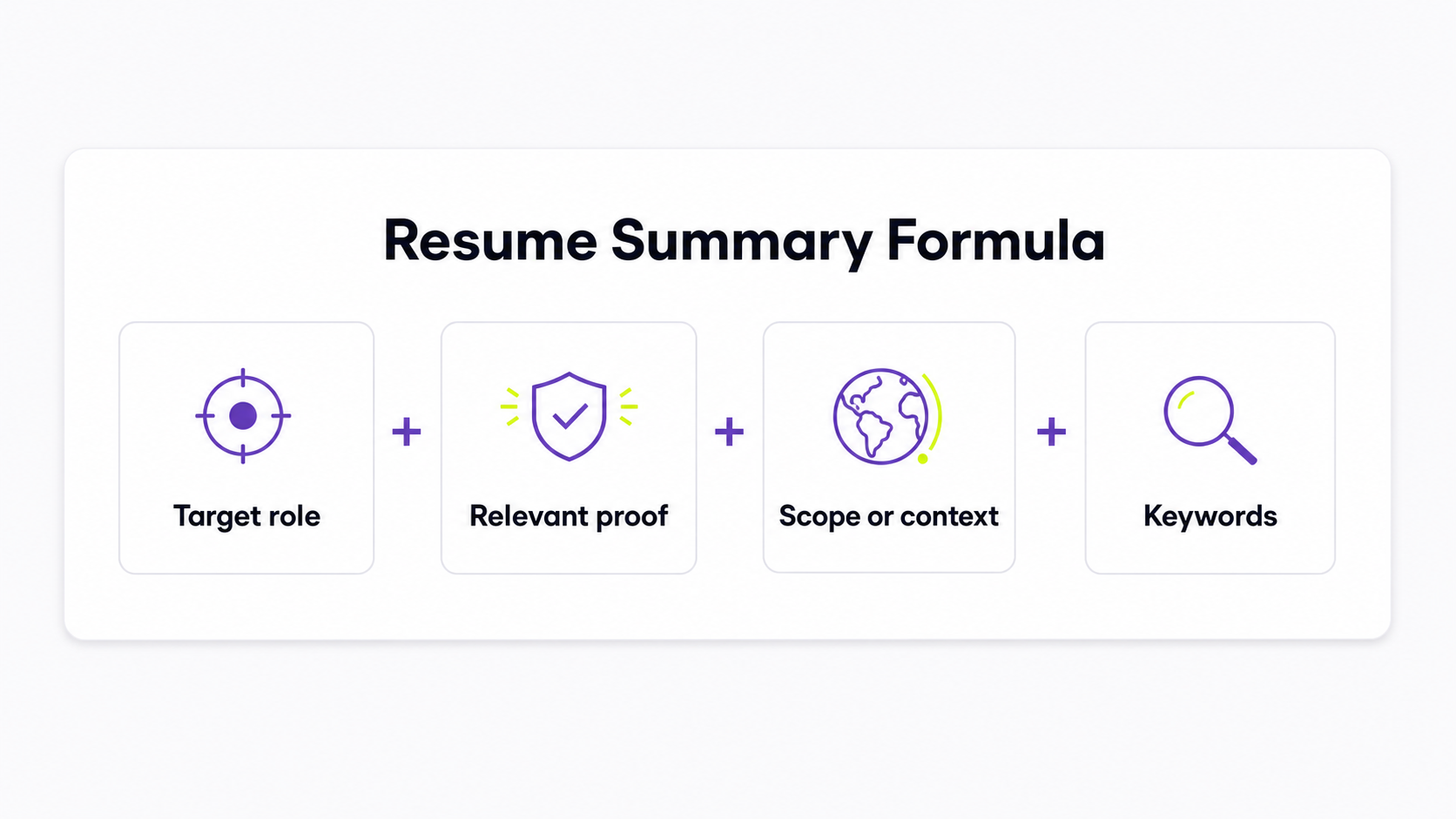
Target role + strongest proof + scope or context + role-relevant keywords
For example, instead of writing "Hardworking customer support professional looking for a new opportunity," write "Customer support specialist with 4 years of experience resolving SaaS support tickets across email, chat, and help center workflows. Known for clear documentation, calm escalations, and maintaining high-quality customer notes for distributed teams."
The goal is not to sound impressive in the abstract. The goal is to make your fit obvious for the specific job.
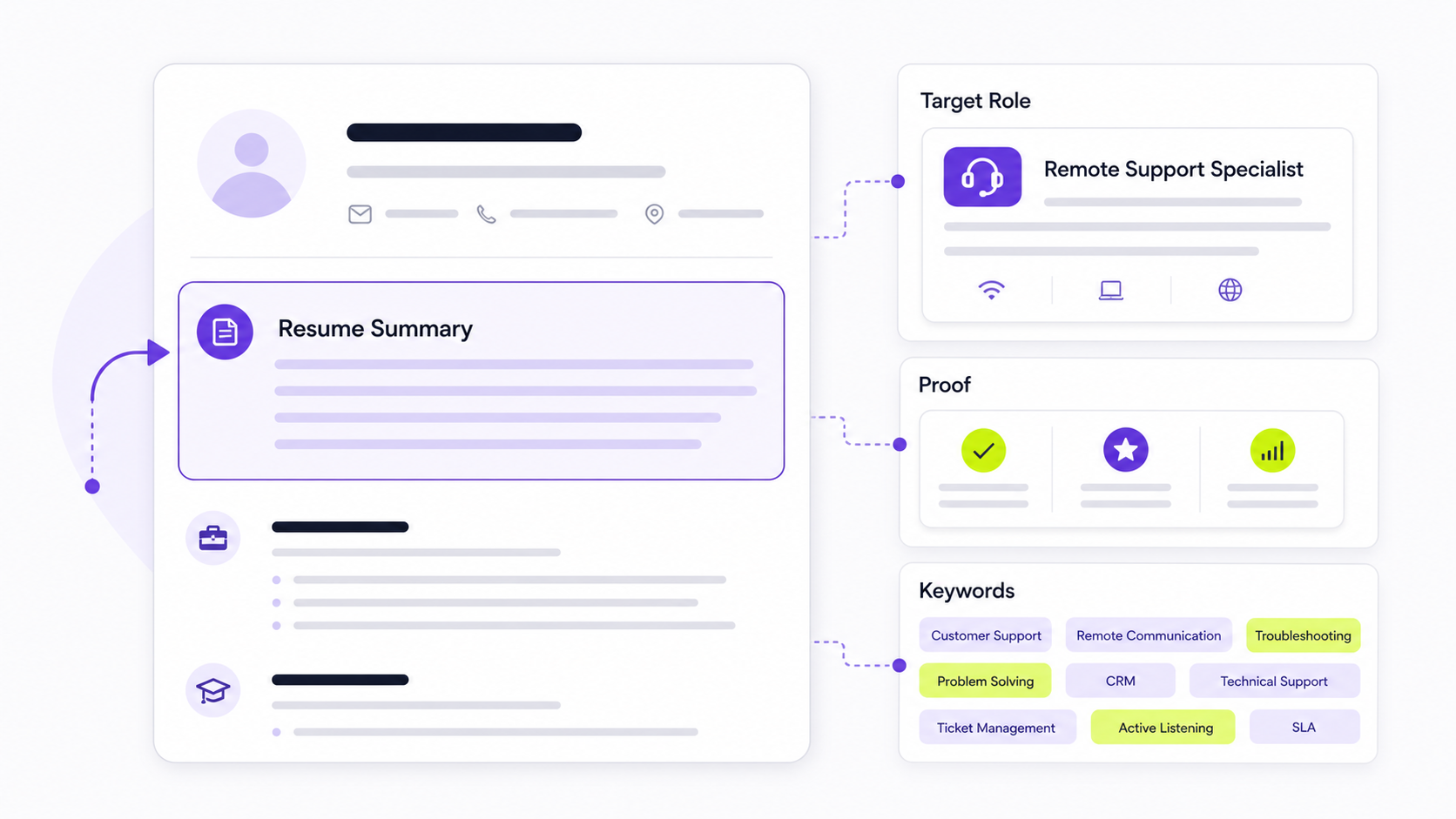
What is a resume summary?
A resume summary is a 2-4 line introduction near the top of your resume. It is also called a professional summary, resume profile, or summary of qualifications.
It usually appears below your name and contact details, before your work experience. A strong summary helps the recruiter quickly understand:
- The role or function you are targeting.
- Your most relevant experience.
- Your strongest skills, tools, or specialties.
- The type of work environment or business context you understand.
- Why your experience matches the job description.
A resume summary should not repeat your whole resume. Think of it as the introduction to the evidence that follows. If you only need a shorter one-line label under your name, use a resume headline instead.
Resume summary vs. resume objective
A resume summary focuses on proof. A resume objective focuses on what you want.
| Section | Best for | Example focus |
|---|---|---|
| Resume summary | Most job seekers with relevant experience, projects, education, or transferable skills | "Here is the proof I match this role." |
| Resume objective | Some entry-level candidates, career changers, or students with limited proof | "Here is the role I am targeting and why it fits my direction." |
Most job seekers should use a summary. Even if you are entry-level, you can usually write a short summary around coursework, internships, volunteer work, projects, tools, customer experience, or transferable skills.
Use an objective only when your career goal needs clarification and you do not have enough role-specific proof yet.
The resume summary formula
Use this structure when drafting:
Target role or function + relevant proof + scope/context + keywords
| Part | What it answers | Example |
|---|---|---|
| Target role | What kind of work are you applying for? | Customer support specialist, data analyst, product manager |
| Relevant proof | What shows you can do the work? | 4 years of experience, portfolio projects, support metrics, technical tools |
| Scope or context | Where have you done it? | SaaS startup, remote team, B2B customers, weekly reporting |
| Keywords | Which role requirements should appear naturally? | SQL, onboarding, CRM, async documentation, stakeholder management |
Before writing your summary, scan the job description. If the role repeatedly mentions onboarding, Salesforce, retention, and cross-functional communication, your summary should not lead with unrelated traits.
Use the Himalayas job description keyword finder to pull out important requirements, then choose the real proof you can support in your experience section.
How to write a resume summary
1. Choose the target role
Your summary should be written for a role, not for every possible job. "Marketing professional" is weaker than "Lifecycle marketing specialist" if the job is about email campaigns, segmentation, and retention.
If you are applying to several types of roles, create different summary versions.
2. Pull requirements from the job description
Look for repeated skills, tools, responsibilities, and outcomes. A strong summary mirrors the role's priorities without copying the job description word for word.
For a remote customer success role, you might see:
- Onboarding.
- Account health.
- CRM notes.
- Product adoption.
- Async communication.
- Cross-functional collaboration.
Those clues tell you what proof to include.
3. Choose your strongest proof
Proof can come from:
- Work experience.
- Internships.
- Freelance work.
- Projects.
- Volunteer roles.
- Coursework.
- Certifications.
- Customer-facing experience.
- Remote collaboration.
If you have metrics, use them. If you do not, use scope: team size, customer type, tools, frequency, region, workflow, or complexity. For more ways to find honest numbers, read How to Quantify Resume Achievements.
4. Add role-relevant keywords
Keywords help recruiters and applicant tracking systems understand your fit, but they need to be natural. Do not stuff a list of tools into one sentence.
Weak:
Experienced in CRM, onboarding, retention, customer success, support, reporting, communication, SaaS, and teamwork.
Stronger:
Customer success specialist with experience onboarding B2B SaaS customers, maintaining CRM notes, and coordinating support handoffs that improve account visibility.
For deeper keyword guidance, use How to Use Resume Keywords.
5. Keep it short
Aim for 2-4 lines. If your summary becomes a paragraph, the recruiter may skip it.
Cut:
- Generic adjectives.
- First-person phrasing.
- Claims your experience section does not prove.
- Details better saved for bullet points.
Resume summary examples
Use these examples as patterns. Replace the role, tools, scope, and proof with your real experience.
Customer support resume summary
Customer support specialist with 4 years of experience resolving SaaS support requests across email, chat, and help center workflows. Skilled at clear troubleshooting, calm escalations, and documenting customer patterns for product and success teams.
Why it works: It names the function, channel experience, and collaboration context.
Software engineer resume summary
Software engineer with experience building backend APIs, improving test coverage, and collaborating with product teams on customer-facing workflows. Comfortable working in TypeScript, Node.js, PostgreSQL, and distributed engineering environments.
Why it works: It combines technical stack, work type, and team context.
Product manager resume summary
Product manager with 5 years of experience shaping B2B SaaS workflows from discovery through launch. Strong background in customer research, prioritization, roadmap communication, and partnering with design and engineering teams.
Why it works: It shows the product lifecycle and cross-functional work.
Marketing resume summary
Lifecycle marketing specialist with experience building email campaigns, segmenting audiences, and improving activation and retention programs. Skilled in translating customer insights into clear messaging across email, landing pages, and in-product touchpoints.
Why it works: It is more specific than "digital marketer" and includes relevant channels.
Sales resume summary
Account executive with experience managing full-cycle B2B sales, qualifying inbound leads, and running consultative demos for software buyers. Known for clear pipeline notes, consistent follow-up, and collaborative handoffs to customer success.
Why it works: It describes the sales motion and behaviors that matter.
Operations resume summary
Operations coordinator with experience improving scheduling, vendor communication, and internal reporting for fast-moving teams. Strong at organizing recurring processes, documenting handoffs, and reducing avoidable follow-up.
Why it works: It gives practical operations proof without needing inflated metrics.
Data analyst resume summary
Data analyst with experience building SQL reports, cleaning messy datasets, and translating findings into decisions for marketing and operations teams. Comfortable using dashboards, spreadsheets, and written analysis to explain trends clearly.
Why it works: It balances technical skill with communication.
Designer resume summary
Product designer with experience designing onboarding, dashboard, and account-management workflows for SaaS products. Skilled in user research, wireframing, design systems, and collaborating with engineers through implementation.
Why it works: It names product surfaces and design responsibilities.
Recruiter resume summary
Technical recruiter with experience sourcing, screening, and coordinating candidates for engineering and product roles. Strong background in candidate communication, structured interview processes, and maintaining accurate pipeline data.
Why it works: It shows recruiting scope and process quality.
Executive assistant resume summary
Executive assistant with experience managing calendars, travel, meeting prep, and follow-up for senior leaders across remote and hybrid teams. Known for discretion, clear communication, and keeping priorities organized across changing schedules.
Why it works: It highlights trust, coordination, and remote/hybrid context.
Remote worker resume summary
Remote operations specialist with experience coordinating async workflows across multiple time zones. Strong at writing clear documentation, organizing handoffs, and keeping projects moving without relying on constant meetings.
Why it works: It proves remote-work readiness with specific behaviors.
Entry-level resume summary
Entry-level data analyst with hands-on experience in SQL, spreadsheets, and dashboard projects through coursework and independent portfolio work. Interested in turning messy data into clear reports that help teams make better decisions.
Why it works: It uses projects and tools as proof instead of pretending to have years of experience.
For more entry-level guidance, read How to Write a Resume With No Experience.
Career changer resume summary
Former teacher transitioning into customer success, with 6 years of experience explaining complex topics, managing stakeholder expectations, and supporting learners through structured plans. Strong fit for onboarding, enablement, and customer education roles.
Why it works: It translates prior experience into the target function.
Manager resume summary
Customer support manager with experience leading distributed teams, improving escalation processes, and coaching support specialists across email and chat channels. Focused on service quality, documentation, and sustainable team operations.
Why it works: It shows leadership context without relying on vague management language.
Weak-to-strong resume summary rewrites
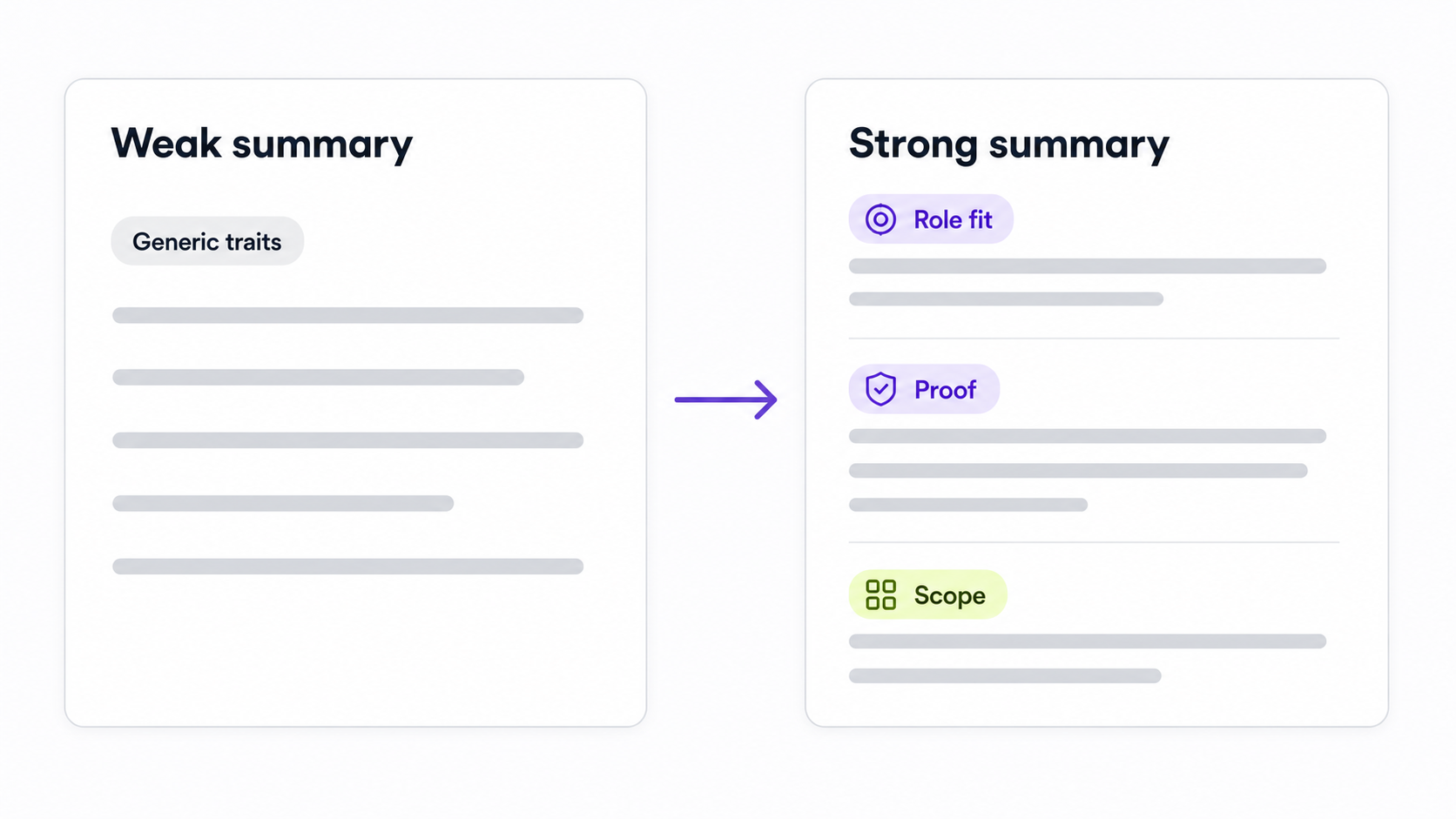
Generic summary
Weak:
Results-driven professional with excellent communication skills and a passion for success.
Stronger:
Customer success professional with experience onboarding SaaS customers, documenting account notes, and coordinating handoffs between sales, support, and product teams.
Why it is stronger: It replaces generic traits with real work.
No-metrics summary
Weak:
Marketing specialist with experience in campaigns and content.
Stronger:
Marketing specialist with experience planning email campaigns, writing landing page copy, and coordinating content calendars for B2B audiences.
Why it is stronger: It adds channels, work type, and audience even without numbers.
Career-change summary
Weak:
Looking for a new role in project management where I can grow my career.
Stronger:
Career changer moving into project coordination after 5 years managing classroom programs, parent communication, schedules, and cross-functional events. Strong fit for roles that need organization, stakeholder updates, and clear documentation.
Why it is stronger: It explains the transition through transferable proof.
Remote-work summary
Weak:
Experienced remote worker who works well independently.
Stronger:
Remote customer operations specialist with experience managing shared inbox workflows, documenting recurring issues, and coordinating async updates across support, product, and success teams.
Why it is stronger: It shows how the person works remotely.
What to include in a resume summary
Include only what helps the recruiter understand fit:
- Your target role or specialty.
- Relevant years of experience, if useful.
- Industry, customer type, or team context.
- Tools, systems, or methods that matter for the role.
- Scope, such as team size, customer volume, regions, or workflow complexity.
- Proof of results, quality, ownership, or collaboration.
- Remote-work strengths when the role is remote.
Your summary should match the rest of your resume. If you claim "strong SQL experience," your projects or work history should prove it.
What to avoid in a resume summary
Avoid:
- "Results-driven" without a result.
- "Passionate" without proof.
- "Hardworking" without context.
- First-person wording like "I am."
- Long paragraphs.
- Keyword stuffing.
- Claims that sound senior but are not backed by your experience.
- Copying the job description directly.
Also avoid turning your summary into a cover letter. The summary should be a quick scan, not a personal essay.
How to use AI to write a resume summary
AI can help you draft options, but it needs real inputs.
Give the tool:
- The target job description.
- Your current resume.
- Three to five achievements or projects.
- Tools and skills you can honestly support.
- The tone you want: clear, specific, and not exaggerated.
Prompt:
Write three resume summary options for this job. Use only the experience below. Keep each summary to 2-4 lines. Avoid generic phrases like "results-driven" unless the result is specific. Include relevant keywords naturally.
Then edit the output. Remove anything you cannot prove. Make the summary sound like a concise recruiter-facing introduction, not a sales pitch.
You can use the Himalayas AI resume builder to draft and refine resume sections, then pair it with the job description keyword finder to make sure your summary reflects the role you are targeting.
What to do after writing your summary
Your summary is only the start. The rest of your resume needs to support it.
Next steps:
- Rewrite your experience with stronger resume bullet points.
- Add honest scope and metrics with resume achievement quantification.
- Check that your resume uses ATS-friendly formatting.
- Tailor your resume to each role with job description matching.
- Search for roles on the Himalayas remote job board.
FAQ
How long should a resume summary be?
A resume summary should usually be 2-4 lines. If it is longer than that, move details into your experience bullets.
Do entry-level candidates need a resume summary?
Entry-level candidates can use a resume summary if they have relevant coursework, projects, internships, volunteer work, customer experience, or transferable skills. If you have almost no relevant proof yet, a short objective may be clearer.
Should a resume summary use first person?
No. Skip "I," "me," and "my." Resume summaries usually use concise fragments, such as "Customer support specialist with 4 years of experience..."
Is a resume summary required for ATS?
No. A resume summary is not required for applicant tracking systems, but it can help include role-relevant keywords naturally. ATS formatting still matters, so keep the section simple and avoid graphics, tables, or unusual layouts.
Should I change my resume summary for every job?
You should adapt it for each type of role. If two jobs have similar requirements, one version may work for both. If the role, industry, or seniority changes, rewrite the summary so the strongest proof appears first.