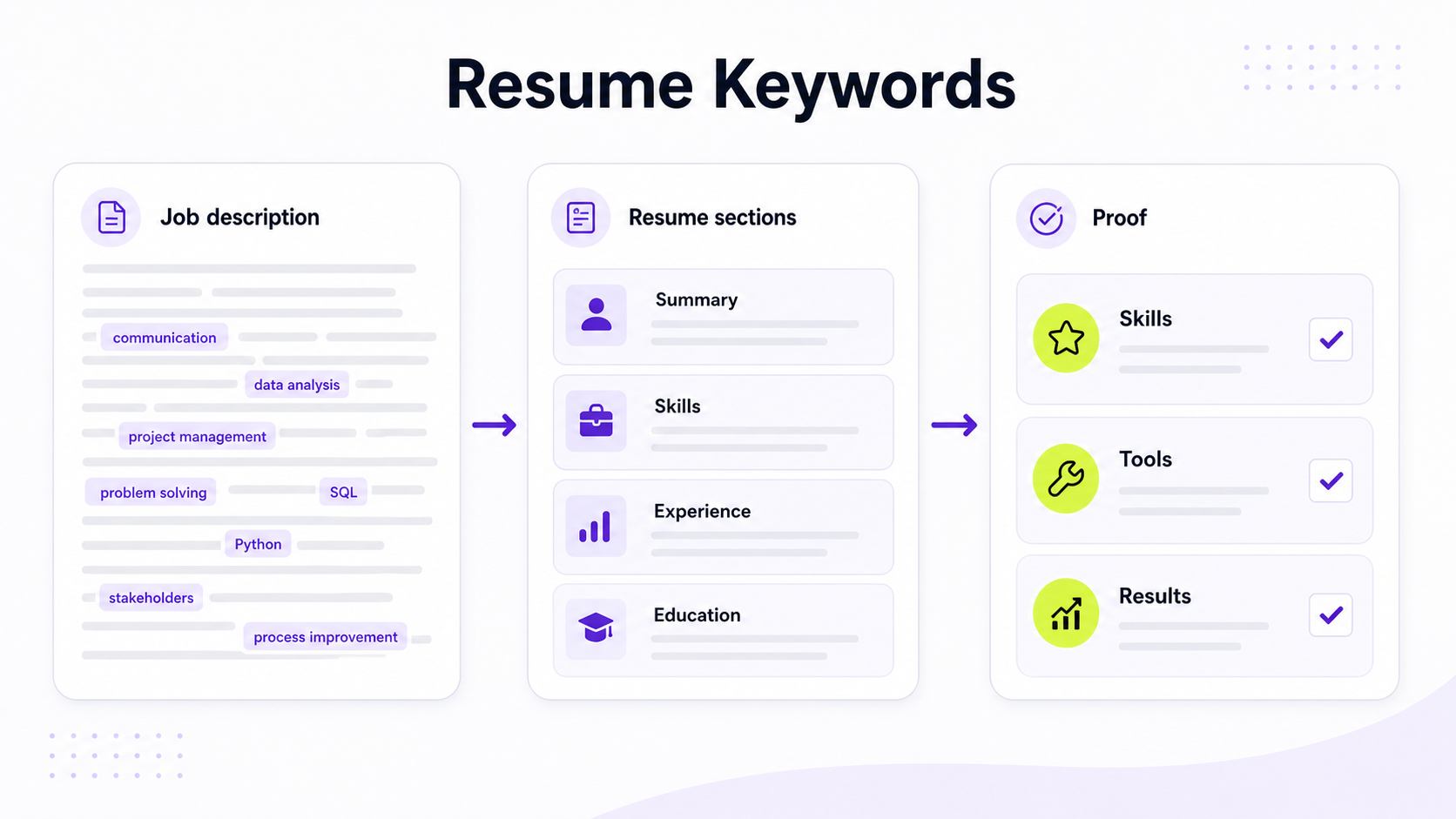
Resume keywords are the role-specific skills, tools, titles, credentials, and phrases employers use to describe the person they want to hire. The best resume keywords come from the job description you are applying to, not from a generic list.
Use them where they are true: in your summary, skills section, work experience bullets, projects, education, and certifications. Then back up the most important keywords with proof. A resume that says "SQL" in a skills list is searchable. A resume that shows how you used SQL to build reports, find trends, or improve a process is much more convincing.
What are resume keywords?
Resume keywords are words or phrases that connect your resume to a target job. They usually describe:
- Skills the employer requires.
- Tools and software used in the role.
- Certifications or licenses.
- Job titles and role names.
- Industry terms.
- Responsibilities from the job description.
- Work styles, such as async communication or cross-functional collaboration.
Applicant tracking systems can parse resumes, store candidate information, and help recruiters search or filter applications. Keywords matter because recruiters may search for the terms that appear in a job posting. But keywords are not magic passwords. A human still needs to believe the resume.
The goal is not to hide a pile of keywords in your resume. The goal is to make your real experience easy to find.
The best resume keywords come from the job description
Generic keyword lists can help you brainstorm, but the job description is the source of truth for a specific application.
Start by reading the posting from top to bottom and highlighting:
- Required skills.
- Tools and platforms.
- Certifications.
- Repeated phrases.
- Responsibilities that appear more than once.
- Job title variants.
- Industry terms.
- Remote-work requirements, if the role is remote or hybrid.
Prioritize must-have requirements over nice-to-have language. If a posting mentions "Salesforce" once in a long nice-to-have section, it may matter less than a required skill repeated in the summary, responsibilities, and qualifications.
You can use the Himalayas job description keyword finder to pull important terms out of a posting before tailoring your resume. Treat the output as a starting point, then decide which terms honestly match your experience.
After you map the keywords, run an AI resume review to check whether the important terms are backed by real evidence instead of just repeated in a skills list.
Types of resume keywords to look for
Most resume keywords fall into a few useful categories.
| Keyword type | Examples | Where it usually belongs |
|---|---|---|
| Required skills | SQL, customer onboarding, financial modeling | Skills, summary, work bullets |
| Tools | HubSpot, Figma, Python, Salesforce, Jira | Skills, work bullets, projects |
| Certifications | CPA, PMP, SHRM-CP, AWS Certified Cloud Practitioner | Certifications, summary |
| Role terms | account expansion, incident response, lifecycle marketing | Summary, work bullets |
| Industry terms | HIPAA, SOC 2, demand generation, fulfillment | Summary, work bullets |
| Remote-work terms | async communication, distributed team, timezone overlap | Summary and bullets when true |
| Soft skills | stakeholder management, leadership, communication | Work bullets with proof |
Hard skills and tools are often easier to search for and verify. Soft skills can still be keywords, but they need evidence. "Communication" is weak by itself. "Led weekly async updates across product, support, and customer success" is stronger because it shows the behavior.
How to find resume keywords in a job posting
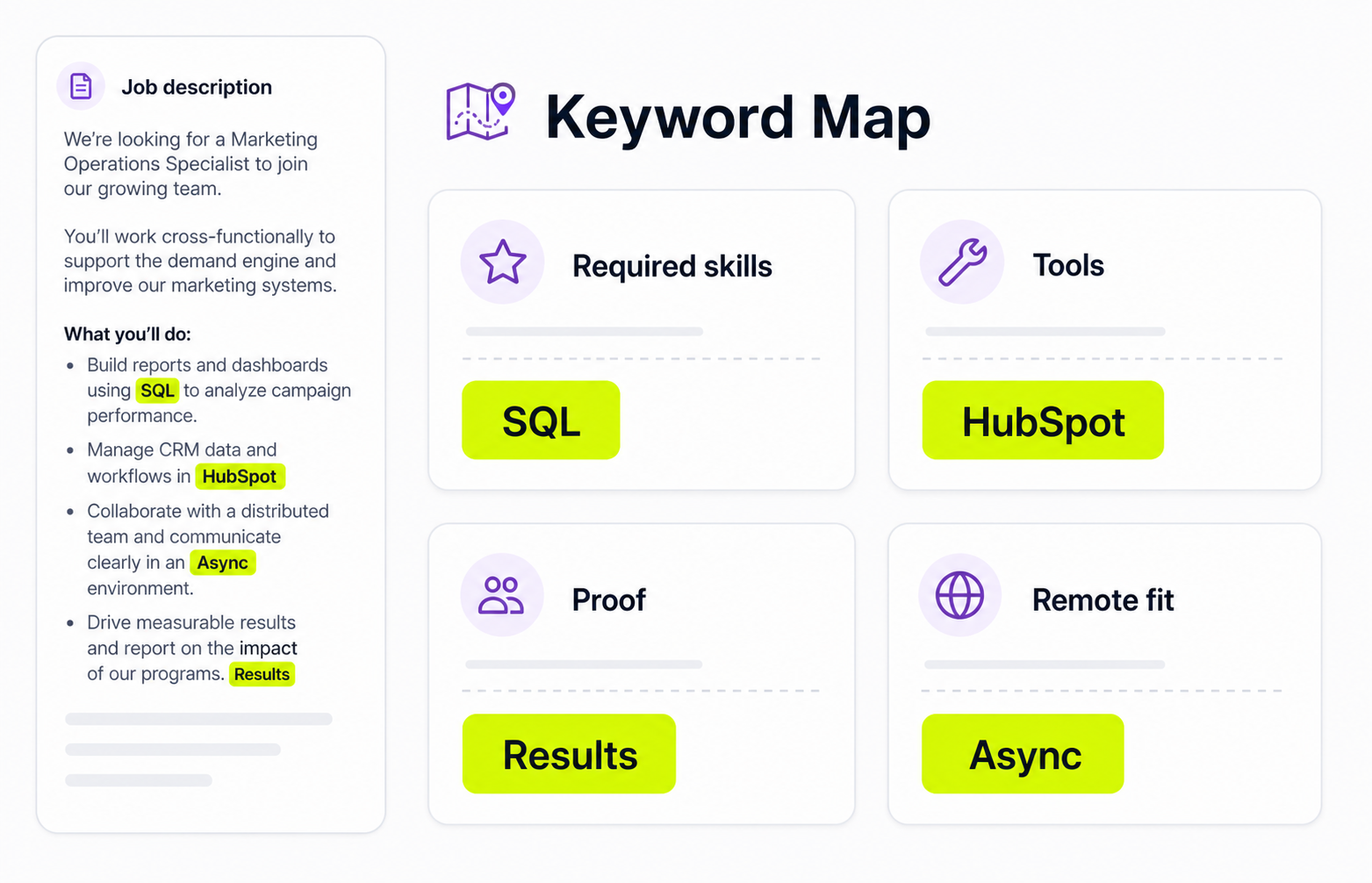
Use a simple keyword map before editing your resume.
1. Copy the job description into a working document
Do not start rewriting yet. First, collect the language the employer uses. Keep the original posting nearby so you can compare your resume against it.
2. Highlight must-have requirements
Look for phrases near labels like:
- "Required qualifications"
- "You have"
- "Must have"
- "Responsibilities"
- "What you'll do"
- "Experience with"
These are usually stronger signals than broad company values or generic traits.
3. Group the keywords
Sort the highlighted terms into categories:
- Required skills.
- Tools.
- Certifications.
- Role responsibilities.
- Industry terms.
- Remote or location constraints.
Grouping helps you avoid stuffing every term into one skills section. Some keywords belong as searchable facts. Others need to appear in work experience where you can prove them.
4. Mark which keywords are true for you
Use three labels:
Strong match: you have direct experience and can prove it.Adjacent match: your experience is related, but the wording differs.No match: you cannot honestly claim it.
Only use strong and adjacent matches. If the posting asks for "HubSpot" and you have used Salesforce, do not list HubSpot. You can still show relevant CRM experience, but do not claim a tool you have not used.
5. Choose exact wording carefully
Use exact wording when it is true. If the job description says "customer onboarding" and your resume says "client setup," you can write:
Led customer onboarding and client setup for 25+ new accounts per quarter.
That sentence keeps your natural language and mirrors the employer's phrase. Do not rewrite your actual past title into a title you never held. If your title was "Account Manager" and the target role is "Customer Success Manager," use the summary or bullets to show the overlap.
Where to put resume keywords
Different keywords belong in different parts of the resume.
Summary
Use the summary for role positioning and your strongest match signals.
Weak:
Experienced marketing professional with many skills.
Better:
Marketing operations specialist with 5 years of experience using HubSpot, lifecycle campaigns, and reporting dashboards to support B2B pipeline growth.
The better version includes role language, tools, responsibilities, and business context.
For more options by role and experience level, use these resume summary examples before deciding which keywords belong at the top of your resume. If you want a shorter line under your name, use a resume headline to combine your target role with one or two high-value keywords.
Skills section
Use the skills section for clear searchable facts:
- Tools.
- Technical skills.
- Certifications.
- Languages.
- Methodologies.
- Role-specific competencies.
Keep it targeted. A long skills section with every tool you have ever touched is harder to scan and less credible.
For a fuller skills-section workflow, read How to List Skills on a Resume.
Work experience bullets
Use work bullets for high-value keywords that need proof.
Weak:
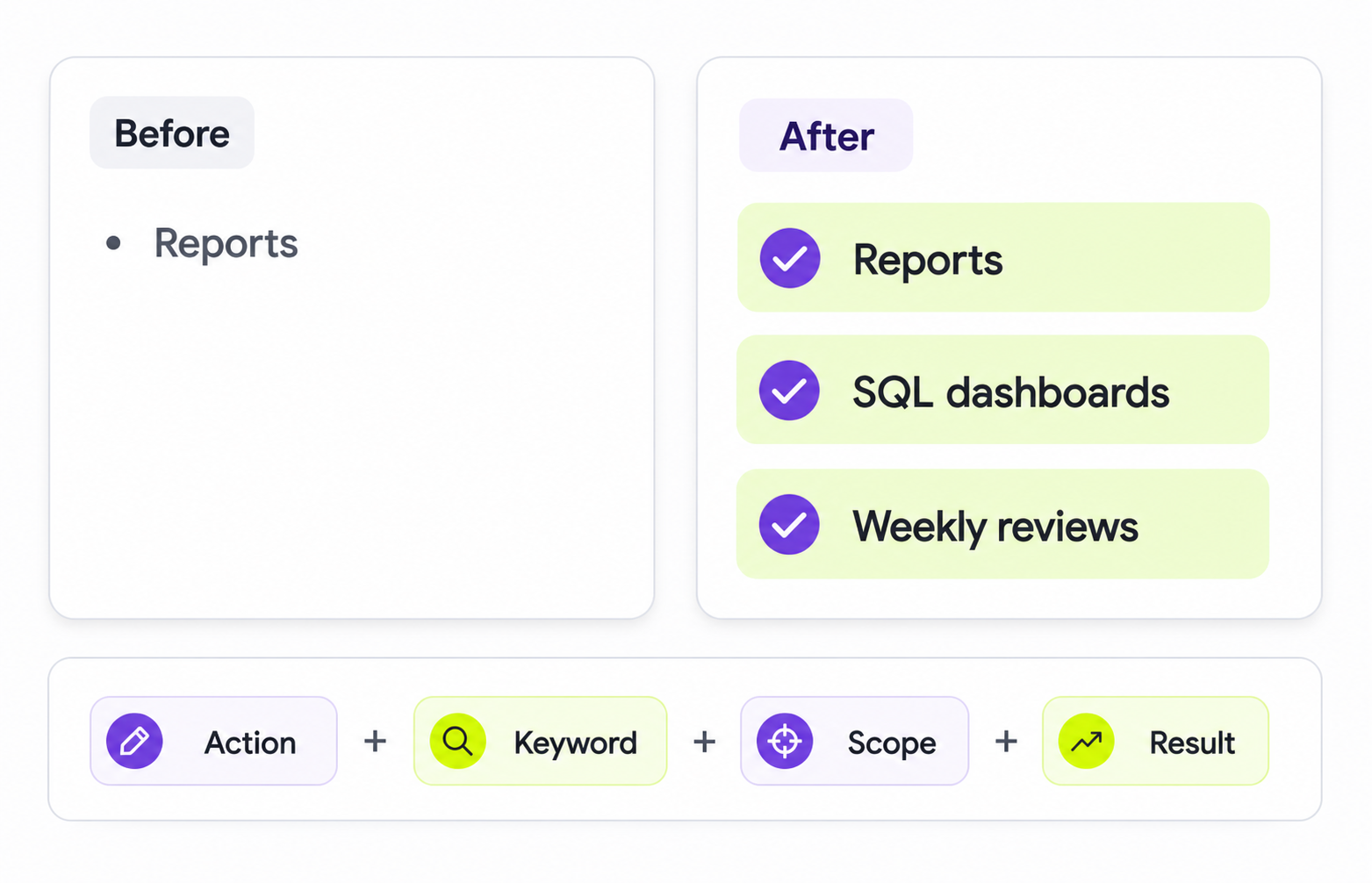
Responsible for reporting, SQL, dashboards, stakeholder management, and weekly reviews.
Better:
Built SQL dashboards for weekly revenue reviews, giving sales and customer success leaders a clearer view of renewal risk.
The better bullet includes the keyword, the work, the audience, and the result. For more examples, read How to Write Resume Bullet Points.
Projects
Projects are useful when you are changing careers, early in your career, or trying to prove a skill that does not appear in your job titles.
For example:
Built a Python dashboard that analyzed 2,000 support tickets and grouped recurring issues by product area.
That project can support keywords like Python, dashboard, support tickets, analysis, and product feedback.
Certifications and education
Put credentials in a dedicated section when the job description names them. Use the official credential name, and include the issuing organization when helpful.
Cover letter
Your cover letter can reinforce keywords, especially when your resume needs context. Do not repeat a keyword list. Use the letter to explain the connection between your background and the role.
How to turn keywords into proof
The strongest resume keywords are attached to evidence.
Use this formula:
Action + keyword + scope + result
Examples:
| Keyword | Weak use | Better use |
|---|---|---|
| SQL | SQL experience | Built SQL dashboards to monitor onboarding completion across 40 enterprise accounts. |
| Stakeholder management | Good stakeholder management | Coordinated weekly stakeholder updates across product, sales, and support during a billing migration. |
| Async communication | Strong async communicator | Created async project updates that reduced recurring status meetings from three per week to one. |
| Customer onboarding | Customer onboarding | Redesigned customer onboarding emails, increasing activation from 54% to 68%. |
| Figma | Figma | Designed Figma prototypes for a self-serve billing flow and handed off specs to engineering. |
If you do not have exact metrics, add scope:
- Number of customers, users, tickets, campaigns, accounts, or projects.
- Team size.
- Frequency.
- Region or market.
- Tool stack.
- Business process affected.
For deeper guidance, read How to Quantify Resume Achievements.
Resume keyword examples by category
Use these examples to brainstorm. Then return to the target job description and choose the terms that match that role.
Customer success
- Customer onboarding
- Account expansion
- Renewal risk
- Churn reduction
- Customer health score
- QBRs
- CRM
- Salesforce
- HubSpot
- Stakeholder management
Marketing
- Demand generation
- Lifecycle marketing
- SEO
- Paid search
- Email marketing
- Content strategy
- Google Analytics
- HubSpot
- Campaign reporting
- Conversion rate optimization
Data and analytics
- SQL
- Python
- Tableau
- Looker
- Data visualization
- Dashboarding
- Forecasting
- Data cleaning
- Experiment analysis
- Business intelligence
Software and technical roles
- JavaScript
- TypeScript
- React
- Node.js
- API design
- CI/CD
- Cloud infrastructure
- AWS
- Unit testing
- System design
Operations and project management
- Process improvement
- Vendor management
- Resource planning
- Risk management
- Budget tracking
- Jira
- Asana
- Agile
- SOPs
- Cross-functional coordination
Remote work
- Async communication
- Distributed team
- Timezone overlap
- Remote onboarding
- Written documentation
- Cross-functional collaboration
- Self-directed work
- Slack
- Notion
- Loom
Remote keywords are useful only when they match the role and your real work style. A remote job posting may care more about written communication, documentation, timezone overlap, and independent execution than the word "remote" itself.
Resume keyword mistakes to avoid
Keyword stuffing
Keyword stuffing means cramming terms into your resume without context. It makes the resume harder to read and can make your experience look less credible.
Bad:
Skills: SQL, SQL reporting, SQL dashboards, analytics, data analytics, analysis, reporting, business reporting, strategic reporting.
Better:
Built SQL reporting dashboards that helped operations leaders review weekly fulfillment delays by region.
Hidden keywords
Do not hide keywords in white text, tiny text, footers, or invisible sections. It is not useful and can damage trust if discovered.
Copying the job description word for word
It is fine to mirror accurate phrases. It is not fine to paste responsibilities that do not describe your work. Recruiters can spot a resume that sounds like a copied posting.
Adding keywords you cannot defend
If you list Kubernetes, financial modeling, or HIPAA compliance, be ready to explain your experience in an interview. Keywords should help the right employer understand your fit, not create claims you cannot support.
Inflating job titles
Use the title you held. If the target title differs, show the connection in your summary:
Account management professional with customer success experience across onboarding, renewal support, and account expansion.
Ignoring formatting
Keywords help only if the resume can be read. Use a clean format, standard headings, and text-based files. If you are unsure, use the checklist in How to Make an ATS-Friendly Resume.
Resume keyword checklist before you apply
Before submitting, check:
- The resume is tailored to one target job.
- The most important keywords come from the job description.
- Every keyword you use is true.
- Required tools and skills appear in the skills section or relevant bullets.
- Important keywords are supported with proof.
- The summary reflects the target role without inflating your title.
- Remote-work keywords are included when they are relevant and accurate.
- You removed generic buzzwords that do not add evidence.
- The resume is still easy for a human to skim.
- The file uses the employer's requested format.
If you want a faster workflow, use the Himalayas job description keyword finder to identify important terms, then use the Himalayas resume builder to turn those terms into a clean, readable resume. Once your resume is ready, you can search remote jobs and track applications in the job application tracker.
FAQ
How many resume keywords should I use?
There is no fixed number. Use the important keywords that accurately match your experience and the target job. A focused resume with 10 relevant, well-supported keywords is stronger than a resume stuffed with 50 weak ones.
Should I use exact phrases from the job description?
Use exact phrases when they are accurate. If the posting says "customer onboarding" and that describes your work, use that phrase. If the phrase is close but not exact, use honest wording that shows the connection.
Are soft skills resume keywords?
Yes, but they need proof. Communication, leadership, adaptability, and collaboration are stronger when attached to a specific situation, audience, or result.
Do ATS systems reject resumes without keywords?
Applicant tracking systems and recruiter searches can make keyword alignment important, but there is no single ATS rule that applies to every employer. Write for both software and people: use relevant terms, keep formatting clean, and prove your experience.
Can I use resume keywords when changing careers?
Yes. Focus on transferable skills, projects, tools, certifications, and responsibilities that genuinely overlap with the target role. Do not claim experience you do not have. Use projects and summary language to explain the bridge.