An asynchronous interview is a job interview where you record answers to interview questions on your own time instead of speaking with an interviewer live. It is also called a one-way video interview, pre-recorded video interview, digital interview, or async interview.
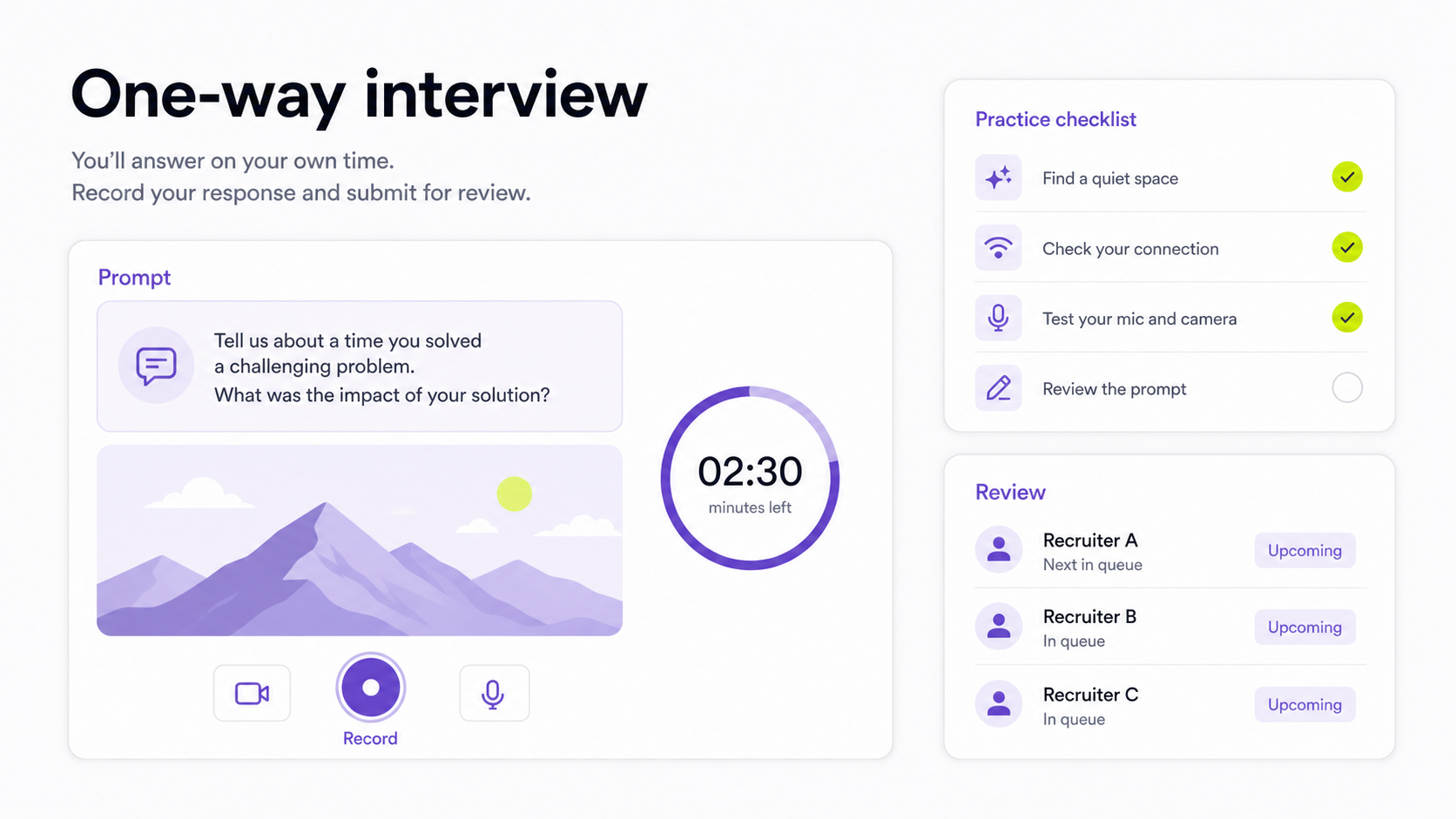
The employer usually sends a link, deadline, and instructions. You open the interview platform, test your camera and microphone, read or watch each prompt, record your answer, and submit your responses. A recruiter, hiring manager, or screening system reviews the answers later.
The format can feel awkward because there is no person nodding, asking follow-up questions, or reacting to what you say. The way to handle that is to prepare concise, specific answers before you record. Treat it like a real first-round interview, but practice for the parts that are different: timing, camera delivery, silence, and no live feedback.
How an asynchronous interview works
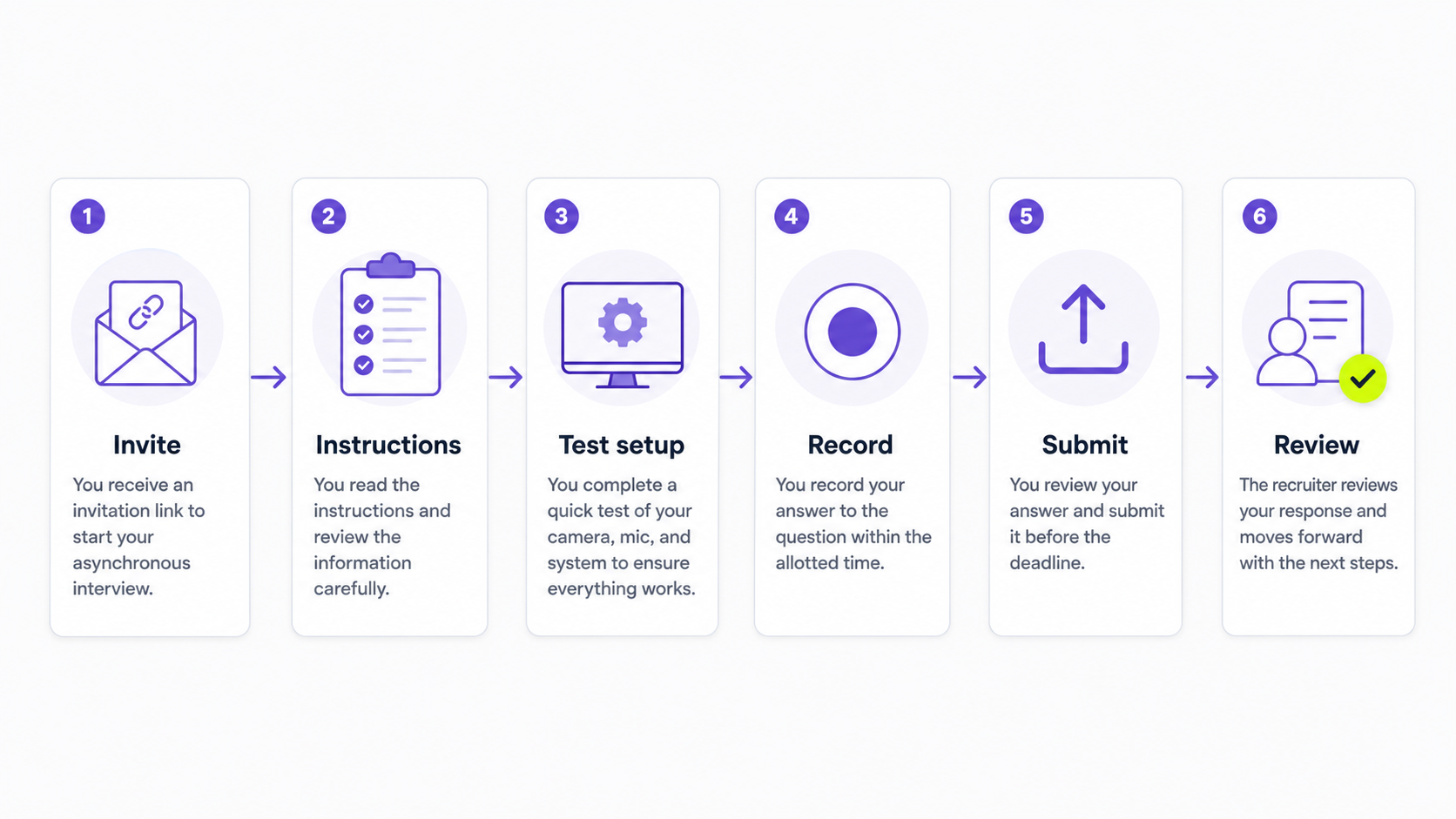
Most asynchronous interviews follow a similar flow:
- The employer sends an invitation link.
- You read the instructions, deadline, and technical requirements.
- The platform lets you test your camera, microphone, and internet connection.
- You answer a set of prompts, usually one at a time.
- Each prompt may have a preparation timer, answer timer, retry limit, or no retry option.
- You submit the interview before the deadline.
- The hiring team reviews your recording and decides whether to move you to the next step.
Some platforms show the question in text. Others play a recorded video prompt from the recruiter or hiring manager. Some let you re-record answers. Others submit the first recording automatically. Read the instructions before you start so you know whether you can pause, retry, skip, or review your answers.
Asynchronous interview vs. live video interview
An asynchronous interview is not the same as a live Zoom, Google Meet, or Teams interview. The camera setup is similar, but the communication is different.
| Format | What happens | What to optimize for |
|---|---|---|
| Asynchronous interview | You record answers to prompts and the employer reviews them later. | Clear structure, concise timing, strong examples, camera delivery, technical setup. |
| Live video interview | You speak with one or more interviewers in real time. | Conversation, follow-up questions, rapport, listening, real-time clarification. |
| Phone screen | You speak live without video. | Voice clarity, concise answers, notes, energy, listening. |
| Written screening question | You type an answer before the interview process continues. | Specific examples, grammar, relevance, clear reasoning. |
In a live interview, you can adjust when the interviewer looks confused or interested. In a one-way interview, you need to build that clarity into the answer from the start.
Why employers use asynchronous interviews
Employers use asynchronous interviews for a few reasons:
- They are easier to schedule across time zones.
- They let recruiters screen more candidates before live interviews.
- They give every candidate the same initial questions.
- They help distributed teams review candidates when hiring managers are not available at the same time.
- They can be useful for high-volume roles, internships, graduate programs, customer-facing roles, and remote jobs.
That does not mean candidates always like them. One-way interviews can feel impersonal, especially when you cannot ask questions or read the room. Your goal is not to love the format. Your goal is to make your strongest evidence easy to understand despite the format.
How to prepare for an asynchronous interview
Prepare in two tracks: content and recording.
1. Read the instructions before you practice
Look for:
- Deadline and timezone.
- Number of questions.
- Preparation time per question.
- Answer time limit.
- Whether you can re-record.
- Whether you can pause between questions.
- Required browser, device, or app.
- Whether the interview includes video, audio, written answers, games, tests, or work samples.
If the instructions are vague, assume you may get only one attempt. Practice before opening the real interview.
2. Research the role and company
You do not need a script for every possible question. You need a small set of relevant stories.
Read the job description and identify:
- The three most important responsibilities.
- Required tools, workflows, or skills.
- Outcomes the role is expected to produce.
- Evidence that the company values remote collaboration, customer focus, speed, quality, ownership, or communication.
Then prepare examples that prove those points. If you are applying for remote roles, also review common remote job interview questions so you can speak clearly about async communication, time zones, self-management, and collaboration.
3. Prepare five reusable stories
Most one-way interview questions can be answered with a few flexible stories:
- A project you are proud of.
- A time you solved a hard problem.
- A time you worked with a difficult constraint.
- A time you collaborated across teams or time zones.
- A time you learned quickly or adapted.
Use the STAR method for behavioral questions:
Situation: What was happening?
Task: What were you responsible for?
Action: What did you do?
Result: What changed?
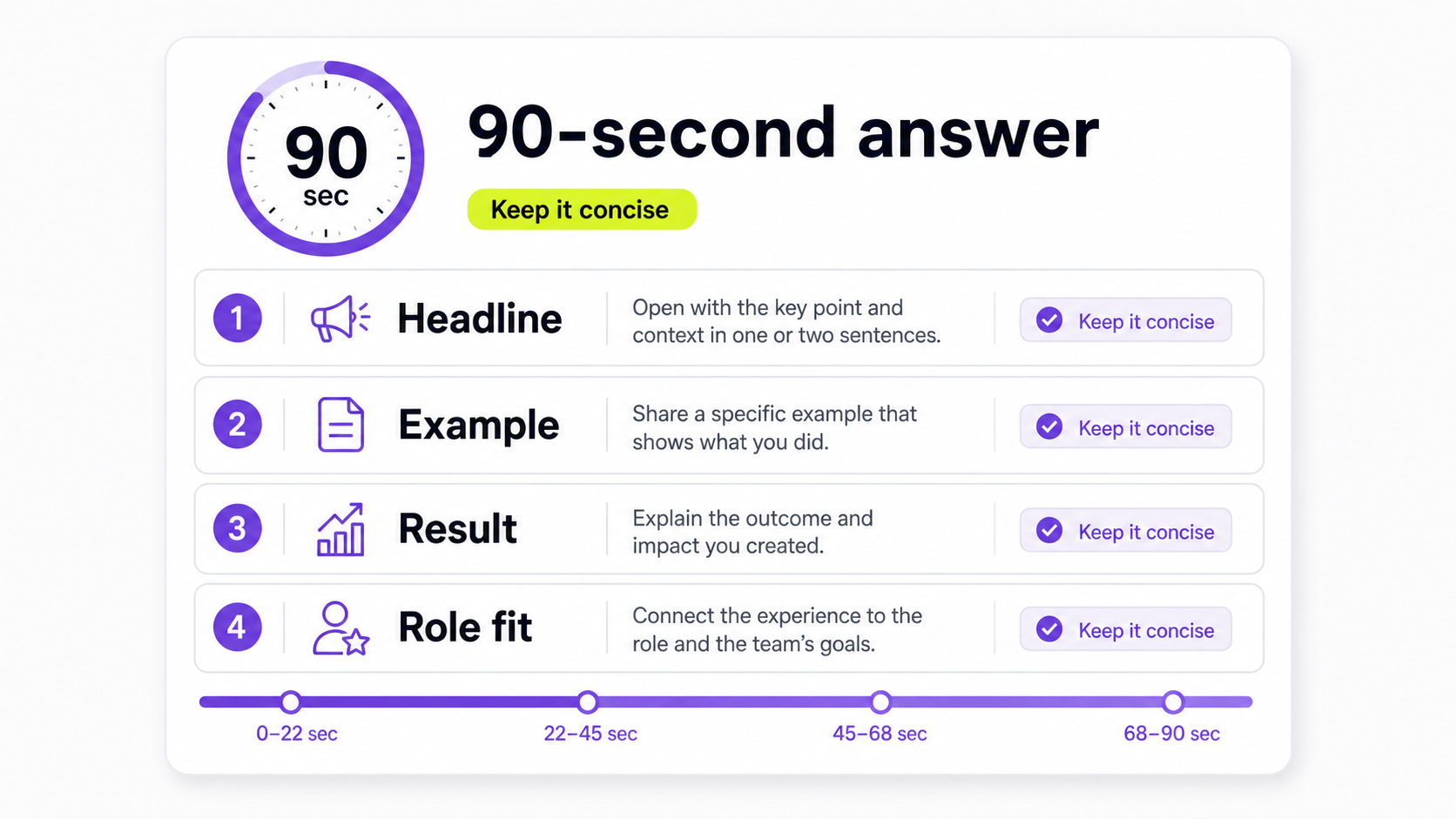
Keep each story tight. In a recorded interview, a 90-second answer usually feels stronger than a 4-minute answer that wanders.
4. Practice out loud
Reading notes silently is not enough. You need to hear whether the answer sounds natural.
Practice:
- A 30-second "tell me about yourself" answer.
- A 60-second motivation answer.
- A 90-second behavioral answer.
- A 30-second closing sentence.
You can use Himalayas AI interview practice before the real recording to rehearse with role-specific questions and get feedback. Use it as preparation, not as help during the actual assessment unless the employer explicitly allows that.
5. Set up your recording space
Your setup does not need to look expensive. It needs to be clear and calm.
Check:
- Camera at or near eye level.
- Light in front of you, not behind you.
- Quiet room.
- Neutral background.
- Stable internet.
- Charged laptop or phone.
- Microphone input selected correctly.
- Notifications turned off.
- Resume, job description, and notes nearby.
Audio matters more than perfect lighting. If the reviewer cannot hear you clearly, the answer will be harder to judge.
Common asynchronous interview questions
The exact questions depend on the role, but these are common:
| Question | What the employer wants | How to answer |
|---|---|---|
| Tell me about yourself. | A concise professional summary. | Give your current target, relevant experience, and why this role fits. |
| Why are you interested in this role? | Motivation and fit. | Connect the role's work to your experience and goals. |
| Why do you want to work here? | Company research. | Mention something specific about the company, product, mission, customers, or role. |
| Describe a relevant project. | Proof you can do similar work. | Use one example with scope, action, and result. |
| Tell me about a challenge or conflict. | Judgment under pressure. | Use STAR and show what you learned or changed. |
| How do you manage deadlines? | Reliability. | Explain your system and give an example. |
| How do you communicate in a remote team? | Async communication and trust. | Mention documentation, updates, response expectations, and handoffs. |
| What are your strengths? | Self-awareness and role fit. | Pick strengths that matter for the job and prove them with examples. |
| What questions do you have? | Curiosity, if the platform allows it. | Ask about success measures, team process, and next steps. |
For deeper preparation, use Himalayas' guides on how to prepare for a job interview, how to answer behavioral interview questions, and what to do if you cannot answer an interview question.
A simple answer structure for one-way interviews
Use this structure when you are not sure how to organize an answer:
Headline + example + result + role connection
Example:
I am strongest in roles where I need to turn messy customer feedback into clear product or process improvements. In my last role, I reviewed support tickets each week, grouped repeat issues, and shared a short summary with product and operations. That helped the team prioritize documentation fixes and reduced repeat setup questions from new customers. This role stood out because it needs someone who can notice those patterns, communicate clearly, and follow through across teams.
Why it works:
- The first sentence answers directly.
- The example is specific.
- The result explains why it mattered.
- The final sentence connects back to the job.
How long should asynchronous interview answers be?
Follow the platform's time limit. If there is no clear guidance, use these ranges:
| Question type | Suggested length |
|---|---|
| Simple logistics or availability question | 20-45 seconds |
| Tell me about yourself | 45-75 seconds |
| Why this role or company | 45-90 seconds |
| Behavioral example | 90-120 seconds |
| Technical explanation or case prompt | Use the allotted time, but organize it clearly |
Short does not mean vague. A strong 75-second answer usually has one clear point, one example, and one result.
Can you use notes in an asynchronous interview?
Usually, yes, but do not read a full script. Reading word-for-word makes your delivery flatter and can pull your eyes away from the camera.
Use notes like this:
Role fit:
- customer onboarding
- async docs
- reduced repeat questions
- connect to distributed team
Do not use notes like this:
I am very excited to apply for this role because I believe my background, experience, and passion for customer onboarding make me an excellent candidate...
Your notes should remind you what to say, not replace your ability to say it.
What to do if you make a mistake
If the platform lets you re-record, use the retry when the answer is unclear, cut off, technically broken, or missing the main point.
Do not re-record forever because one word sounded awkward. A natural answer with one small stumble is usually better than a stiff answer after 12 attempts.
If the platform does not allow retries:
- Pause for one second.
- Correct yourself plainly.
- Continue.
For example:
Let me say that more clearly. The main result was that the support team had fewer repeat setup questions, because the documentation answered the issue before customers needed to file a ticket.
Recovering calmly is part of the signal.
Mistakes to avoid
Rambling
One-way interviews punish rambling because there is no interviewer to interrupt, redirect, or ask a follow-up. Decide your point before you start.
Reading from a script
Scripts can sound unnatural and make it harder to maintain camera contact. Use bullet notes instead.
Ignoring the first 10 seconds
Start with the answer, not a long warm-up.
Weak:
That is a great question. I think there are a lot of different ways to answer it, but I would probably say...
Stronger:
The strongest example is a customer onboarding project I led last quarter.
Treating it like a casual recording
Dress and prepare as if a hiring manager will watch the clip, because they might.
Looking at yourself the whole time
Look near the camera for key sentences. It does not need to be constant, but it should feel like you are speaking to a person.
Using AI during the real recording
Do not use AI tools, answer generators, or hidden prompts during an interview assessment unless the employer explicitly allows it. It can violate the employer's process and make your answers sound less authentic. Use AI before the interview to practice, improve structure, and identify weak examples.
What to do after submitting an asynchronous interview
After you submit:
- Save the job description, company name, deadline, and questions you remember.
- Write down which answers felt strong and which felt weak.
- Prepare follow-up questions for a live interview.
- Keep applying to other roles instead of waiting passively.
- Send a follow-up only if the employer's process makes it appropriate.
If you move to a live interview, expect the hiring team to ask deeper questions about the answers you recorded. Prepare to expand on your strongest examples and explain tradeoffs.
If the platform gave you no chance to ask questions, bring them to the next round. Start with questions about success measures, team communication, manager expectations, and the hiring timeline. Himalayas has a full guide to answering do you have any questions for me? if you want examples.
Questions to ask if you are concerned about privacy or fairness
You may not be able to ask questions inside the one-way interview itself. If you have serious concerns, you can ask the recruiter before or after submitting.
Reasonable questions include:
- Who will review my recording?
- Will the recording be reviewed by a person, software, or both?
- How long will my recording be stored?
- Can I request an accommodation or alternate format?
- What should I do if the platform fails or my connection drops?
- Will I have a live interview before a final decision?
Keep the message short and practical. You are not trying to debate the whole hiring process. You are trying to understand how your information will be used and how to complete the assessment fairly.
Asynchronous interview checklist
Before recording, confirm:
- I read the instructions, time limit, retry rules, and deadline.
- I tested my camera, microphone, browser, and internet.
- I closed distracting tabs and notifications.
- I prepared five role-relevant stories.
- I practiced answers out loud with a timer.
- I have bullet notes, not a full script.
- I know why I want this role and company.
- I can explain how my experience matches the job description.
- I have a backup plan if the platform glitches.
- I am ready to submit without over-editing every answer.
FAQ
Is an asynchronous interview the same as a one-way video interview?
Usually, yes. "Asynchronous interview" is the broader term. "One-way video interview" is the common candidate-facing version where you record video answers without a live interviewer.
Are asynchronous interviews reviewed by humans?
Sometimes yes, sometimes no, and sometimes both. Some employers use the platform only to collect recordings for recruiters or hiring managers. Others may use transcripts, scoring tools, or automated screening features. Do not assume every async interview is AI-scored, but read the instructions and ask the recruiter if you need clarity.
Can you redo an asynchronous interview answer?
It depends on the platform and employer settings. Some allow unlimited practice but limited final attempts. Others allow one recording only. Read the retry rules before starting.
What should you wear for a one-way video interview?
Wear what you would wear to a first-round video interview for the same company. The safest choice is clean, simple, and slightly more polished than the company's everyday dress code.
What if the platform glitches?
Take a screenshot or note the error, then contact the recruiter or support email listed in the invitation. Keep the message factual: what happened, when it happened, what device/browser you used, and whether you need the link reset.
Should you send a thank-you email after an asynchronous interview?
Usually not for the recording alone unless you have been communicating directly with a recruiter. If a recruiter personally invited you or helped with a technical issue, a short thank-you can make sense. Save the more detailed thank-you email after an interview for live recruiter, hiring manager, or panel conversations.
Are asynchronous interviews fair?
They can make scheduling easier, but they can also feel impersonal and may raise accessibility, privacy, or bias concerns depending on the platform and review process. If you need an accommodation, have technical constraints, or are unsure how your recording will be evaluated, ask the recruiter for guidance.
Final advice
An asynchronous interview is still an interview. The difference is that you need to create clarity without a live conversation.
Prepare a few strong stories, practice with a timer, set up your camera and audio, and answer each prompt with one clear point. If you want realistic practice before recording, use Himalayas AI interview practice, then browse remote jobs and remote companies that match how you want to work.