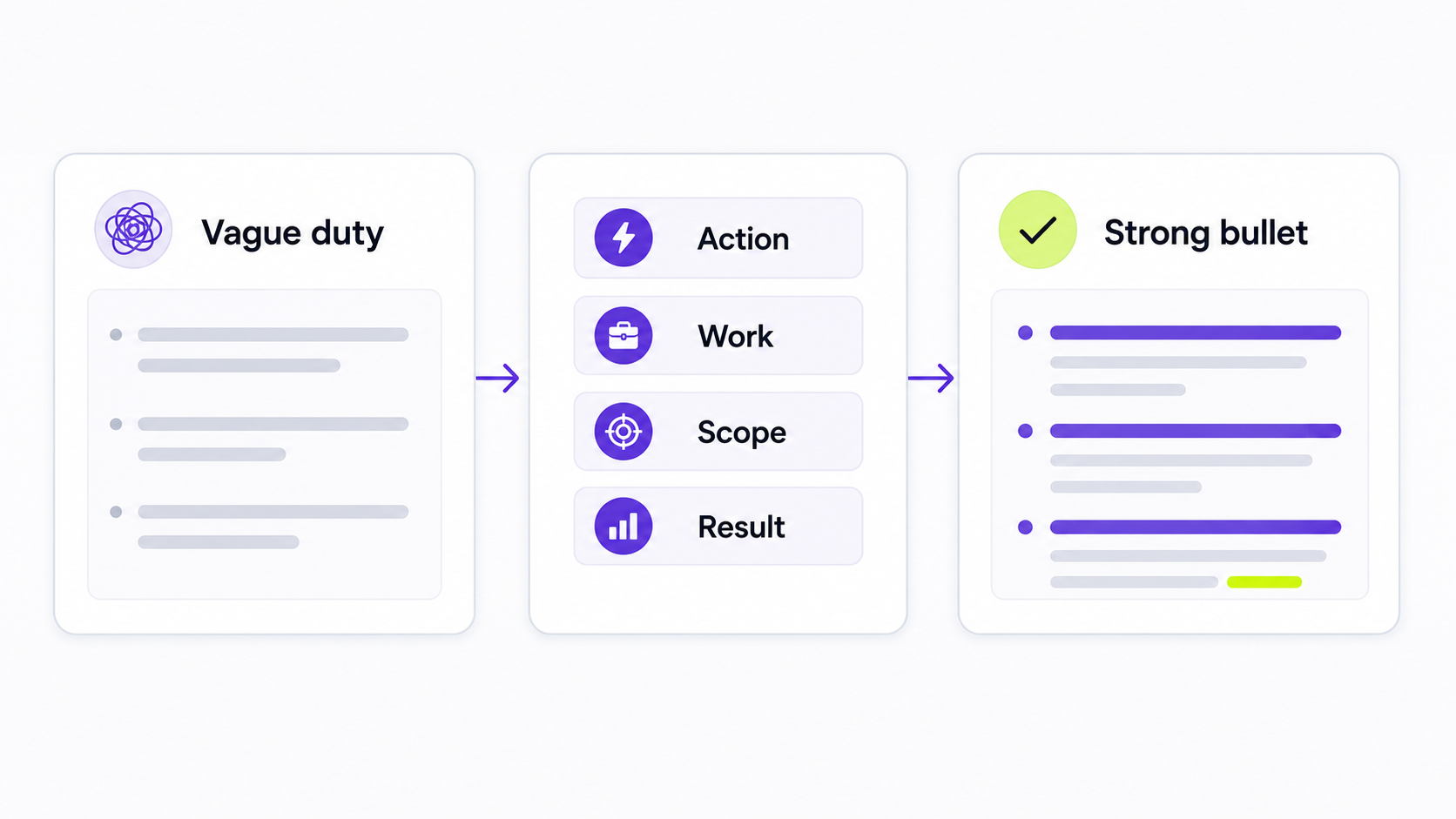
To write strong resume bullet points, start each bullet with a specific action, explain the work you did, add scope or context, and end with the result or reason it mattered. A useful formula is:
Action verb + work + scope + result
For example, instead of writing "Responsible for customer support," write "Resolved 45+ customer support tickets per week across email and live chat, helping maintain a 92% CSAT score."
The goal is not to make every line sound dramatic. The goal is to give a recruiter quick, believable proof that you can do the work in the job description.
What are resume bullet points?
Resume bullet points are short lines under a job, project, volunteer role, or education entry that explain what you did and why it mattered.
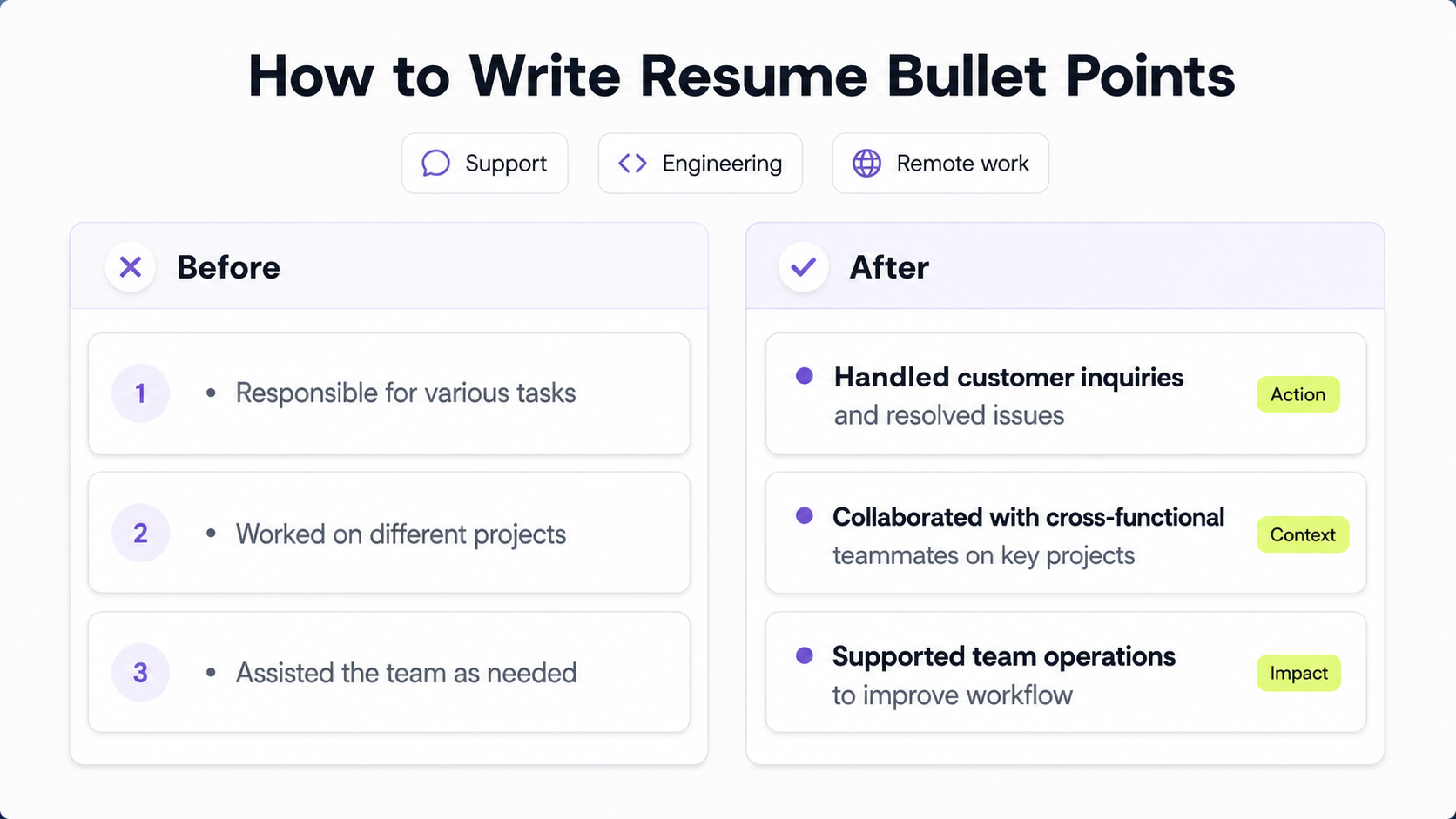
Weak bullets list responsibilities:
Responsible for onboarding new customers.
Strong bullets show evidence:
Onboarded 30+ new customers per month, creating setup notes that reduced repeat questions for the support team.
A hiring manager should be able to scan your bullets and understand:
- What kind of work you have done.
- How much responsibility you handled.
- Which tools, customers, teams, or systems you worked with.
- What changed because of your work.
- Why your experience matches the role.
The resume bullet point formula
Use this structure for most bullets:
Action verb + work + scope + result
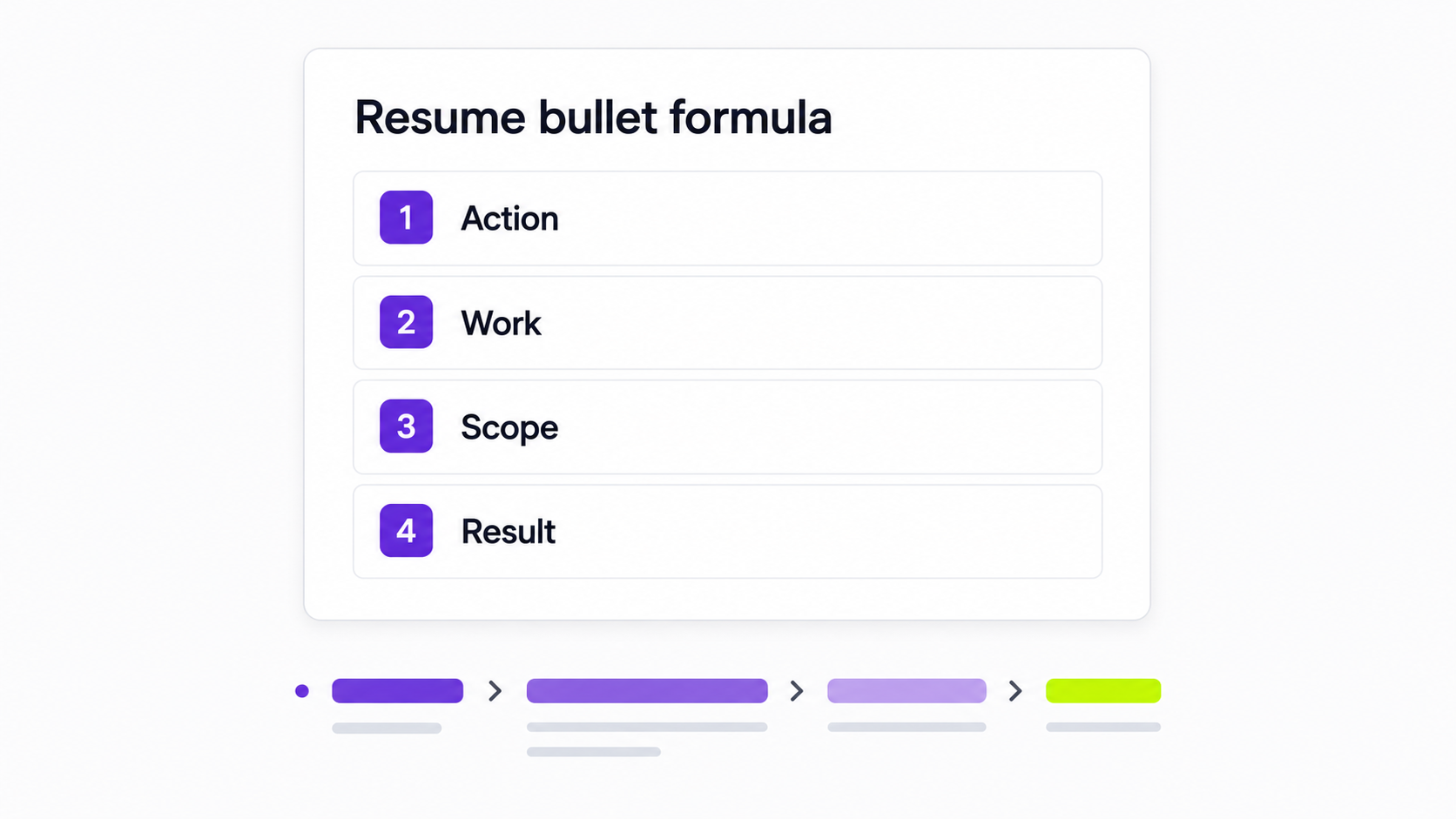
| Part | What it answers | Example |
|---|---|---|
| Action verb | What did you do? | Built, managed, improved, analyzed |
| Work | What task, project, or responsibility? | onboarding docs, support queue, reporting dashboard |
| Scope | How big or complex was it? | 30 customers, 4 teams, 12 weekly reports |
| Result | Why did it matter? | reduced delays, improved accuracy, increased adoption |
Example:
Built onboarding documentation for a 40-person remote team across 5 timezones, reducing repeat setup questions during new-hire onboarding.
This works because it gives action, audience, context, and impact. Even without a hard percentage, it is more useful than "Created documentation."
How to write strong resume bullet points
Start with the job you want, not the job you had. Your resume does not need to describe every task you performed. It needs to prove the parts of your experience that matter for the target role.
1. Read the job description first
Before rewriting bullets, identify the role's repeated requirements. Look for skills, tools, outcomes, and responsibilities that appear more than once.
For example, a customer success job might emphasize onboarding, retention, product adoption, CRM hygiene, and cross-functional work. A software engineering job might emphasize reliability, APIs, testing, performance, and collaboration with product.
Use the Himalayas job description keyword finder to pull out the strongest requirements, then choose bullets that prove those requirements honestly.
2. Choose proof, not tasks
A task says what you were assigned. Proof shows what you contributed.
Task:
Attended weekly sales meetings.
Proof:
Prepared weekly pipeline notes for 8 account executives, helping the sales team prioritize stalled opportunities.
If a bullet does not show relevant proof, cut it or rewrite it.
3. Start with a specific action verb
Use verbs that describe the work precisely:
- Built
- Led
- Improved
- Reduced
- Launched
- Coordinated
- Analyzed
- Automated
- Supported
- Designed
- Resolved
- Documented
- Recruited
- Negotiated
- Implemented
Avoid weak openings like:
- Responsible for
- Helped with
- Worked on
- Assisted in
- Participated in
Those phrases are not always wrong, but they usually hide the action. Replace them with the thing you actually did.
4. Add scope
Scope helps the reader understand the size of the work. It can be a number, but it does not have to be a performance metric.
Useful scope includes:
- Number of customers, users, tickets, accounts, campaigns, projects, hires, or reports.
- Team size.
- Budget size.
- Region, timezone, or market.
- Tool, system, or platform.
- Frequency, such as daily, weekly, monthly, or quarterly.
- Deadline or launch window.
Weak:
Managed reports.
Stronger:
Managed 12 weekly sales reports across HubSpot and Google Sheets for regional sales managers.
5. Add a result or reason it mattered
The result is the "so what?" of the bullet. It can be a measurable outcome, but it can also be a business reason.
Measurable result:
Reduced invoice review time from 5 days to 2 days.
Reason it mattered:
Improved handoff quality between sales and customer success.
If you have real metrics, use them. If you need help finding honest numbers, read How to Quantify Resume Achievements.
6. Cut filler
Resume bullets should be easy to scan. Remove words that do not add proof.
Usually cut:
- Successfully
- Various
- Multiple, unless the number is unclear but meaningful
- Responsible for
- In order to
- Worked closely with, unless collaboration is the point
- Helped, unless your role was genuinely supporting
Before:
Successfully worked closely with various teams in order to improve the customer onboarding process.
After:
Coordinated onboarding updates with sales, support, and product teams, reducing customer handoff gaps.
7. Keep tense and formatting consistent
Use present tense for work you still do:
Manage weekly reporting for 6 customer success managers.
Use past tense for previous roles:
Managed weekly reporting for 6 customer success managers.
Either use periods at the end of every bullet or do not use them at all. Consistency matters more than the choice.
Resume bullet point examples
Use these examples as patterns, not scripts. Your bullets should reflect your real work, tools, scope, and outcomes.
| Role | Weak bullet | Stronger bullet |
|---|---|---|
| Customer support | Answered customer questions. | Resolved 45+ weekly support tickets across email and live chat, maintaining clear notes for product and success teams. |
| Software engineer | Worked on backend APIs. | Built and maintained REST API endpoints for billing workflows, improving reliability for customer account updates. |
| Marketing | Managed social media. | Planned 6 monthly social campaigns, coordinating copy, design, and reporting across LinkedIn and email channels. |
| Sales | Talked to prospects. | Managed a pipeline of 80+ SMB prospects and documented objections to improve follow-up messaging. |
| Operations | Improved internal process. | Standardized invoice review for 3 departments, reducing approval delays and clarifying ownership. |
| Product manager | Worked with design and engineering. | Led discovery and launch planning for 4 product updates, aligning design, engineering, and customer feedback. |
| Designer | Created product designs. | Designed onboarding screens and handoff specs that helped engineering ship a cleaner first-run experience. |
| HR/recruiting | Scheduled interviews. | Coordinated 35 candidate pipelines per month, improving interview handoffs between recruiters and hiring managers. |
| Entry-level | Helped with research. | Researched 120+ competitor listings and summarized weekly findings for the sales team. |
| Remote work | Worked with remote team. | Documented async handoff notes for a distributed team across 4 timezones, reducing repeated status-check meetings. |
What if you do not have numbers?
You do not need a number in every bullet. A bullet without a metric can still be strong if it shows scope, complexity, or relevance.
Use these instead of fake metrics:
- Scope: customers, users, tickets, accounts, projects, regions, systems, or team size.
- Frequency: daily, weekly, monthly, quarterly.
- Tools: Salesforce, HubSpot, Zendesk, Jira, Figma, SQL, Python, Notion.
- Audience: executives, customers, candidates, engineers, hiring managers.
- Constraints: deadline, compliance need, timezone coverage, migration, launch, limited resources.
- Quality: accuracy, consistency, documentation, handoff clarity, response time.
Weak:
Helped with hiring.
Stronger without a hard metric:
Maintained candidate notes and interview scheduling for remote hiring managers across US and European timezones.
Best, if true:
Maintained 25+ candidate pipelines per month for remote hiring managers across US and European timezones.
Never invent a number you cannot explain in an interview.
How many bullet points should each job have?
For most resumes, use:
- 3-6 bullets for recent, relevant roles.
- 1-3 bullets for older or less relevant roles.
- 0 bullets for roles that only need a title, company, and dates.
More bullets are not automatically better. A recent role with six sharp bullets is stronger than a role with twelve generic tasks.
Prioritize bullets that match the job description. If you are applying for a remote customer success role, keep bullets about onboarding, retention, async communication, product feedback, and customer outcomes. Cut bullets that do not help that story.
For a deeper tailoring workflow, read How to Tailor Your Resume to a Job Description.
Resume bullet formatting rules
Keep formatting boring and readable.
- Use bullets, not dense paragraphs.
- Keep most bullets to one or two lines.
- Start each bullet with a verb.
- Keep bullet style consistent.
- Use the same tense pattern throughout.
- Put the most relevant bullets first.
- Avoid stuffing the same keyword into every line.
- Do not copy the job description word for word.
If your bullet wraps to three or four lines, it is probably trying to do too much. Split it, cut details, or move the less important information elsewhere.
Common resume bullet mistakes
Listing every task
Your resume is not a job description. It is a relevance document. You can leave out tasks that do not support the role you want next.
Using vague verbs
"Helped," "handled," and "worked on" are sometimes accurate, but they rarely show ownership. Replace them with the action you took.
Adding fake metrics
Metrics help only when they are true and explainable. If you do not have a number, use scope or context instead.
Writing bullets that are too broad
Weak:
Managed operations and improved processes for the company.
Stronger:
Created a weekly operations tracker for 4 department leads, clarifying blockers before Monday planning meetings.
Making every bullet sound the same
If every bullet starts with "Managed," the resume becomes hard to scan. Vary the verbs based on the actual work: managed, built, analyzed, documented, launched, resolved, coordinated, improved.
Use AI without making your resume sound fake
AI can help you rewrite bullets, but it should not invent your achievements. Use it as an editor, not a source of facts.
Try this prompt:
Rewrite these resume bullets for a [target role]. Keep every claim truthful. Do not invent metrics, tools, employers, or outcomes. For each bullet, use action + work + scope + result. If a metric is missing, ask me what number or scope I can honestly support.
Then review every output:
- Is the claim true?
- Can you explain the number?
- Does it match the job description?
- Does it sound like you?
- Is it shorter and clearer than the original?
You can use the Himalayas AI resume builder to rewrite and tailor your resume, then use the job description keyword finder to check whether your strongest bullets match the role.
Resume bullet point checklist
Before you apply, check each important bullet:
- Does it start with a clear action?
- Does it describe specific work?
- Does it include scope, tools, audience, or frequency?
- Does it include a result or reason the work mattered?
- Is it relevant to the target job?
- Is it truthful and explainable?
- Is it shorter than two lines if possible?
- Does it avoid filler?
After your resume is ready, write a matching cover letter with the Himalayas AI cover letter generator, save each version in the job application tracker, and apply to remote roles on Himalayas.
FAQ
Should resume bullet points have periods?
Either style is acceptable. Use periods after every bullet or after none of them. Consistency matters more than the specific choice.
Do all resume bullet points need numbers?
No. Numbers are useful when they are true and relevant, but scope, tools, audience, deadlines, and complexity can also make a bullet stronger.
Can resume bullet points be two lines?
Yes. One to two lines is normal. If a bullet becomes three or four lines, cut details or split it into separate ideas.
Should every job have the same number of bullets?
No. Recent and relevant roles deserve more space. Older or less relevant roles can have fewer bullets.
Are resume bullet points better than paragraphs?
For most resumes, yes. Bullets are easier to scan and help recruiters find relevant proof quickly.