Hiring remote developers works best when you treat it as a structured engineering hiring process, not a generic search for someone who can code from home.
The short version:
- Define the role, seniority, stack, outcomes, and remote constraints.
- Choose the right hiring model: employee, contractor, freelancer, agency, marketplace, or direct job post.
- Write a clear remote developer job description.
- Source candidates from remote job boards, referrals, communities, marketplaces, and your own network.
- Screen for technical fit, communication, timezone fit, and independent execution.
- Run structured interviews and a realistic work sample.
- Make a clear offer that explains compensation, equipment, schedule, benefits, and legal setup.
- Onboard the developer with access, context, code review norms, and team connection.
The details matter. A strong remote developer can move your product forward without daily supervision. A poor fit can create expensive rework, unclear handoffs, security risk, and slow releases.
Define the role before you start sourcing
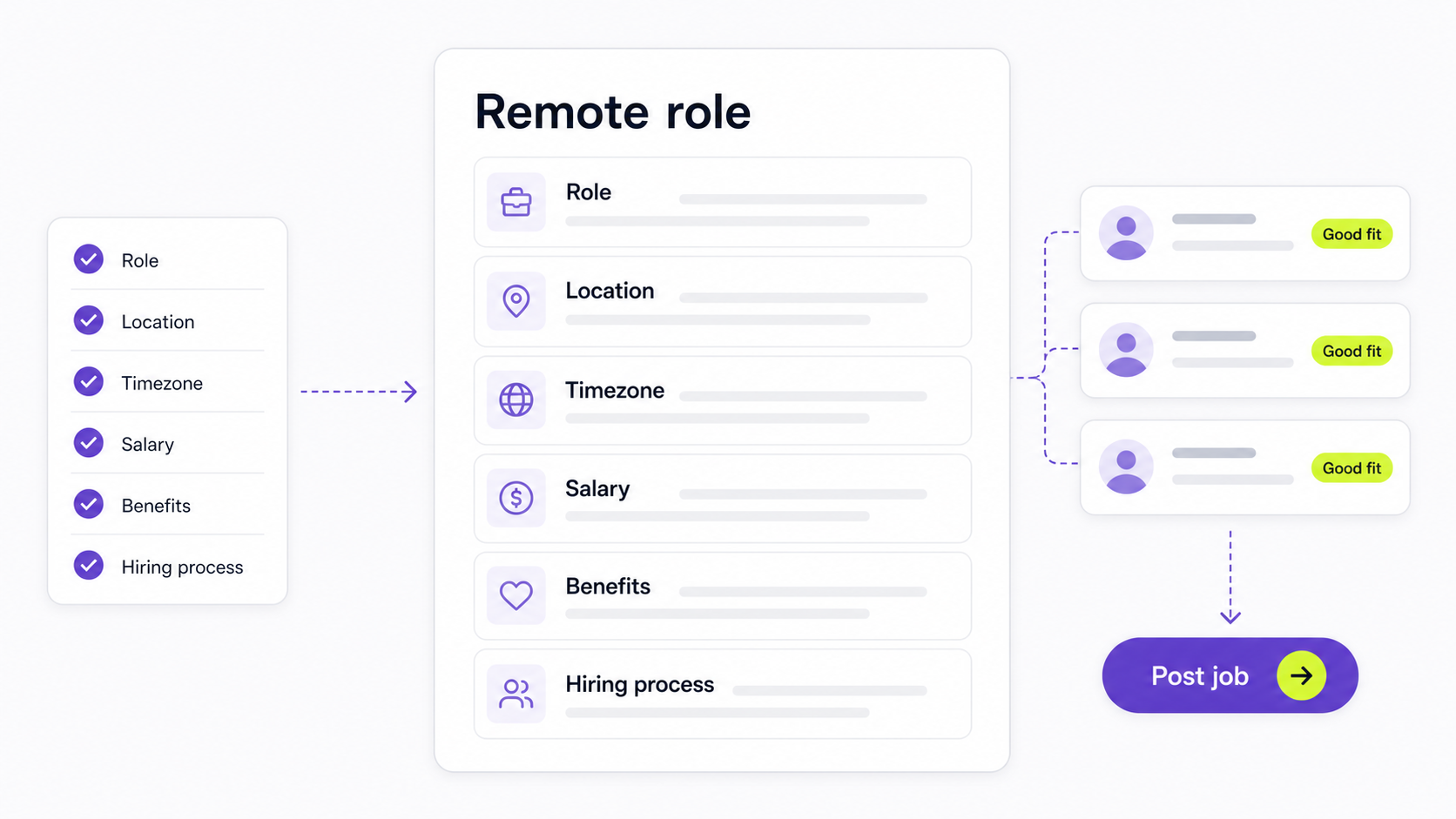
Do not start by asking, "Where can I find developers?" Start by asking, "What problem do we need this developer to own?"
Clarify:
- Role: front-end developer, back-end developer, full-stack developer, mobile developer, DevOps engineer, data engineer, machine learning engineer, or another specialty.
- Seniority: junior, mid-level, senior, staff, lead, or manager.
- Primary outcome: ship a feature, maintain a platform, improve infrastructure, support customers, build internal tools, or scale an engineering team.
- Tech stack: languages, frameworks, databases, cloud platforms, testing tools, observability tools, and deployment process.
- Team context: who they will work with, who reviews their code, who owns product decisions, and how engineering priorities are set.
- Remote setup: eligible countries, timezone overlap, meeting cadence, async expectations, equipment, security, and travel.
This prevents two common hiring mistakes: writing a vague "remote software developer" post that attracts everyone, or overloading the requirements until only a fictional candidate qualifies.
If you need help turning the role into a job post, start with the remote job description template and adapt a role-specific template such as Software Engineer Job Description, Front-end Developer Job Description, or Back-end Developer Job Description.
Choose the right hiring model
"Remote developer" describes where the person works. It does not describe the employment model.
| Hiring model | Best for | Watch out for |
|---|---|---|
| Full-time employee | Long-term product work, core systems, team continuity | Payroll, benefits, location eligibility, equipment, and onboarding expectations |
| Contractor | Defined scope, specialized expertise, flexible capacity | Misclassification risk, handoff quality, availability, and access control |
| Freelancer | Short projects, prototypes, bug fixes, design-to-code work | Limited context, inconsistent availability, and unclear maintenance ownership |
| Agency | Larger projects, multi-role delivery, speed | Less direct control over individual contributors and higher coordination overhead |
| Talent marketplace | Faster shortlist of vetted candidates | Marketplace fees, vendor-specific process, and narrower candidate pool |
| Direct remote job post | Building your own pipeline and employer brand | Requires strong screening, structured interviews, and candidate communication |
If the developer will own core product work for months or years, a full-time employee or long-term contractor usually makes more sense than a one-off freelancer. If you need a focused project delivered quickly, a contractor, agency, or marketplace may be better.
For legal, tax, payroll, work authorization, benefits, and contractor classification questions, use qualified local advice or a trusted payroll/EOR provider. The right setup depends on where your company and candidate are based.
Write a remote developer job post
A remote developer job post should explain the work and the remote operating model.
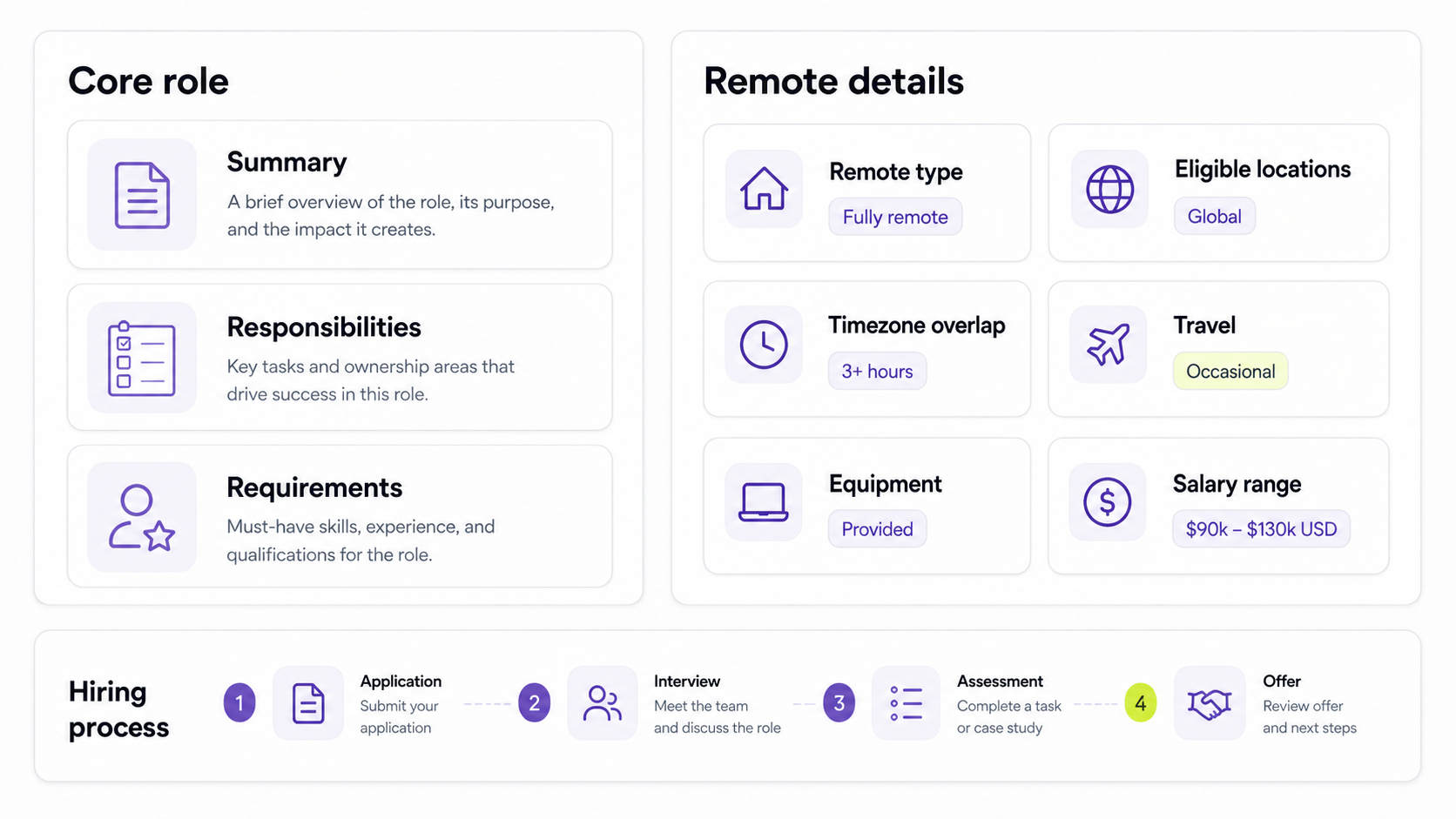
Include:
- Clear role title: "Senior React Developer" is better than "Frontend Wizard."
- Product context: what the team builds and who uses it.
- Ownership: the systems, features, services, or outcomes the developer will own.
- Stack: languages, frameworks, cloud services, databases, testing, CI/CD, and observability tools.
- Engineering workflow: code review, pull requests, branching, releases, on-call, incident response, and documentation.
- Remote type: fully remote, remote-first, hybrid, country-specific remote, timezone-limited remote, or work from anywhere.
- Eligible locations: countries, states, regions, or timezones.
- Timezone overlap: specific hours or overlap expectations.
- Compensation: salary or rate range, currency, equity, bonus, and location-based pay policy where relevant.
- Equipment and security: laptop, device management, VPN, access control, and data handling.
- Hiring process: steps, timeline, interview format, work sample expectations, and whether any task is paid.
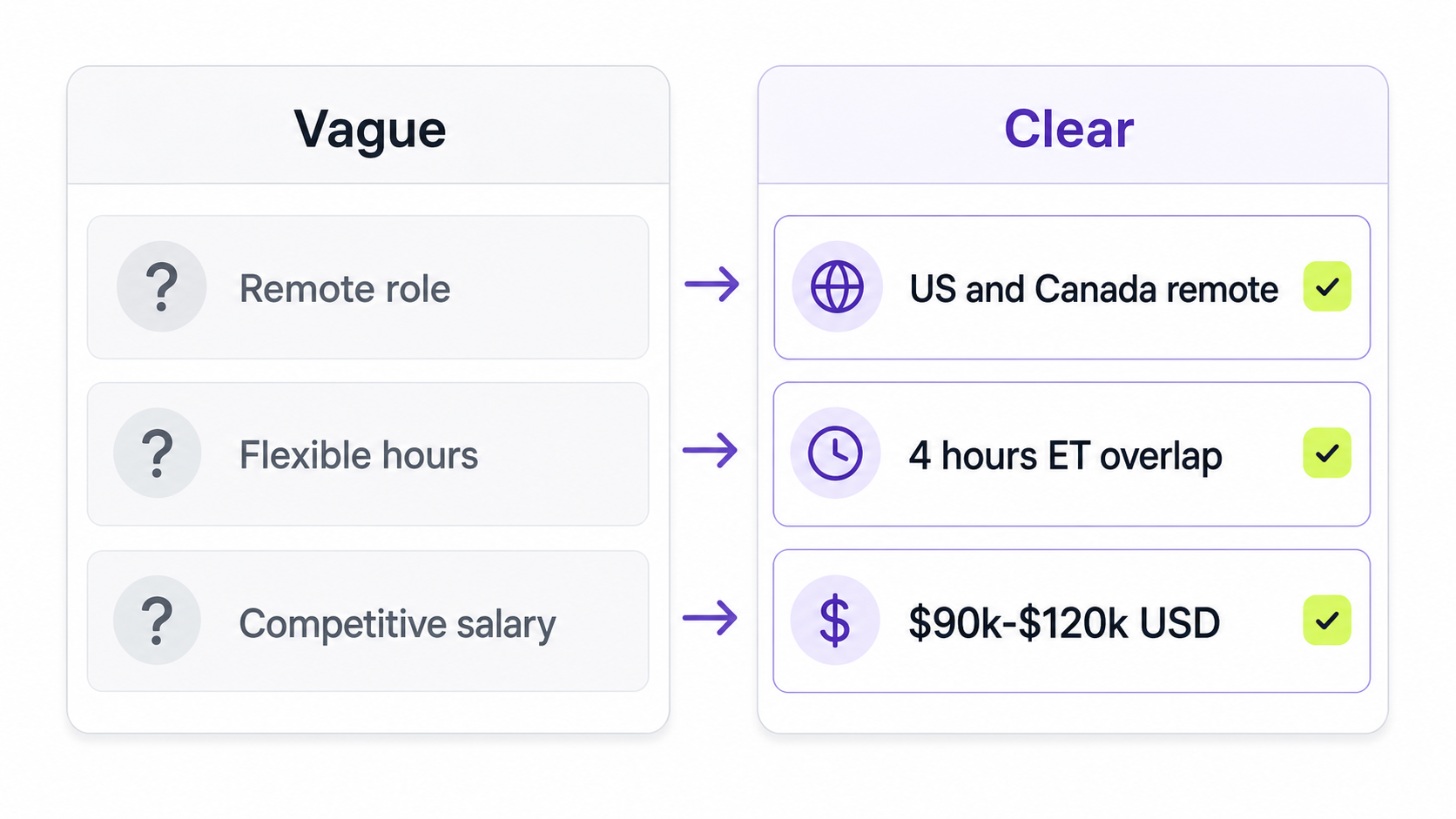
Be direct about constraints. Candidates are more likely to trust a post that says "remote for candidates based in Canada and the United States with four hours of overlap with Eastern Time" than one that says "remote anywhere" and reveals restrictions later.
Where to find remote developers
Use more than one sourcing channel, but do not treat every channel the same.
| Channel | Best use |
|---|---|
| Remote job boards | Attract developers already looking for distributed work |
| Referrals | Reach candidates trusted by people who know your engineering standards |
| Developer communities | Find specialists by language, framework, or domain |
| Open-source projects | Identify maintainers and contributors with public work |
| Talent marketplaces | Build a faster shortlist for specific skills |
| Freelance platforms | Fill short-term project or prototype needs |
| Social networks | Share the role with relevant technical and founder audiences |
| Recruiters or agencies | Expand reach when the role is senior, urgent, or hard to source |
If you want candidates who already prefer remote work, publish the role where remote candidates are searching. You can post a remote job on Himalayas once the role, location eligibility, and hiring process are clear.
Screen for technical fit and remote fit
Remote developer screening should not only ask, "Can this person code?" It should ask, "Can this person make engineering progress in our environment?"
Use a scorecard:
| Area | What to evaluate | Strong signals |
|---|---|---|
| Technical skill | Stack fit, system design, debugging, testing, code quality | Explains tradeoffs, asks good constraints questions, writes maintainable code |
| Product judgment | Ability to connect technical work to user and business outcomes | Prioritizes impact, names risks, avoids overengineering |
| Async communication | Writing, status updates, handoffs, documentation | Shares context clearly, documents decisions, escalates blockers early |
| Collaboration | Code review, pairing, feedback, cross-functional work | Gives respectful feedback and responds well to review |
| Remote readiness | Timezone fit, self-management, workspace, meeting discipline | Can work independently without disappearing |
| Security maturity | Access control, secrets handling, device practices | Understands least privilege and responsible data handling |
| Onboarding risk | Ramp speed, domain learning, support needed | Can describe how they learn unfamiliar systems |
Keep the scorecard tied to the job. A senior infrastructure engineer and a mid-level front-end developer should not be evaluated with the same rubric.
Interview remote developers
Use structured interviews. Every candidate should be evaluated against the same role criteria so the team is not relying on vibes, confidence, or interview performance alone.
Useful interview areas:
- Technical depth: "Walk us through a system you built or improved. What tradeoffs did you make?"
- Debugging: "Tell us about a production issue you diagnosed. How did you narrow it down?"
- Code review: "How do you give feedback when you disagree with an implementation?"
- Remote communication: "How do you keep teammates informed when priorities change?"
- Ambiguity: "Tell us about a project where the requirements were unclear. What did you do first?"
- Ownership: "What does a good handoff look like when you will be offline?"
- Timezone fit: "What kind of overlap do you need to collaborate well?"
For remote roles, written communication is part of the job. Consider adding one short written prompt, such as asking the candidate to summarize a technical decision, explain a tradeoff, or write a project update.
Use a practical work sample carefully
A work sample can reveal how a developer thinks, but it can also create a poor candidate experience if it is too long, too vague, or too close to free production work.
Good work samples are:
- Short enough to complete in a reasonable time.
- Clearly scoped.
- Related to the actual role.
- Evaluated with a published rubric.
- Paired with a follow-up discussion.
- Paid when the assignment is substantial.
Avoid asking candidates to build a full feature for your product, debug your real backlog for free, or spend a weekend on speculative work. For many roles, a live code review, architecture discussion, paid project, or take-home exercise with a strict time limit is enough.
Make the offer clear
A remote offer should explain more than salary.
Clarify:
- Compensation, currency, bonus, equity, and review cycle.
- Employment type: employee, contractor, part-time, full-time, temporary, or project-based.
- Work location and any location restrictions.
- Timezone overlap and expected availability.
- Benefits, PTO, holidays, and leave.
- Equipment, home-office support, software, and security requirements.
- Travel, retreats, customer visits, or onsite expectations.
- Start date and onboarding schedule.
If compensation varies by location, level, or employment setup, explain that before the final offer stage. Surprises late in the process damage trust.
Onboard remote developers intentionally
Remote onboarding is not just account access and a welcome call. A developer needs technical context, social context, and a safe path to their first meaningful contribution.
Before day one:
- Provision accounts, device, repository access, documentation, VPN, and development environment instructions.
- Assign an onboarding buddy.
- Prepare a first-week schedule.
- Pick a small first issue that teaches the codebase without blocking critical work.
- Share architecture docs, product context, team rituals, and decision-making norms.
During the first month:
- Explain code review expectations.
- Walk through deployment and incident response.
- Schedule regular manager and buddy check-ins.
- Pair on one real task if possible.
- Ask what context is missing.
- Make team connection explicit, especially if the developer has not met teammates in person.
Remote software developer onboarding research has found that building social connection can be one of the hardest parts of remote onboarding. Treat connection as part of productivity, not as an optional perk.
Remote developer hiring checklist
Before publishing the role:
- The role outcome is clear.
- Required and nice-to-have skills are separated.
- The stack and engineering workflow are specific.
- Remote type and eligible locations are clear.
- Timezone overlap is defined.
- Compensation range and currency are included where possible.
- Employment model is clear.
- Security, equipment, and access expectations are clear.
- Hiring steps and timeline are listed.
- Work sample expectations are reasonable.
- Interviewers share the same scorecard.
- The onboarding plan exists before the offer is accepted.
Publish your remote developer role
Once the role is clear, publish it where remote developers are already looking. You can post a remote job on Himalayas and connect your role with candidates who understand distributed work.
If you are still shaping the job post, use the remote job description template first, then adapt the engineering sections for the exact developer role you need.
FAQ
How do you hire remote developers?
Define the role, choose the hiring model, write a clear remote developer job post, source candidates through relevant channels, screen for technical and remote-work fit, run structured interviews, use a practical work sample, make a clear offer, and onboard the developer with access, context, and team support.
Where can I hire remote developers?
You can hire remote developers through remote job boards, referrals, developer communities, open-source networks, talent marketplaces, freelance platforms, recruiters, agencies, and social networks. The best channel depends on whether you need a full-time employee, contractor, freelancer, or project team.
What should I look for in a remote developer?
Look for technical ability, product judgment, written communication, code review habits, independent execution, timezone fit, security maturity, and the ability to learn unfamiliar systems. Remote fit should be evaluated separately from technical skill.
Should I hire a full-time remote developer or a freelancer?
Hire a full-time remote developer when the work is core to your product, ongoing, and context-heavy. Hire a freelancer or contractor when the work is specialized, short-term, or project-based. If the person will behave like a long-term employee, confirm the right legal and payroll setup before hiring.
How do you interview remote developers?
Use structured interviews tied to the role scorecard. Cover technical depth, debugging, system design, code review, async communication, ambiguity, ownership, and timezone fit. Add a realistic work sample or technical discussion, but keep it scoped and respectful of the candidate's time.
What should a remote developer job post include?
Include the role title, product context, responsibilities, tech stack, seniority, engineering workflow, remote type, eligible locations, timezone overlap, compensation, equipment, security expectations, hiring process, and application instructions.
How do you onboard remote developers?
Provision access before day one, assign a buddy, provide architecture and product context, explain code review and release norms, schedule manager check-ins, pick a small first task, and create opportunities for team connection. Remote onboarding should help the developer understand both the codebase and how the team works.