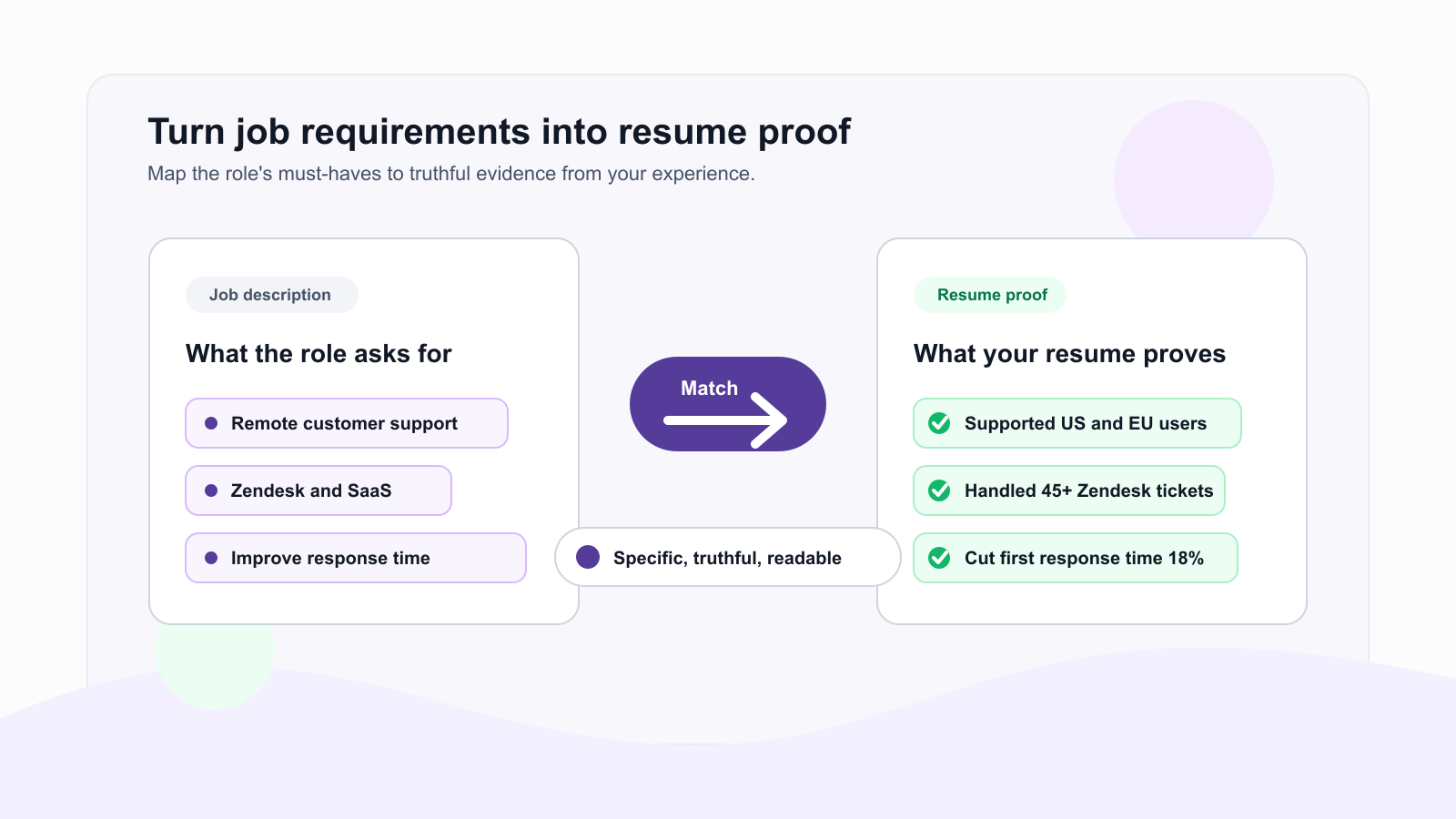
To quantify resume achievements, turn a vague responsibility into a clear result using numbers, scope, or measurable proof. Start with what you did, identify what changed because of your work, choose the most honest metric, then write the bullet so a recruiter can understand the size and impact of the achievement quickly.
The goal is not to force a number into every line. The goal is to make your strongest experience easier to believe.
What does it mean to quantify resume achievements?
Quantifying a resume achievement means adding evidence that shows the size, frequency, speed, quality, value, or outcome of your work.
That evidence can include:
- Revenue, cost, budget, or savings.
- Percent increases or decreases.
- Time saved.
- Number of customers, users, tickets, projects, hires, campaigns, or accounts.
- Team size, company size, region, or audience.
- Error reduction, quality improvement, uptime, response time, or satisfaction.
- Frequency, such as weekly, monthly, or quarterly work.
A quantified bullet is stronger than a duty because it shows what changed.
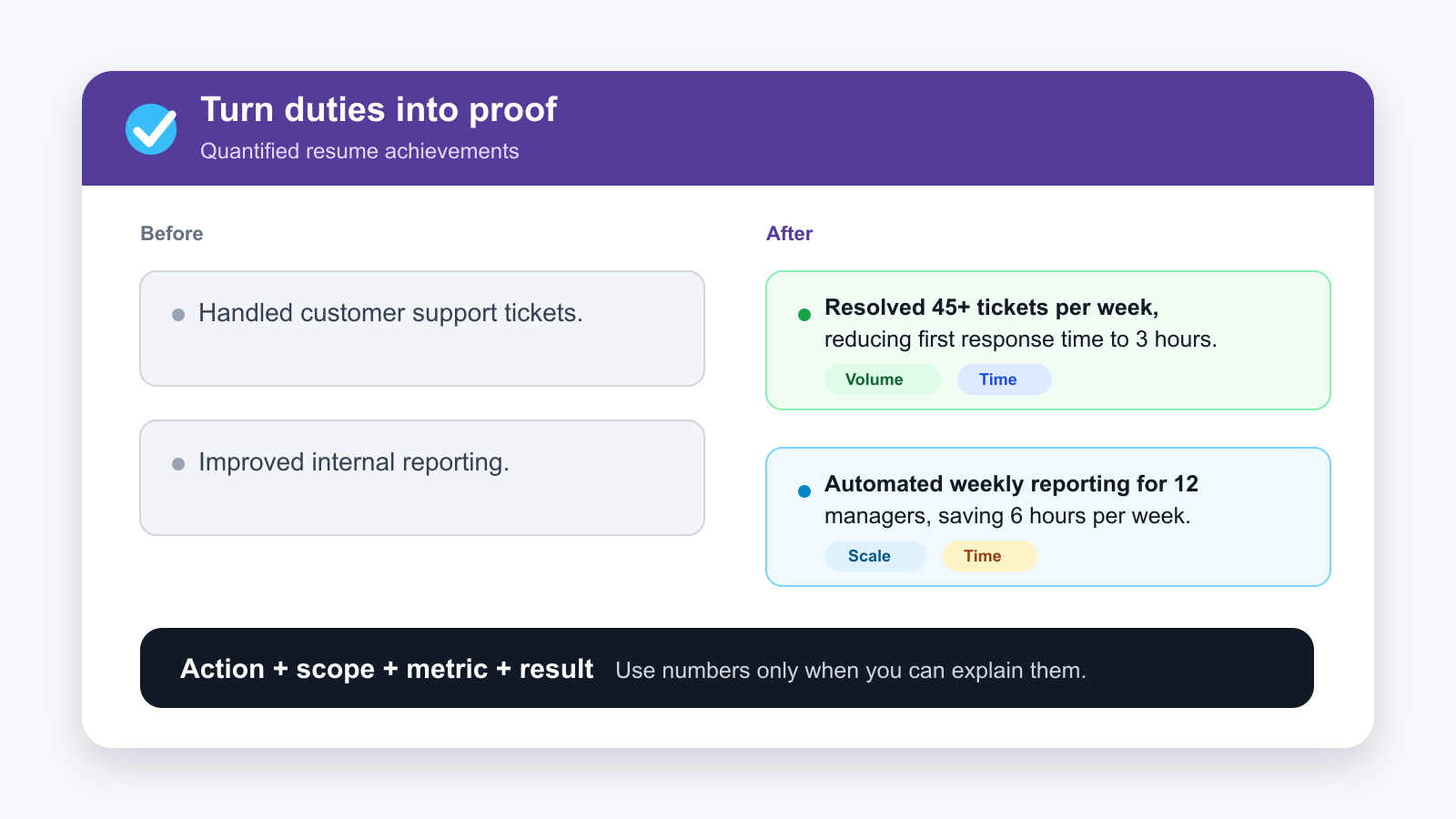
Weak:
Handled customer support tickets.
Stronger:
Resolved 45+ customer support tickets per week across US and EU timezones, helping reduce first-response time from 8 hours to 3 hours.
The second bullet gives scope, context, and impact. It is easier to understand and easier to trust.
Why quantified achievements make your resume stronger
Most weak resumes list responsibilities. Strong resumes show proof.
Responsibilities describe the work you were assigned:
- Managed projects.
- Helped customers.
- Improved processes.
- Worked with cross-functional teams.
Achievements describe what happened because you did the work:
- Delivered 6 projects in one quarter.
- Supported 120+ customers across 4 regions.
- Reduced a manual process from 3 hours to 35 minutes.
- Coordinated weekly launches with engineering, design, and marketing.
Numbers help because they answer questions a recruiter or hiring manager already has:
- How much responsibility did you have?
- How often did you do the work?
- What was the outcome?
- Was the work small, routine, complex, or business-critical?
- Can this person do the kind of work our role requires?
You do not need a perfect metric for every bullet. But the bullets that prove your fit for the target job should be as concrete as possible.
The resume achievement formula
Use this formula:
Did [action] for [scope or audience], resulting in [measurable outcome].
Or, if the outcome is hard to measure:
Did [action] across [scope], improving [process, quality, speed, consistency, or customer experience].
The best bullets usually include four parts:
| Part | What it answers | Example |
|---|---|---|
| Action | What did you do? | Automated reporting |
| Scope | How big was the work? | for 12 account managers |
| Metric | What number proves it? | reduced prep time by 6 hours per week |
| Result | Why did it matter? | improved forecast visibility |
Example:
Automated weekly reporting for 12 account managers, reducing manual prep time by 6 hours per week and improving forecast visibility.
If you are tailoring your resume to a specific job, choose metrics that match the job description. A customer success role may care about retention, adoption, account size, and response time. An operations role may care about cost, accuracy, throughput, and process speed.
Use the Himalayas job description keyword finder to identify the role's most important requirements, then choose achievements that prove those requirements with real evidence.
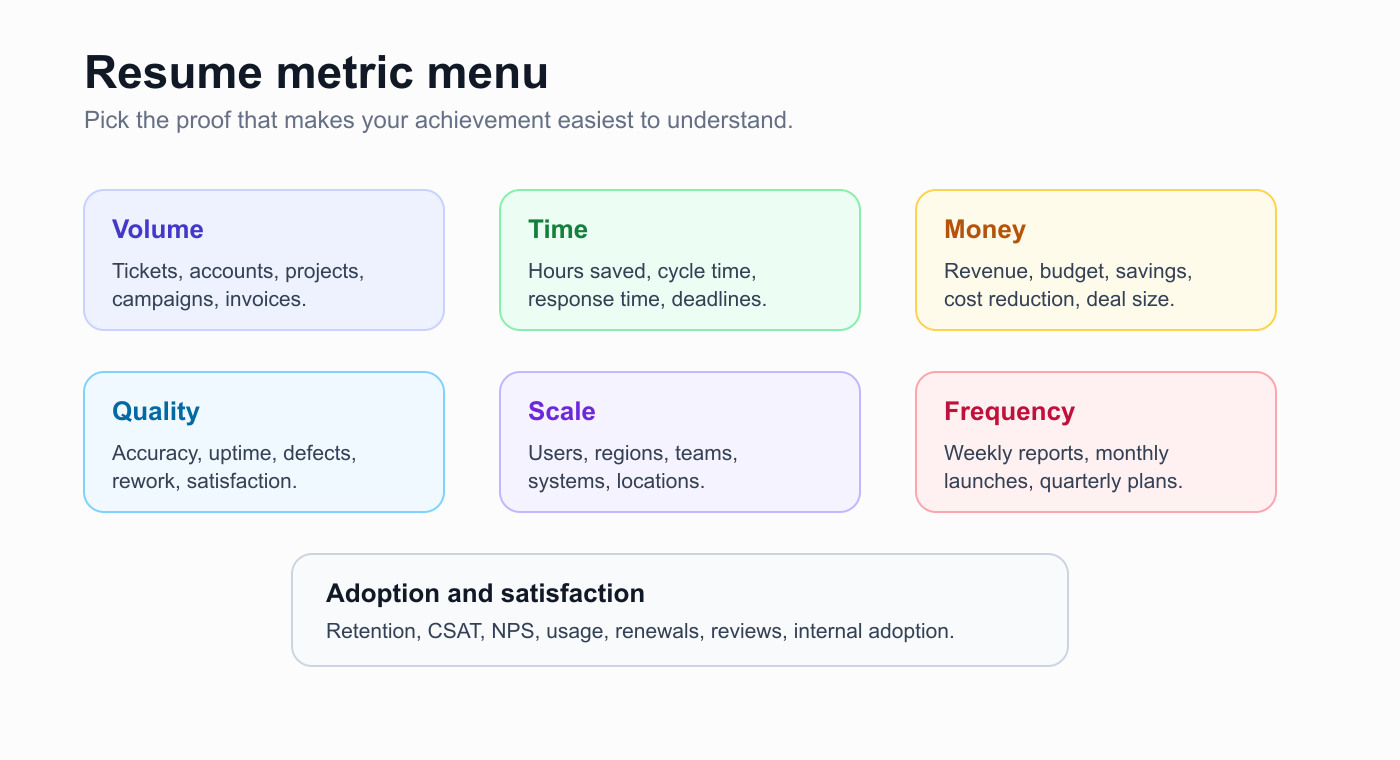
Seven types of resume metrics you can use
You do not need revenue numbers to quantify your resume. Many useful metrics are about scale, speed, quality, or consistency.
| Metric type | Use it to show | Examples |
|---|---|---|
| Volume | How much work you handled | tickets, calls, accounts, campaigns, projects, invoices |
| Time | Speed, efficiency, or deadlines | hours saved, cycle time, response time, delivery time |
| Money | Business value | revenue, budget, savings, cost reduction, deal size |
| Quality | Better outcomes | error rate, uptime, accuracy, rework, defect reduction |
| Scale | Size of responsibility | users, employees, regions, team size, systems, locations |
| Frequency | Repeated responsibility | weekly reports, monthly launches, quarterly planning |
| Satisfaction | User or customer outcome | NPS, CSAT, adoption, retention, reviews, renewals |
If you cannot find a result metric, start with scope. A bullet with scope is still stronger than a generic duty.
Generic:
Created onboarding documentation.
Better:
Created onboarding documentation for a 40-person remote team across 5 timezones.
Best, if true:
Created onboarding documentation for a 40-person remote team across 5 timezones, reducing repeat setup questions by 30%.
How to find numbers when you do not have obvious metrics
Most people have more usable metrics than they think. They are often stored in tools you already used at work.
Look for numbers in:
- Project plans.
- Weekly updates.
- Performance reviews.
- Support tools.
- CRM records.
- Analytics dashboards.
- Sales reports.
- Invoices or budgets.
- Calendar history.
- Meeting notes.
- Pull requests, tickets, or sprint boards.
- Customer feedback.
- Internal docs.
Ask practical questions:
- How many people used the thing I built?
- How many customers, tickets, accounts, or projects did I handle?
- How often did I do this work?
- How long did the process take before and after?
- What changed in quality, speed, cost, reliability, or satisfaction?
- What was the size of the team, budget, region, or system?
- What deadline, launch, migration, or business goal did this support?
If you do not have exact numbers, use honest scope instead of fake precision.
Acceptable:
Supported 30+ weekly customer conversations across email and live chat.
Risky:
Increased customer satisfaction by 47.3%.
The risky version only works if you can explain where that exact number came from.
Is it okay to estimate resume metrics?
It can be okay to use a reasonable estimate if the number is based on real work and you can explain the math in an interview.
Use estimates carefully:
- Prefer ranges when exact numbers are unavailable.
- Use conservative numbers.
- Base the estimate on records, calendar history, dashboards, or repeated workload.
- Avoid fake precision.
- Do not invent outcomes you cannot defend.
For example, if you handled about 10 tickets a day, 5 days a week, it is reasonable to write "resolved 50+ support tickets per week" if that reflects your normal workload.
If you only know the scope, write the scope:
Coordinated onboarding tasks for a distributed product team across North America and Europe.
That is better than inventing a reduction in onboarding time.
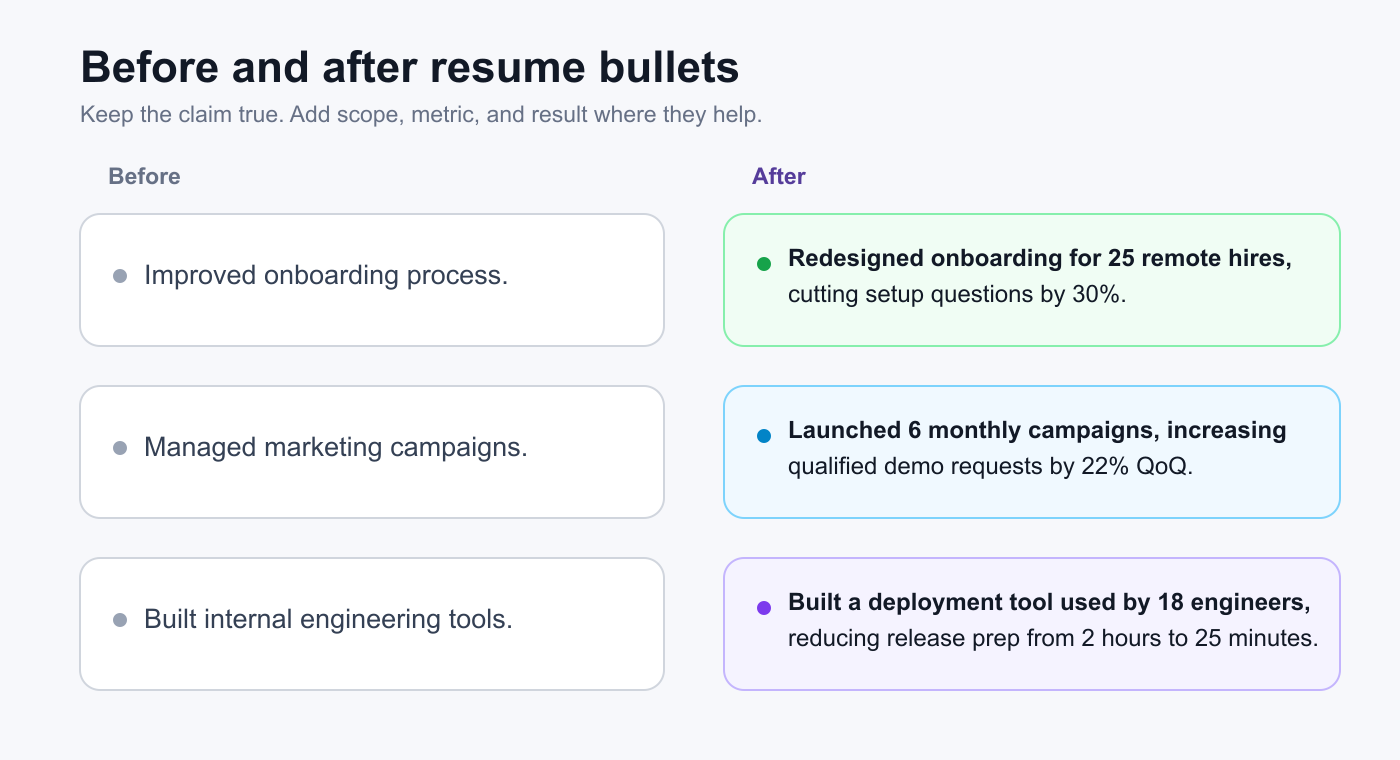
Before and after quantified resume examples
Use these examples as patterns, not scripts. Your resume should use your real numbers and your real work.
| Role | Before | After |
|---|---|---|
| Customer support | Helped customers and answered tickets. | Resolved 45+ support tickets per week across email and chat, maintaining a 92% CSAT score. |
| Software engineering | Built internal tools for the team. | Built an internal deployment tool used by 18 engineers, cutting release prep from 2 hours to 25 minutes. |
| Marketing | Managed social media campaigns. | Managed 6 monthly social campaigns, increasing qualified demo requests by 22% quarter over quarter. |
| Sales | Worked with prospects and closed deals. | Managed a pipeline of 80+ SMB accounts and closed $420K in annual contract value. |
| Operations | Improved team processes. | Standardized invoice review for 3 departments, reducing approval time from 5 days to 2 days. |
| Product | Worked with design and engineering on launches. | Led 4 feature launches with design and engineering, supporting adoption by 12,000 monthly active users. |
| Design | Created designs for product features. | Designed 9 onboarding screens that increased new-user activation from 41% to 53%. |
| HR | Helped with recruiting and onboarding. | Coordinated 35 candidate pipelines per month and reduced average scheduling time by 40%. |
| Entry-level | Assisted with research and reports. | Researched 120+ competitor listings and summarized findings in a weekly report used by the sales team. |
| Remote work | Collaborated with a remote team. | Coordinated weekly async handoffs across 4 timezones, reducing project status meetings from 3 per week to 1. |
How to quantify remote-work achievements
Remote work creates useful metrics that many candidates overlook.
Look for evidence around:
- Timezone coverage.
- Response time.
- Async documentation.
- Meeting reduction.
- Project handoffs.
- Customer support across regions.
- Written communication.
- Remote onboarding.
- Distributed-team delivery.
- Tool adoption.
Examples:
Created async project updates for a 12-person remote team, reducing recurring status meetings from 4 per week to 2.
Supported customers across APAC and North America timezones, maintaining a median first response time under 4 hours.
Built onboarding docs for remote hires in 6 countries, helping new teammates complete setup without live support calls.
These bullets work because they show the reality of remote work: clear writing, handoffs, autonomy, and coordination.
What to do if you cannot quantify a bullet
Some achievements do not fit neatly into a number. That is fine.
If you cannot quantify a bullet, strengthen it with:
- Scope: who, what, where, how many teams, or how many systems.
- Specificity: name the tool, process, audience, or project type.
- Before/after context: what changed, even without a number.
- Proof: shipped, adopted, approved, selected, promoted, renewed, launched, documented.
- Relevance: connect the bullet to the target job's requirements.
Weak:
Helped improve documentation.
Better:
Rewrote API documentation for the billing integration, making setup steps clearer for engineers and customer success.
Even without a number, the second bullet is more useful because it names the work and the audience.
Common mistakes when adding resume metrics
Making up numbers
Do not add a metric just because the bullet looks empty. If you cannot explain the number in an interview, remove it or replace it with scope.
Adding numbers that do not matter
Not every number proves impact. "Attended 35 meetings" is less useful than "reduced recurring project meetings from 5 per week to 2."
Using fake precision
Precise numbers look suspicious when they are not tied to a real source. If you estimated, use a clean range or a conservative rounded number.
Quantifying every bullet
A resume full of numbers can be hard to read. Use metrics where they clarify your strongest proof. Some bullets can focus on leadership, judgment, technical depth, or collaboration.
Repeating the same metric
If every bullet says "improved efficiency," the resume still feels generic. Vary your proof: speed, quality, scope, adoption, revenue, customer outcomes, and complexity.
Ignoring the target job
The best metric depends on the role. Before applying, compare your resume to the job description and move the most relevant quantified achievements higher on the page. The Himalayas guide to tailoring your resume to a job description walks through that process.
Can AI help quantify resume achievements?
Yes, AI can help you find metric ideas and rewrite bullets, but it should not invent facts for you.
AI is useful for:
- Turning duties into achievement-focused bullets.
- Suggesting metric categories.
- Making bullets clearer and shorter.
- Matching achievements to a job description.
- Finding vague language in your resume.
AI is risky when it:
- Adds numbers you did not provide.
- Exaggerates your role.
- Rewrites bullets so they sound generic.
- Optimizes for keywords instead of truth.
Use AI as an editor. You provide the evidence.
The Himalayas AI resume builder can help you create and tailor resume bullets, especially when you already know the metrics and proof points you want to include.
AI prompt to quantify resume achievements
Use this prompt when you have a resume bullet, job description, and a list of real work details:
Rewrite the resume bullets below to make them achievement-focused and measurable.
Rules:
- Do not invent metrics, tools, titles, clients, or outcomes.
- If a number is missing, suggest 3 honest metric types I could look for.
- Use concise resume language.
- Keep each bullet under 30 words.
- Prioritize metrics that match the job description.
Job description:
[paste job description]
Current resume bullets:
[paste bullets]
Real details I can verify:
[paste ticket volume, project scope, tools, team size, time saved, customer outcomes, revenue, budget, deadlines, or other facts]
After using the prompt, check every number. If you cannot defend it, remove it.
Resume achievement checklist
Before you submit your resume, ask:
- Is the number true or responsibly estimated?
- Can I explain where it came from?
- Does it prove something the target job cares about?
- Is the bullet clear without internal company context?
- Did I include scope when an outcome metric was unavailable?
- Did I move the strongest quantified bullets near the top?
- Did I avoid fake precision and inflated claims?
- Did I keep the resume readable?
FAQ
Should every resume bullet have a number?
No. Your strongest and most relevant bullets should include numbers when numbers make the impact clearer. Other bullets can show technical depth, leadership, collaboration, or judgment without a metric.
What if my job was not numbers-based?
Use scope, frequency, time, quality, audience, or complexity. Teachers, designers, administrators, writers, support reps, engineers, and entry-level candidates can often quantify workload, audience, deadlines, tools, or deliverables even when they do not own revenue metrics.
Is it okay to estimate resume metrics?
Yes, if the estimate is conservative, based on real work, and easy to explain. Avoid exact-looking numbers unless you have a source. When in doubt, use a range or scope.
How many quantified achievements should I include?
There is no fixed number. A practical target is to make the top two or three bullets under your most relevant roles measurable. Add more where the metric is meaningful, not just because you can.
Can I use percentages without baseline data?
Be careful. A percentage needs a baseline. "Reduced response time by 40%" is only credible if you know the before and after. If you do not, write the actual before/after times or use scope instead.
How do I quantify soft skills?
Tie the soft skill to an observable outcome. Instead of "strong communicator," write "Created weekly launch updates for 5 cross-functional teams" or "Documented handoff processes used by 20 remote teammates."
Where should quantified achievements go on a resume?
Put them in your work experience bullets, resume summary, and selected project descriptions. The work experience section is usually the most important because it connects the metric to a role, company, and timeframe.
Final recommendation
Quantify the achievements that prove your fit. You do not need to turn every bullet into a spreadsheet, but you do need enough concrete evidence to show the scale and value of your work.
Start with your most important role, rewrite the top bullets with action, scope, and outcome, then tailor those bullets to the job description. When you are ready to turn your proof points into a cleaner resume, use the Himalayas AI resume builder and apply to roles on the remote job board.