LinkedIn Recruiter costs $10,800/year for a single seat. That's fine for large companies with dedicated recruiting teams, but it's tough for startups, small businesses, and hiring managers who recruit occasionally. The core question is whether you need LinkedIn's massive generalist database, or whether a focused alternative gets you better results for remote roles at a fraction of the cost.
Himalayas offers a free talent search and recruiting workflow across 200K+ remote-focused candidates, and you can run it entirely through talking to an AI like Claude. Here's how the two compare and when each makes sense.
The pricing gap
LinkedIn Recruiter Lite runs around $170/month. The full Recruiter product starts at $835/month billed annually. Enterprise pricing goes higher. Every seat is an additional cost.
Himalayas talent search is free. No per-seat pricing, no monthly subscription, no InMail credits to manage. The MCP tool is a public tool that works without authentication. Connect the Himalayas MCP server to any AI assistant and start searching for talent or posting jobs immediately.
The tradeoff is scope. LinkedIn has 900M+ profiles across every industry and geography. Himalayas has 200K+ candidates who have specifically opted into remote work. For most remote-first companies, the bottleneck isn't finding enough candidates, it's finding the right ones.
What you get from Himalayas talent search
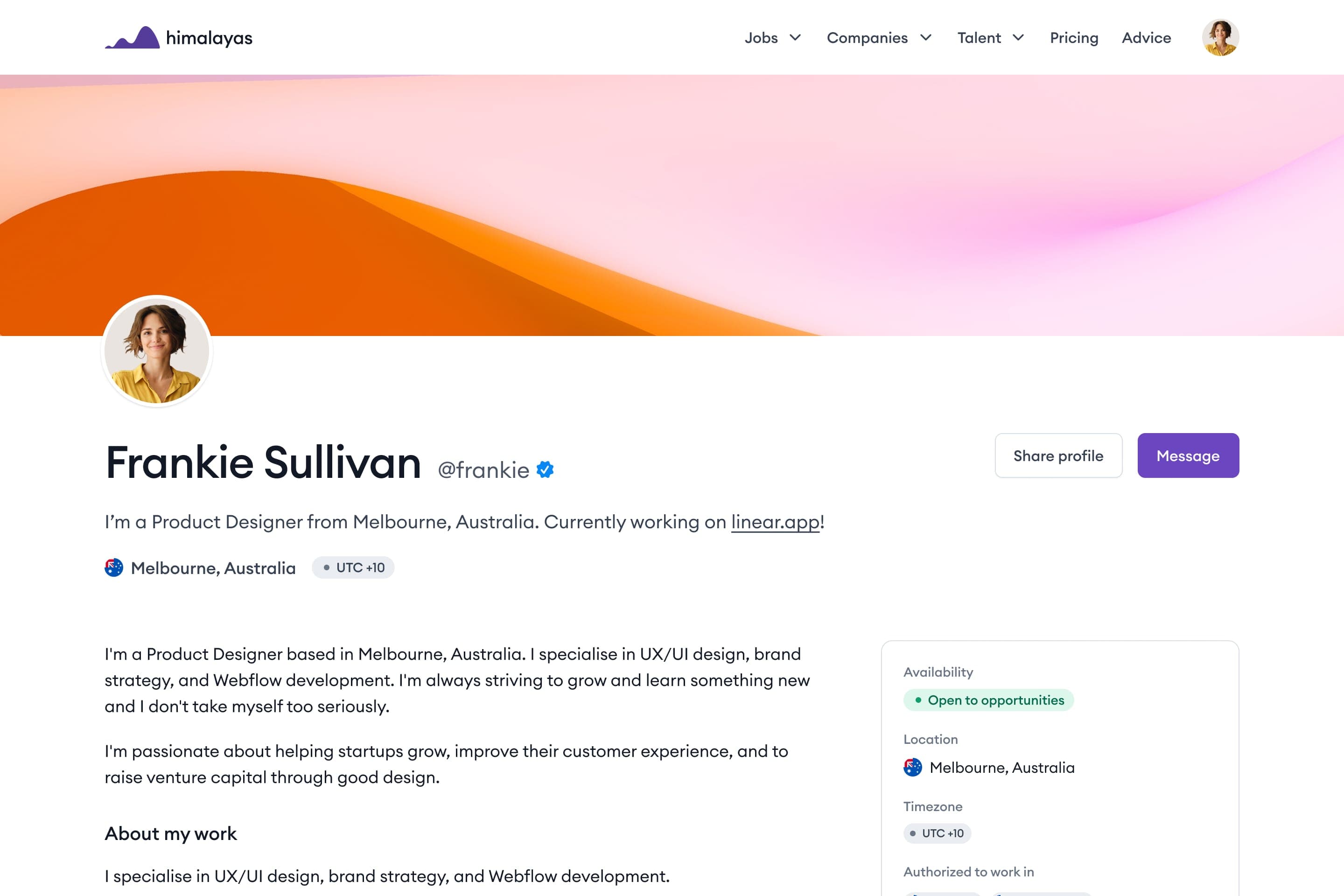
Each candidate profile includes skills, bio, country, timezone, years of experience, desired salary range, work preferences, and availability status. Candidates on Himalayas have actively created profiles for remote job opportunities.
You can also pull up full candidate profiles, bio, complete work history, education, tech stack, and social links directly in the conversation. This gives you the depth you'd normally get from clicking through to a LinkedIn profile, without leaving your AI assistant.
You can search by keyword, filter by country, and page through results. Through AI conversation, the workflow is natural:
"Find senior backend engineers in Europe who know Python and have 5+ years of experience."
The AI runs the search, summarizes the top matches, and you can drill into specific candidates or refine your criteria — all in the same conversation.
Where LinkedIn Recruiter still wins
LinkedIn's advantages are real and worth acknowledging.
Scale and reach. If you need to hire a VP of Sales in Chicago for an in-office role, Himalayas isn't the right tool. LinkedIn's database covers every geography, industry, and seniority level. For non-remote or highly specialized executive searches, it's hard to beat.
ATS integrations. LinkedIn Recruiter plugs into most enterprise applicant tracking systems. If your team's workflow is built around Greenhouse or Lever with LinkedIn sourcing, switching has a real cost.
Passive candidates. Many LinkedIn profiles belong to people who aren't actively looking but might be open to the right opportunity. Himalayas candidates are quite often actively looking, which means higher intent but a smaller pool.
Where Himalayas wins
Free talent search and recruiting workflow. A startup hiring three remote engineers per year doesn't need a $10K/year recruiting platform. Free talent search, free messaging, plus free job posting (with optional paid promotion) covers the entire workflow. And unlike LinkedIn's InMail credits, messaging on Himalayas is unlimited, including directly through your AI assistant.
Remote-first signal. Every candidate on Himalayas has explicitly opted into remote work. You do not need to filter through profiles where "open to remote" means "willing to consider hybrid two days a week." The intent signal is clear.
AI-native workflow. Instead of learning Recruiter's search syntax and navigating its interface, you describe what you're looking for in plain English. The AI handles query construction, result filtering, and summarization. You can search for candidates, deep-dive into their full profiles, message them directly, and combine it all with salary benchmarking and job posting in a single conversation, something that requires switching between multiple tools in the LinkedIn ecosystem.
Salary data in the same conversation. Ask "what's the market rate for a remote senior frontend engineer?" and get salary benchmarks from Himalayas data without leaving your AI assistant. On LinkedIn, salary insights are a separate product.
A practical sourcing workflow
Here's what a complete remote hiring workflow looks like using Himalayas through AI:
- Search talent: "Find remote product managers with fintech experience"
- Deep-dive into profiles: "Show me the full profile for the top candidate, their work history, tech stack, and education"
- Reach out: "Send this candidate a message about our Senior PM role at $160-190K"
- Benchmark salary: "What's the salary range for a remote senior PM?"
- Post the role: "Post a remote Senior Product Manager role at $160-190K with these requirements..."
- Follow up: "Show me all my candidate conversations, any new replies?"
- Build your brand: "Update our company profile to highlight our async-first culture and add our tech stack"
Every step happens in conversation. No tab switching, no form filling, no separate tools.
When to use which
Use Himalayas when you're hiring for remote roles, you want a free starting point, you prefer AI-native workflows, or you're a small team that doesn't need enterprise recruiting infrastructure.
Use LinkedIn Recruiter when you're hiring for in-office or hybrid roles, you need to reach passive candidates at scale, your ATS integration with LinkedIn is critical to your workflow, or you're running high-volume enterprise recruiting.
Use both when you're a growing company that hires both remote and in-office. LinkedIn covers your generalist needs; Himalayas gives you a focused, free channel specifically optimized for remote talent.
Getting started
Connect the Himalayas MCP server to your AI assistant and run your first talent search in under two minutes:
{
  "mcpServers": {
    "himalayas": {
      "command": "npx",
      "args": ["-y", "mcp-remote", "https://mcp.himalayas.app/mcp"]
    }
  }
}
You can connect in any AI platform that supports MCP servers, including Claude (Claude Desktop, Claude Code, Claude Cowork), ChatGPT, Gemini, Openclaw, Microsoft Copilot Studio, and more.
No API key, no authentication, no credit card. Just ask your AI assistant to find the candidates you're looking for.
Once connected, try the full recruiting workflow: search for candidates, review their detailed profiles, and message your top picks, all in one conversation. For the complete walkthrough, see How to Hire Remote Talent with AI. For the complete MCP tool reference, see the MCP Server documentation.